2023 World Cruise, Cruising, Travelogues

Leg 7: Canary Islands & Morocco

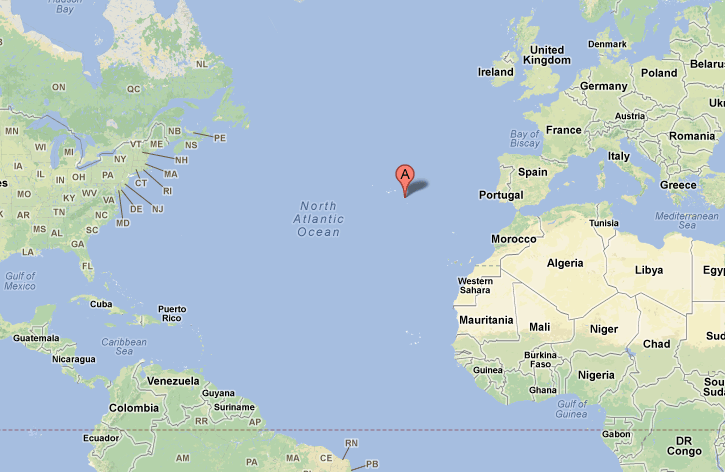
Before moving on from Dakar, Senegal towards the Canary Islands, I’d like to describe our visit to the mythical “Null Island” as it is called. Not an island at all, but rather the location on the ocean where the equator crosses the prime meridian. In terms of navigation, it marks zero minutes latitude and zero minutes longitude. Here’s the screen shot from Tom’s phone GPS from that very spot.

Unfortunately, the buoy that is supposed to be permanently moored here in 3 miles of water, has disappeared.  Perhaps due to weather or some other demise.  More information on Null Island: https://en.wikipedia.org/wiki/Null_Island

Even more special on this location is that the Captain decided to take the rare opportunity to position the ship in the cross hairs… our bow in the northern hemisphere, stern in the southern hemisphere, port in eastern and starboard in western.  Cool!  

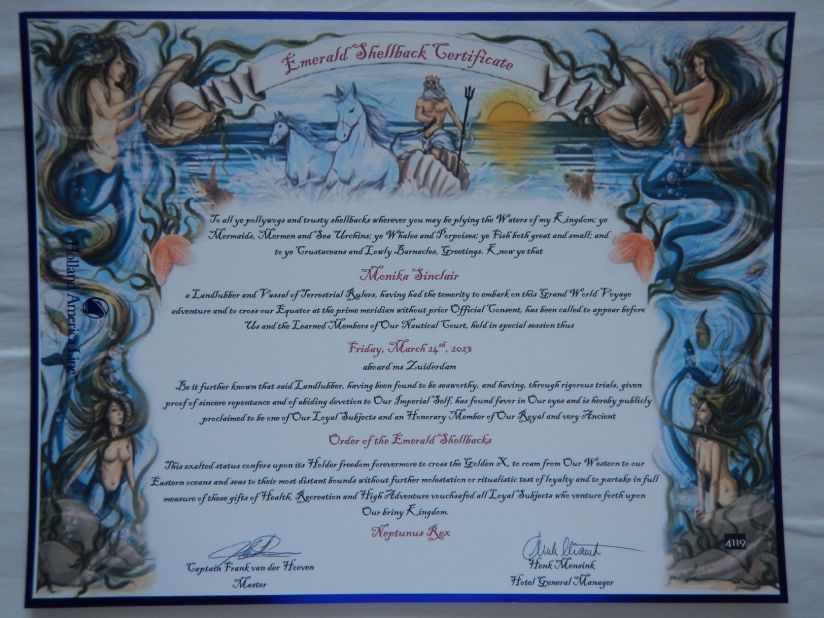
According to old maritime traditions, you are a Polliwog until you cross the equator. Thereafter you are a Shellback.  If you cross the equator at the International Dateline, you become a Golden Shellback and even more extraordinary, if you cross at Prime Meridian (where we did) you become an Emerald Shellback. 

King Neptune bestows these designations during elaborate ceremonies that typically include kissing a fish and being bathed in some disgusting concoction of whatever was aboard.  Fortunately for guests aboard, only the crew actually had to go through the initiation ceremonies!

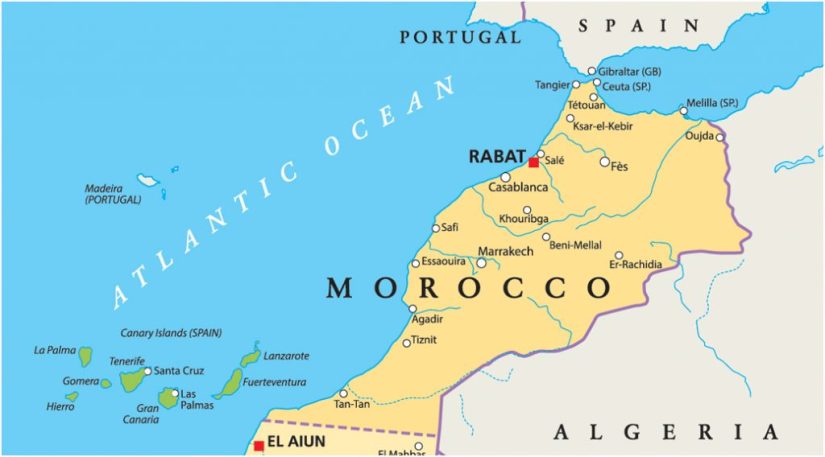
Our journey continues onward to the Canary Islands, which lie 62 miles west of Morocco. A Spanish volcanic archipelago, consisting of 7 main islands in the Atlantic Ocean.

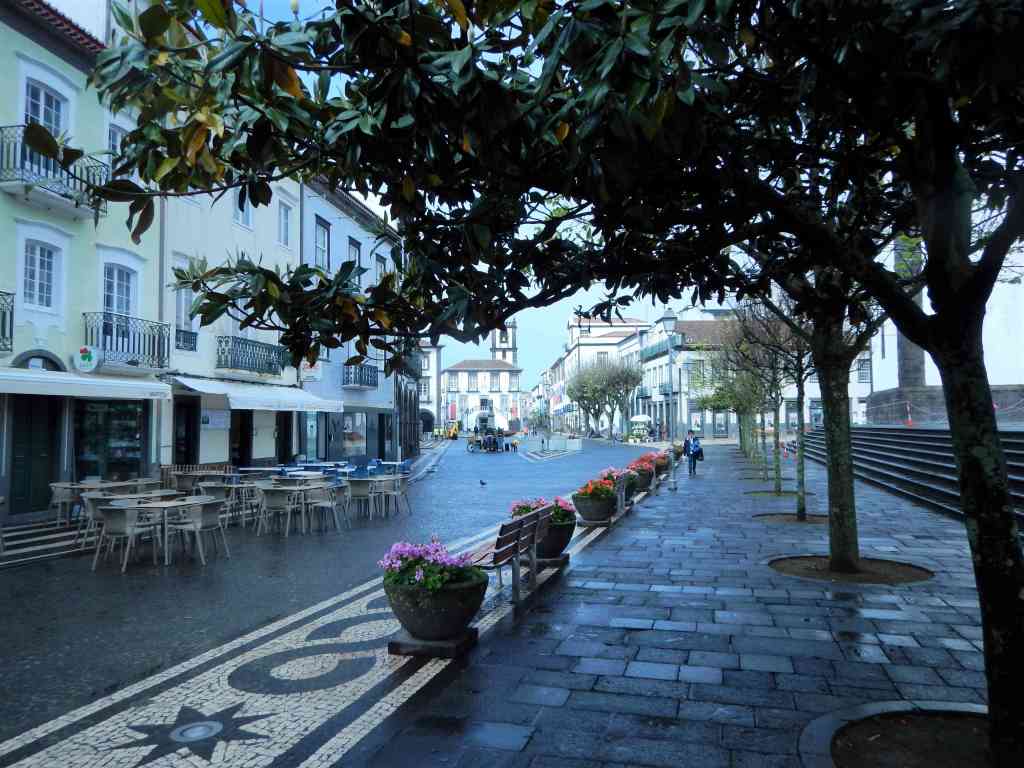
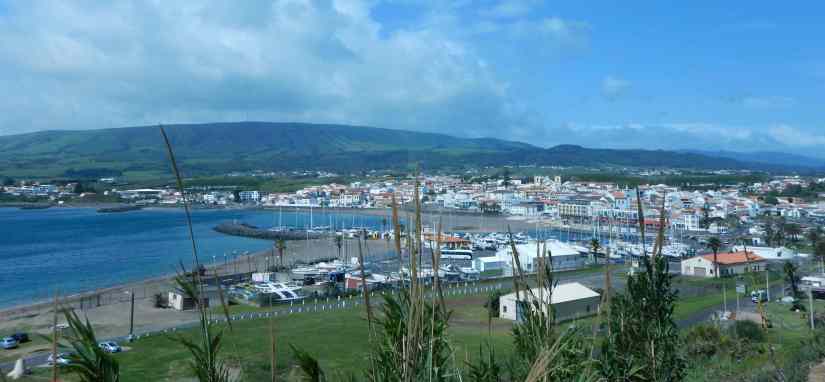
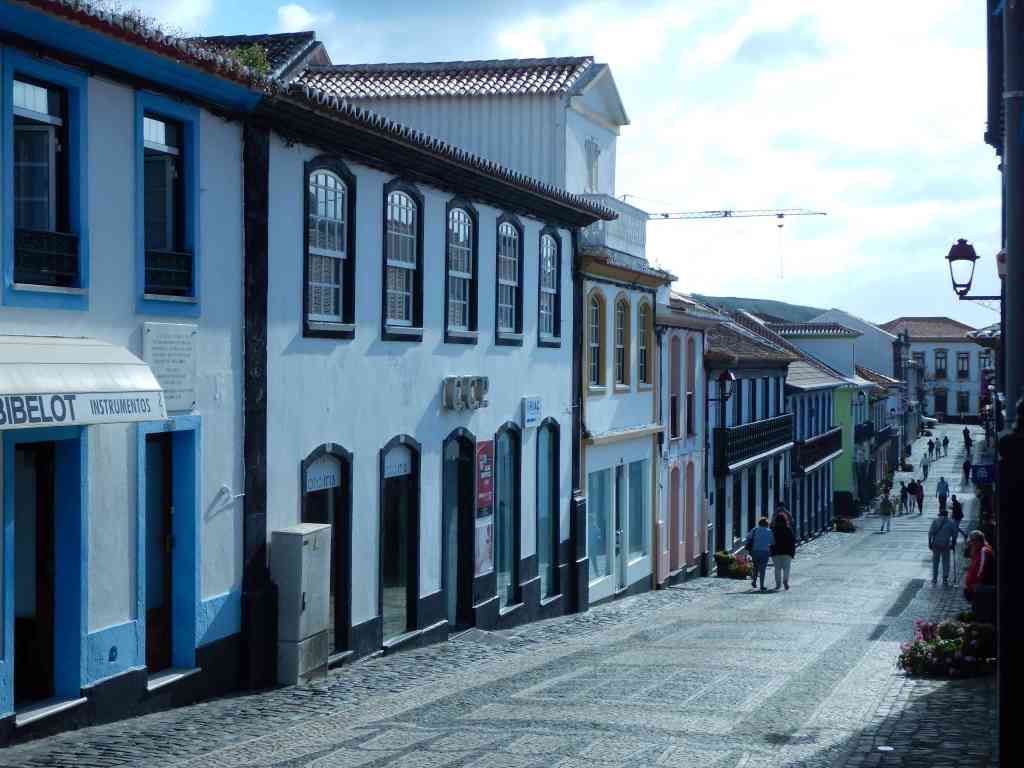
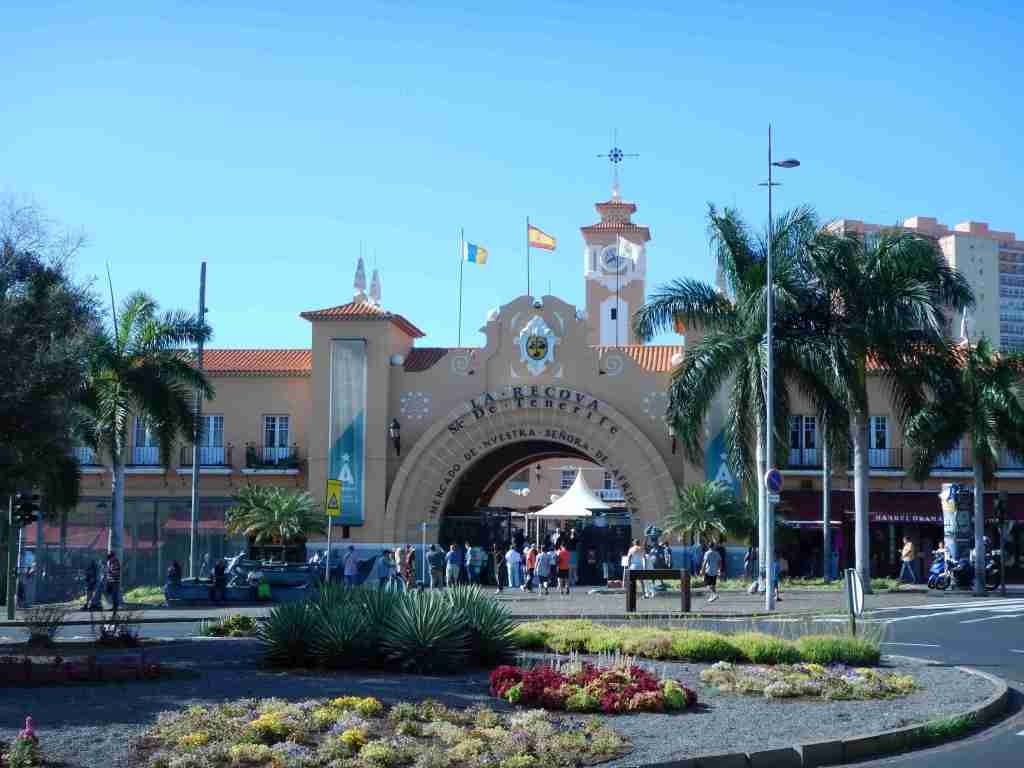
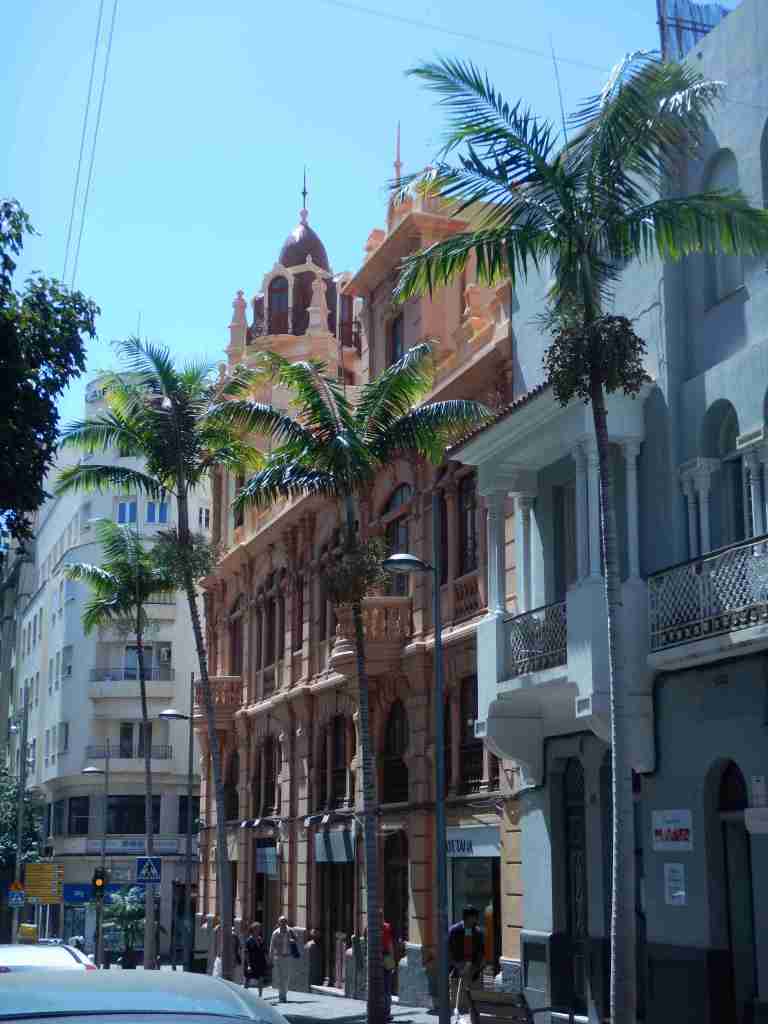
We arrived to the city of Santa Cruz on the Canary Island of Tenerife.   It’s a gorgeous, sunny day of 70 degrees and we’re greeted by clean streets, wonderful architecture, plazas, sidewalk cafes and shaded parks. 

Santa Cruz, Tenerife – The Canary Islands

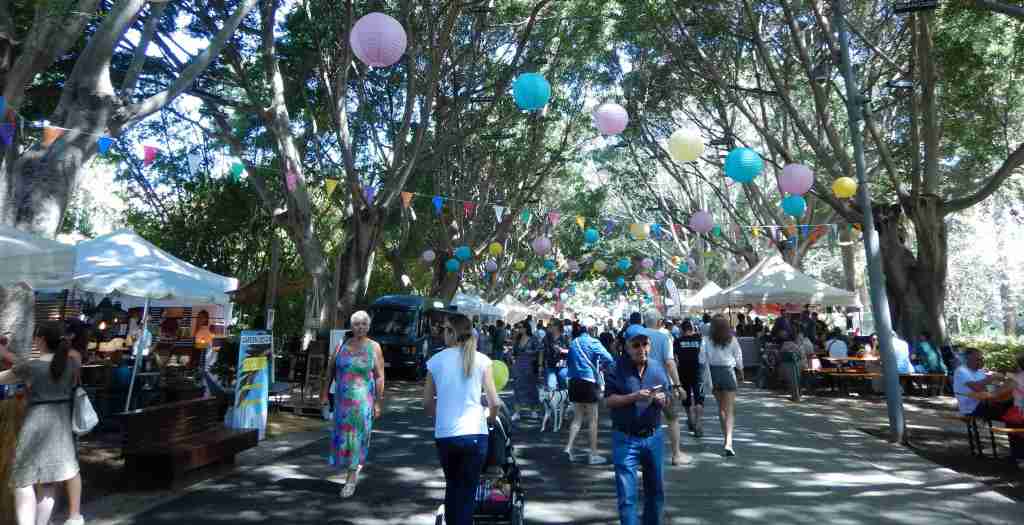
Several festivals were going on, giving the town a vibrant, joyful feel on this Palm Sunday.  Families in the parks with their kids and dogs were everywhere enjoying live music, balloons, and Chinese lanterns hanging from the trees. 

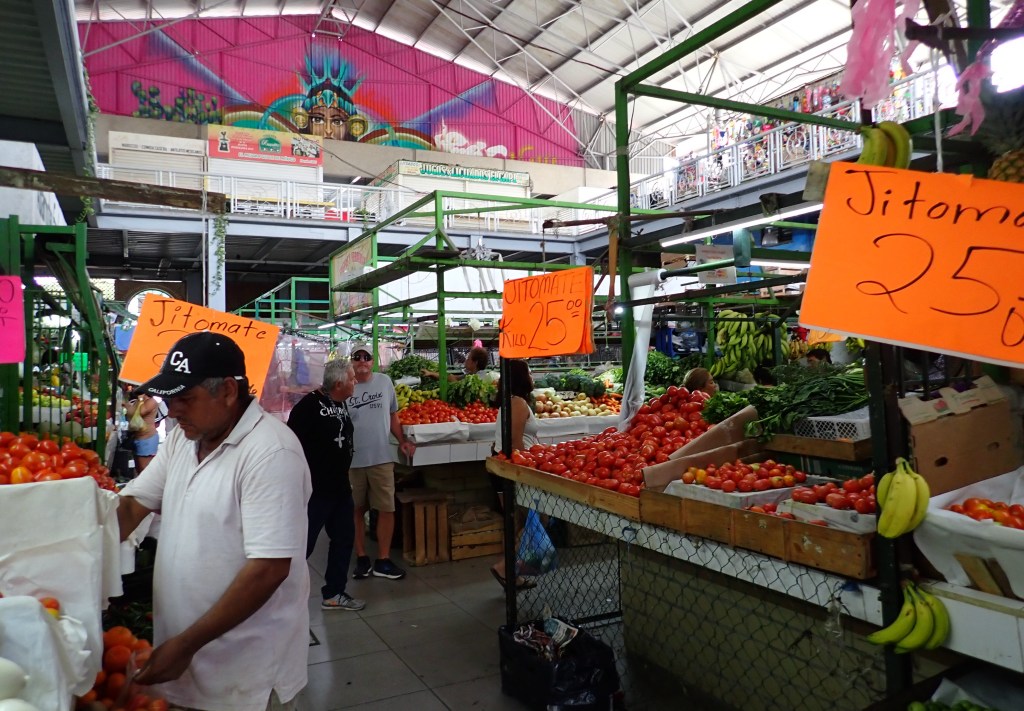
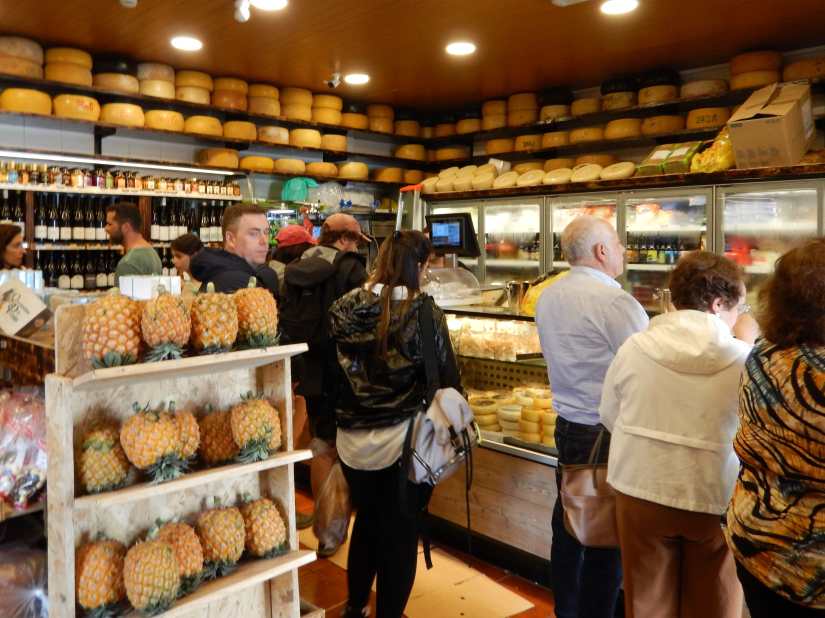
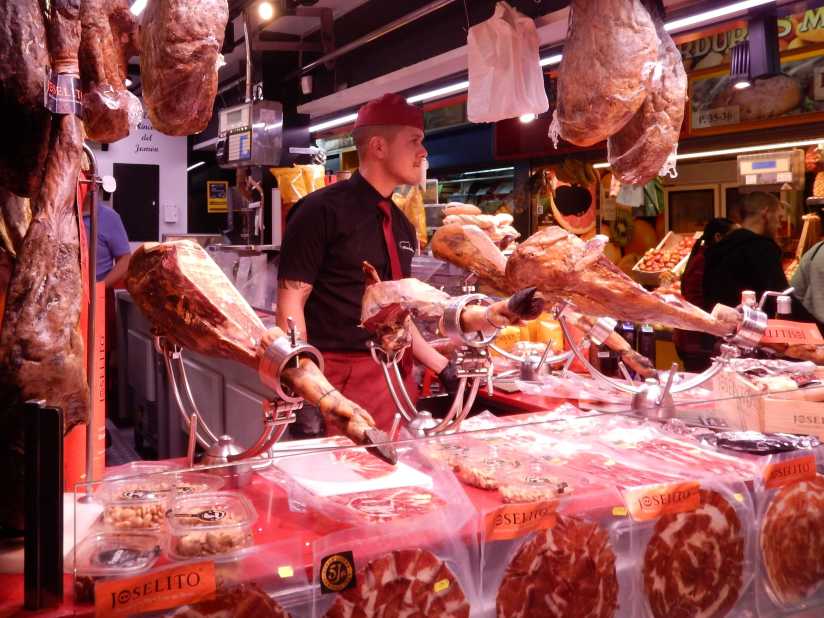
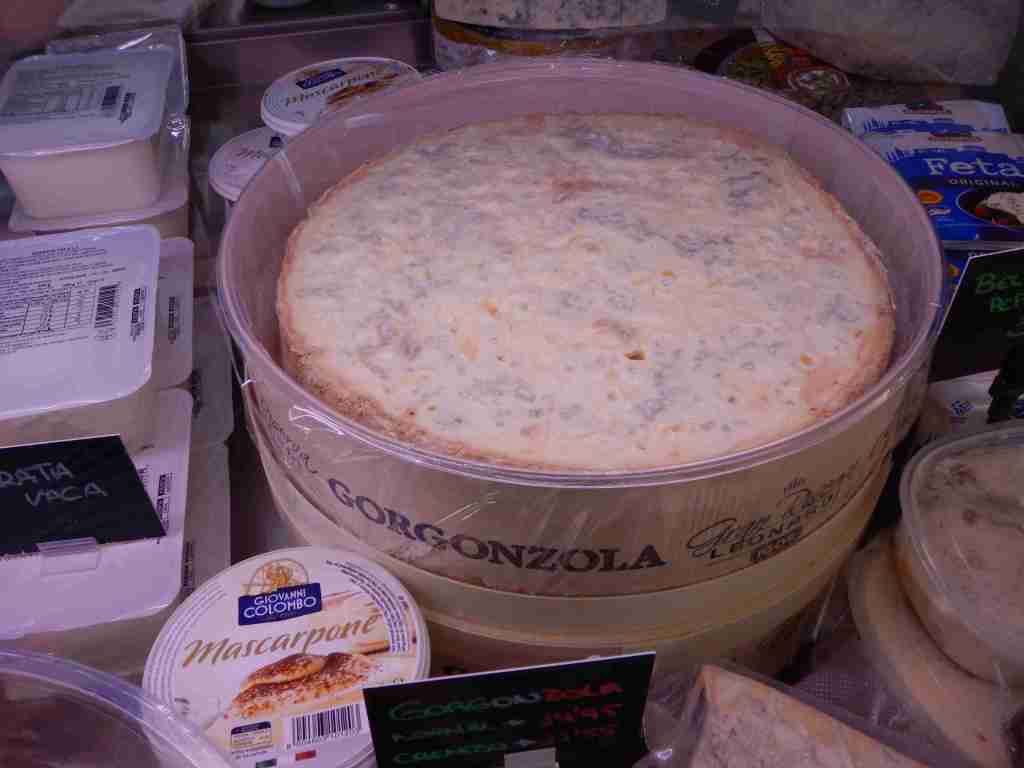
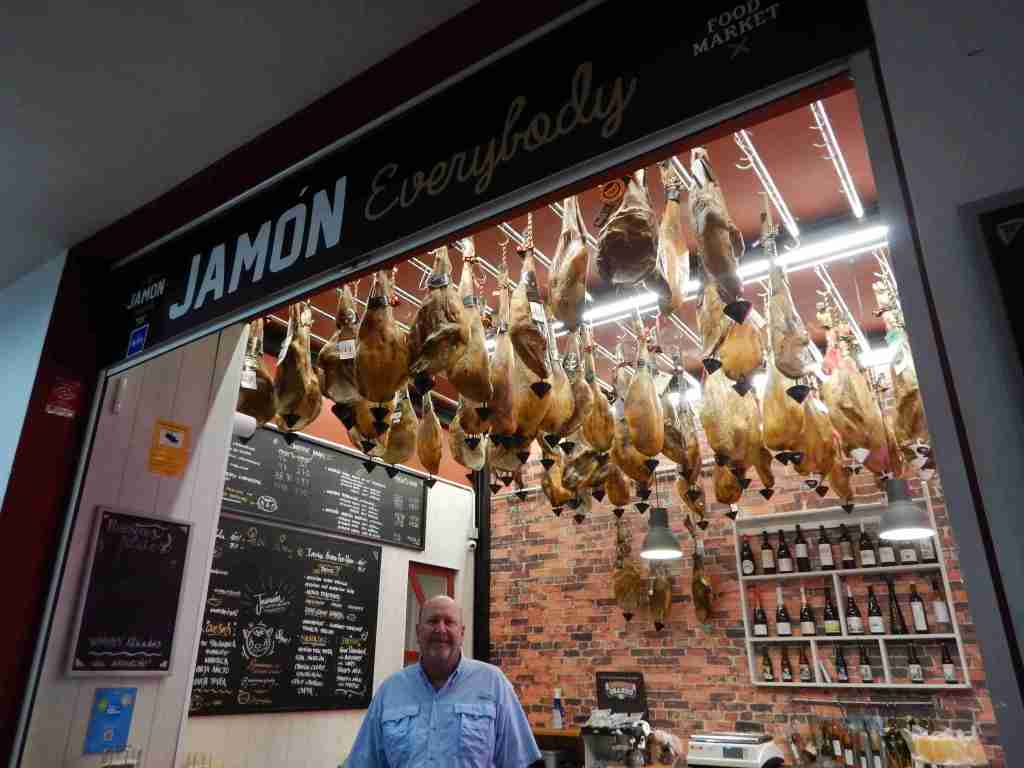
The ornately decorated Central Market is also bustling with abundance of produce, Serrano and Iberian hams, splendid cheeses, seafood, and bakery items as beautiful as they are delicious.  The young, goo-ey Gorgonzola that had to be sampled with spoons was especially decadent.

Streets are teaming with folks enjoying the Spring temperatures.  Several walking bands seemed to project the mood of upbeat spontaneity in the streets.

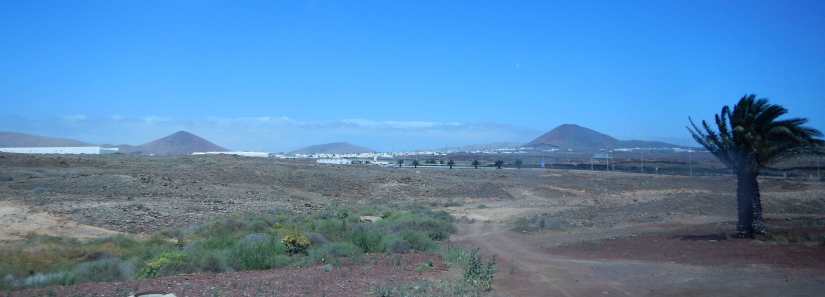
From Santa Cruz, we visit a neighboring Canary Island the next day:  Arrecife.  While only 160 miles away, the terrain on this island is entirely different.  An arid and rocky landscape replaces the lush, sub-tropical greenery of Tenerife.  Hardly a tree exists on the volcanic peaks that roll on in each direction. 

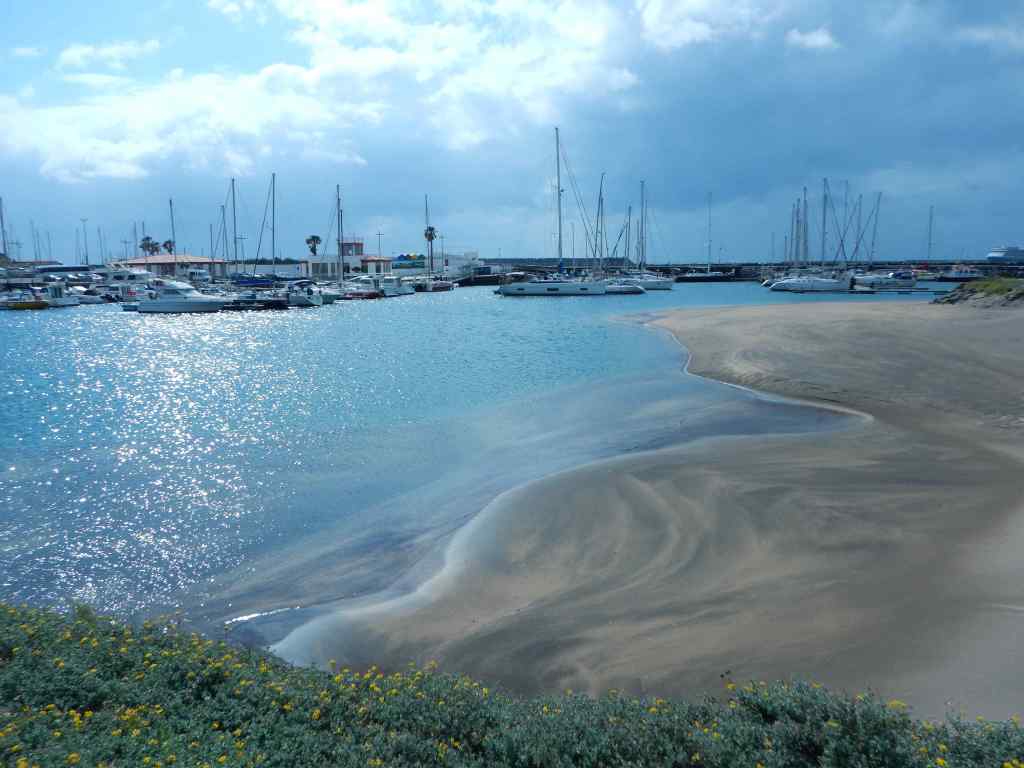
We pull into the port of Lanzarote, a popular beach town for northern Europeans. 

White-washed multi-home buildings with blue roofs rim the coastline like Lego blocks.  Adjacent to town, we strolled the lagoon, where the daily tide leaves lots of small fishing boats lying in the mud once a day. 

Lanzarote features a beautiful beachfront promenade, though still quiet during our pre-season visit.

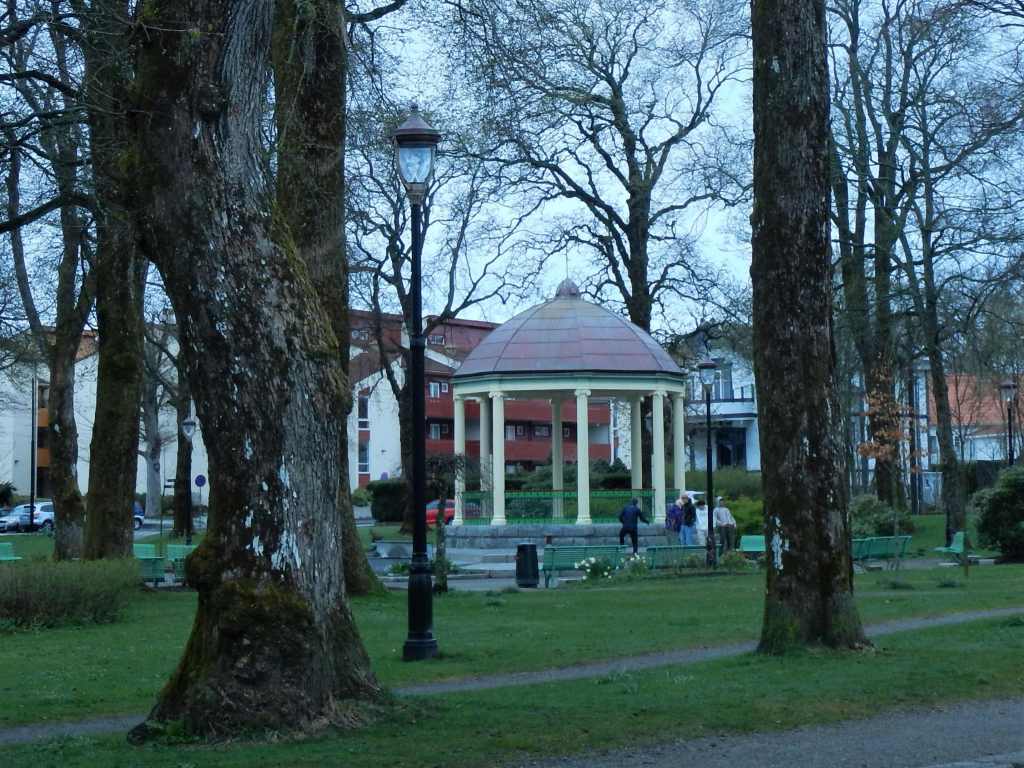
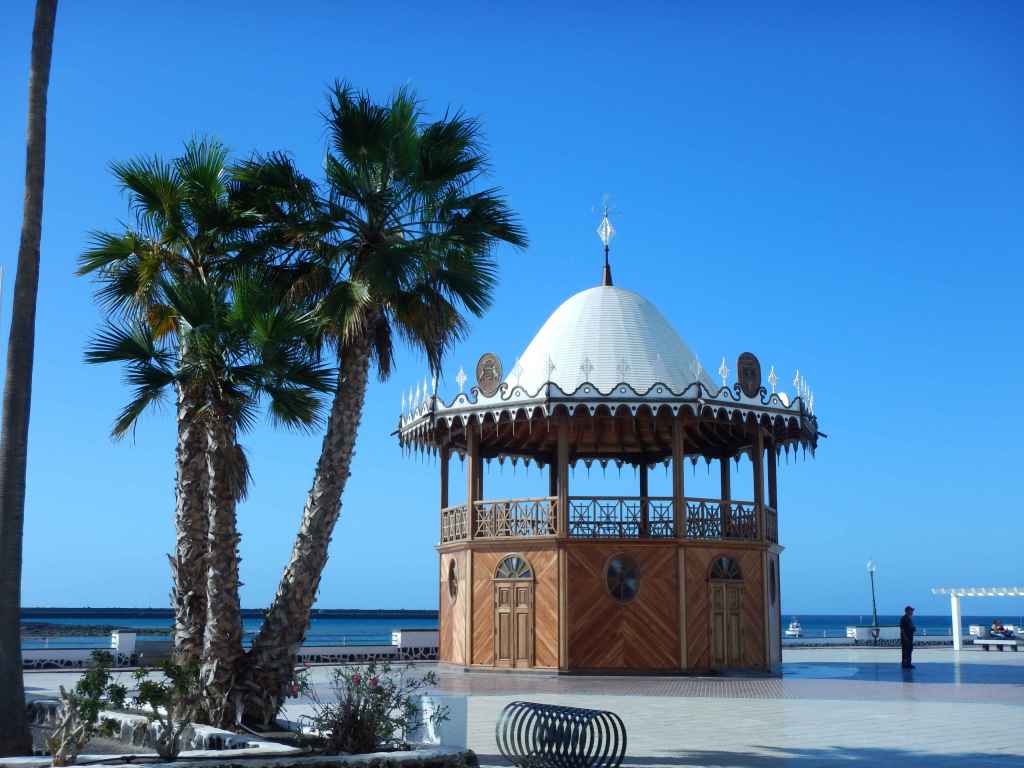
The craftsmanship on this promenade gazebo was incredible, both inside and out.

We found the Canary Islands beautiful, welcoming and needing more time to explore. We will be back someday!

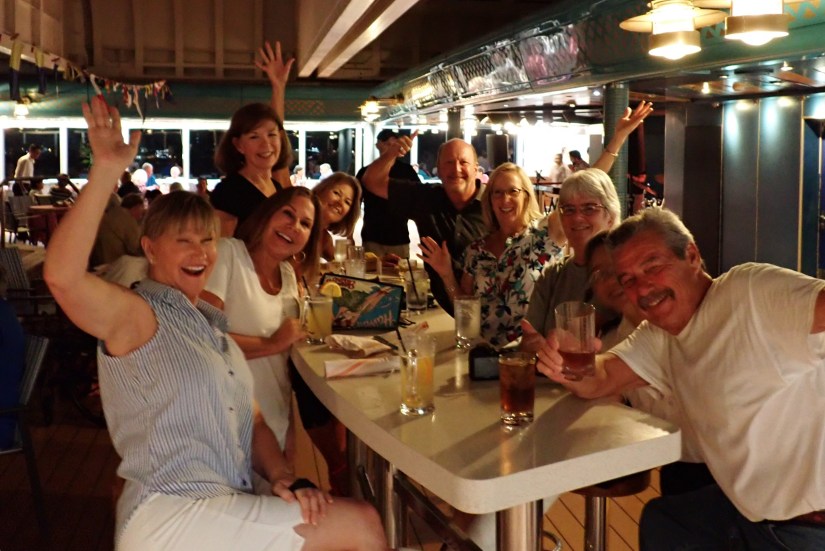
Tom’s birthday was celebrated at sea along with a dozen of our shipmate friends. It was a very fun afternoon pool party!

As we journey further north, the Islamic country of Morocco offers epic Atlas Mountains, sweeping deserts, ancient cities, and it greets travelers with warm hospitality and the perfect glass of mint tea. Slightly larger than the state of California, Morocco’s personality seems to be influenced by both Arab and African worlds. It’s a place where old world and modern collide. Traditional souks (open markets), medinas (walled urban centers) and kasbahs (forts) sit adjacent to sleek, high-end malls, buildings and wide boulevards. Men and women dress modestly. Agriculture is rich; oranges, spices, argan oil, tea, olives, dates. We will visit three coastal cities: Agadir, Casablanca and Tangier.

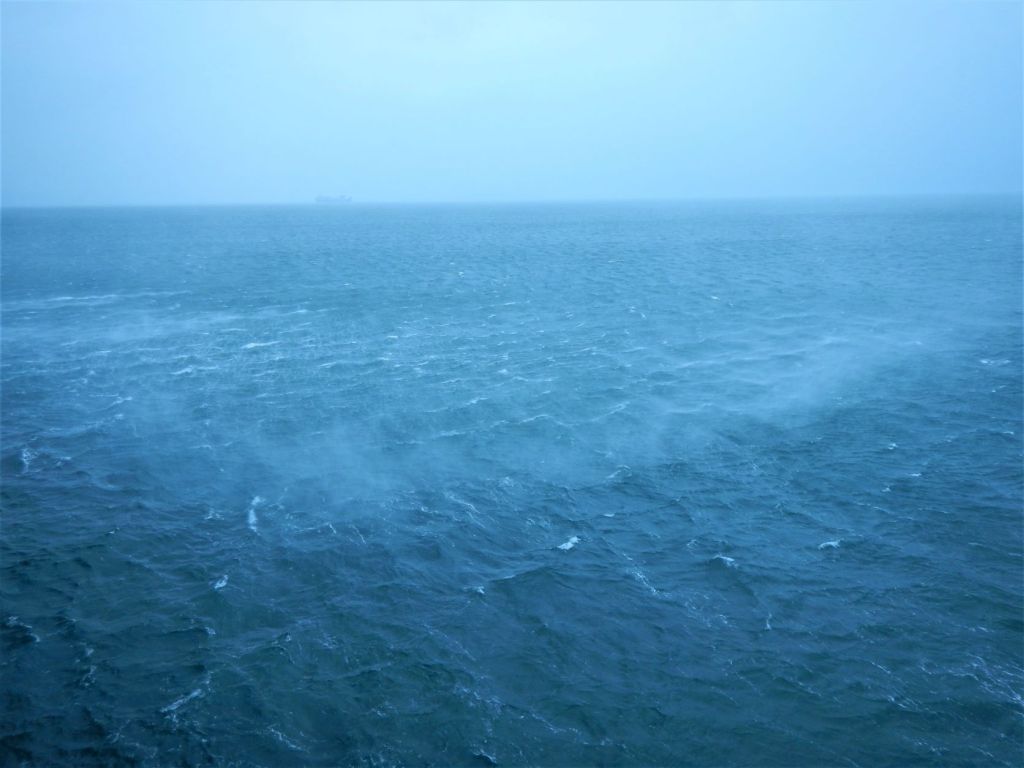
During our 226-mile crossing from the Canaries to Agadir, Morocco, we found strong northwest winds that produced choppy 10 foot waves. The ships stabilizers do an amazing job in keeping us from rolling too much.  Pitching is another story. Nevertheless, the Zuiderdam handled the slight conditions with grace. Some of the passengers, not so much, as evidenced by the empty dining room and other public areas on board.

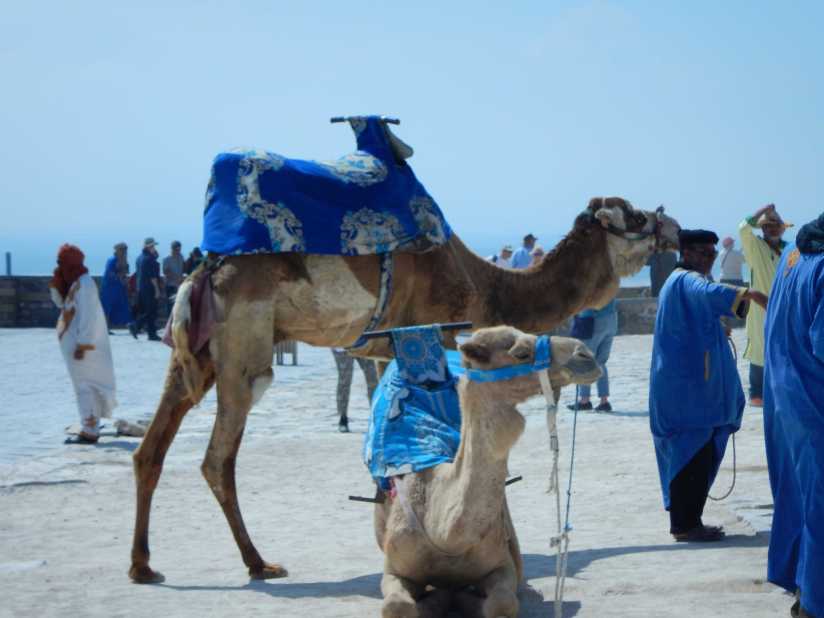
Agadir is a big fishing port and resort town. The promenade parallels the wide beach for more than a mile, and camels are awaiting to give you a ride. Tourists joke that there’s one price to get on; another to get off.

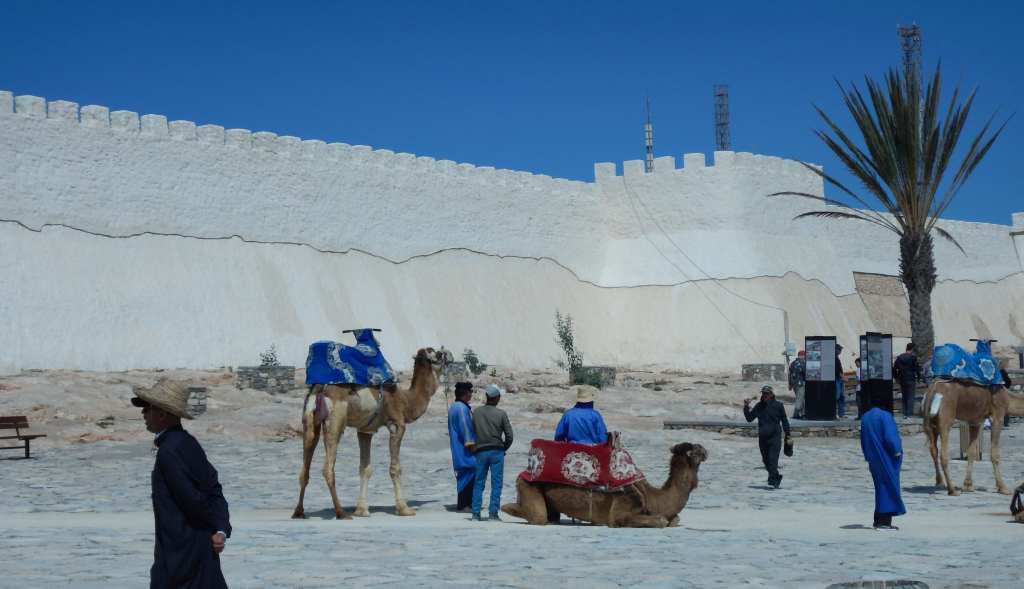
It’s a windy 70 degrees when we strike out to the cable car that will take us on a long aerial ride to the rebuilt Kasbah, 775 feet above sea level. The original was demolished by an earthquake in 1960 which killed 15,000 people and injured 20,000.

View from the cable car

After departing the kasbah, we visited the Souk El Had d’Agadir, a 32 acre space filled with 6,000 shops/booths; furniture, rugs, fabric, appliances, books, ceramics, spices, olives, produce, tea and metal works including tea and coffee pots of every shape. 

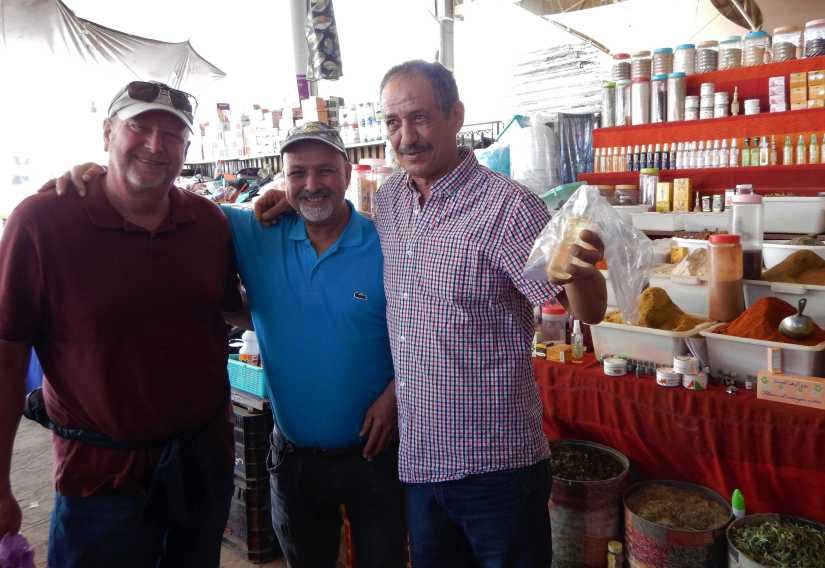
We bought a tea blend and enjoyed a hot cup with the seller and his brother.  

The scents and sounds of the Souk were captivating, as the call to prayer sounded over loudspeakers throughout the Souk and neighborhoods, which you can hear in this video:

(Turn your volume up to hear the call to prayer in this video.)

During our 7-mile walk today, we also found the Argan Oil Factory.  Argan trees only grow in Morocco and goats climb the trees to eat the fruit.  The goats are the only ones who fancy the fruit, which is pressed to expel the valuable oil that is used in a variety of ways, including soaps, lotions, and conditioners.

By the time we wound our way back to the shoreline, the winds had increased to 35-40 knots, kicking up the sands of the beach. 

Our visit is during Ramadan, so very few open cafes or restaurants were found during the day. But we were lucky to find one open on the windy oceanfront, Le Nil Bleu, and revived our energy with chicken shamwara and pizza.

Back aboard, the Captain announced that due to the high winds, we wouldn’t leave Agadir until tomorrow morning when winds were more settled.  However, despite the later departure, our arrival to Casablanca would still be on time.

Casablanca is the largest port city in Morocco. It has a population of 3 million people and it’s known for its beaches, nightclubs and architecture. And of course, the movie.

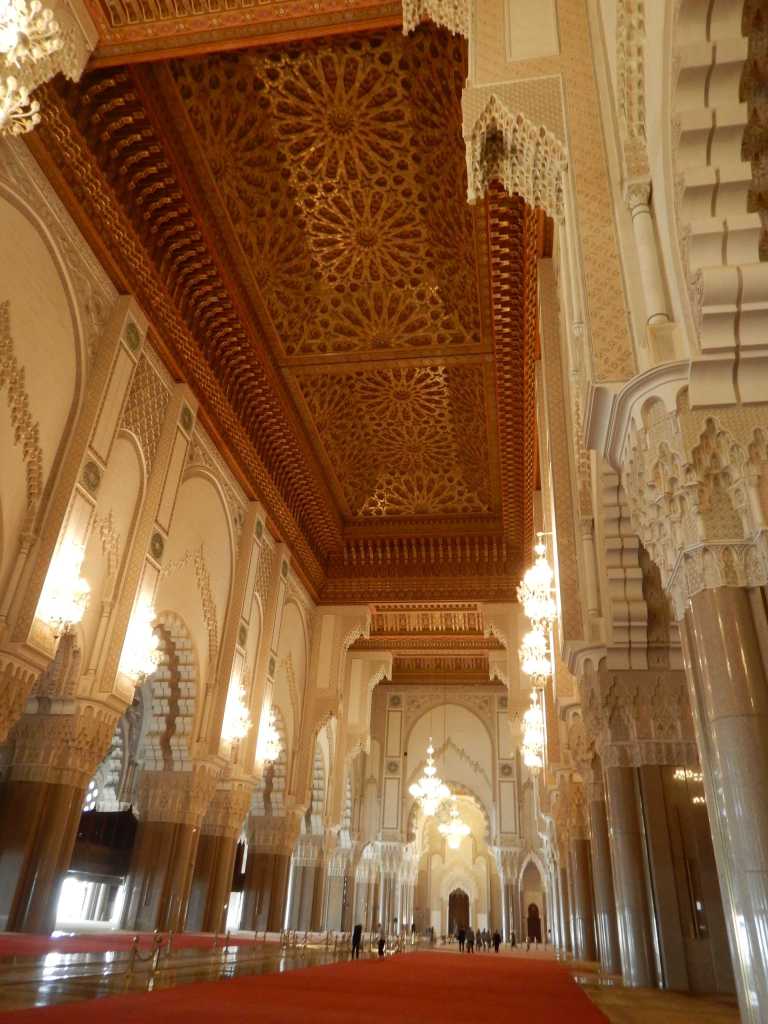
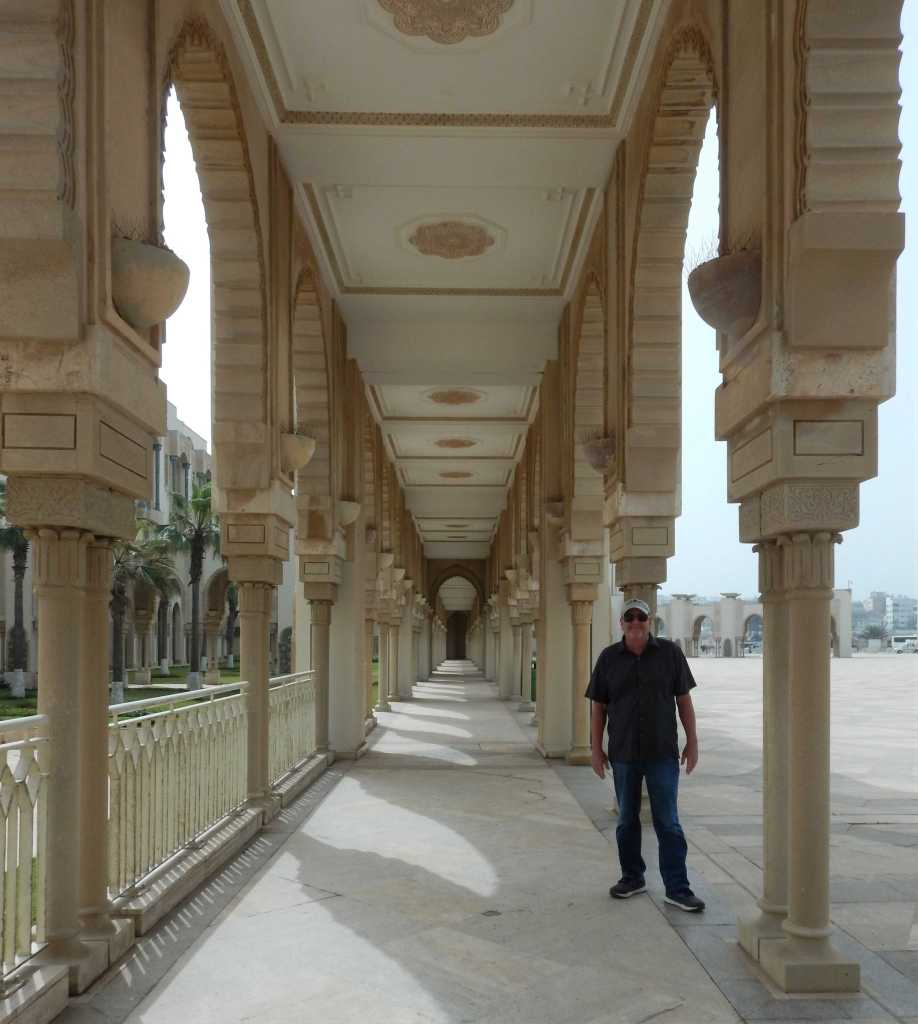
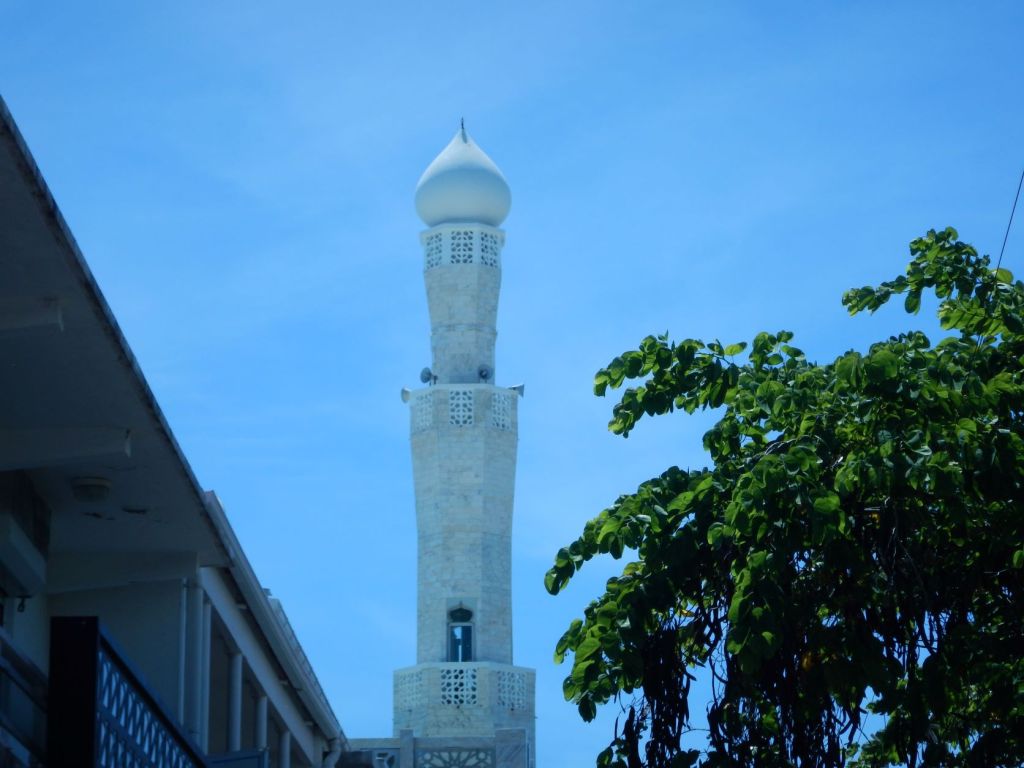
By far, the most astonishing of all architecture in this city, is The Hassan II Mosque, completed in 1993. It can accommodate 25,000 worshippers inside and another 80,000 outside. The minaret (tower) is 689 feet and is the second highest in the world. Construction cost is an estimated $800 million, and it took 6 years to build, employing 3,000 craftsman, and 10,000 workers who toiled with porcelain, stone, wood and plaster.  While there are Italian chandeliers and marble, all other materials are from Morocco. The King footed the bill for 1/3 the cost and local Moroccan residents funded the rest.   Our photos hardly do it justice, and certainly don’t capture the sheer enormity of the place. For more photos and info, please view its website at: https://www.fmh2.ma/en/node

The size of the pedestrians in this photo (if you can see them) may give you a sense of scale.

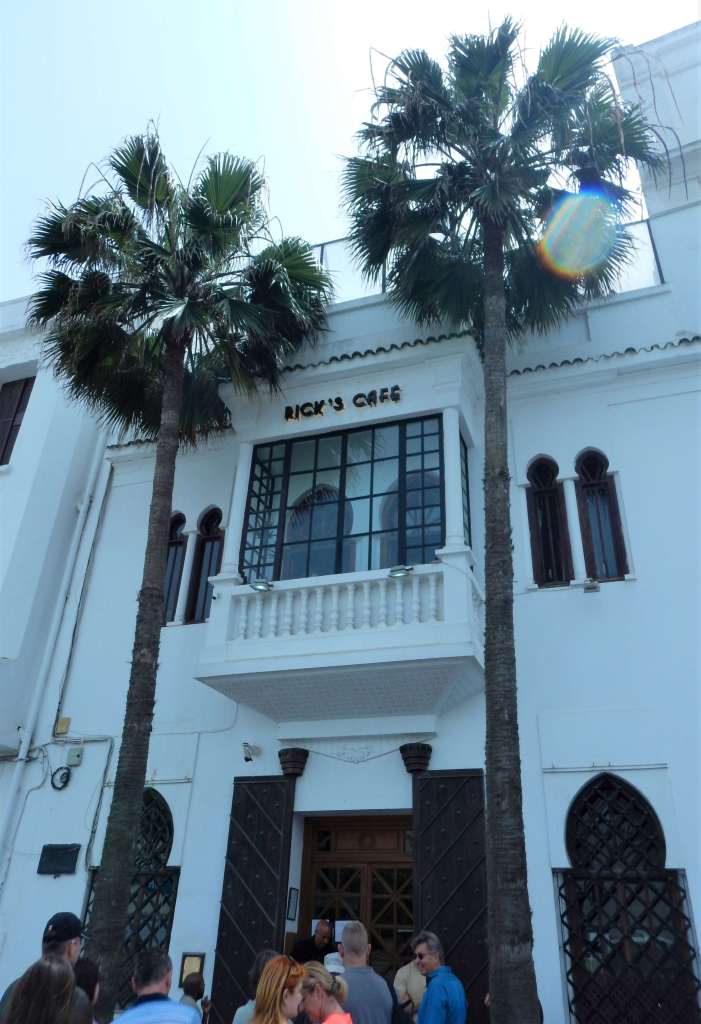
And speaking of the movie, while scenes of Casablanca were filmed in Morocco, Ricks Café was not. It was a stage set. Nevertheless, the one-hour long line to get into the fictitious replica was slow moving. And due to Ramadan, the only thing open was across the street at the modern mall: McDonalds!  

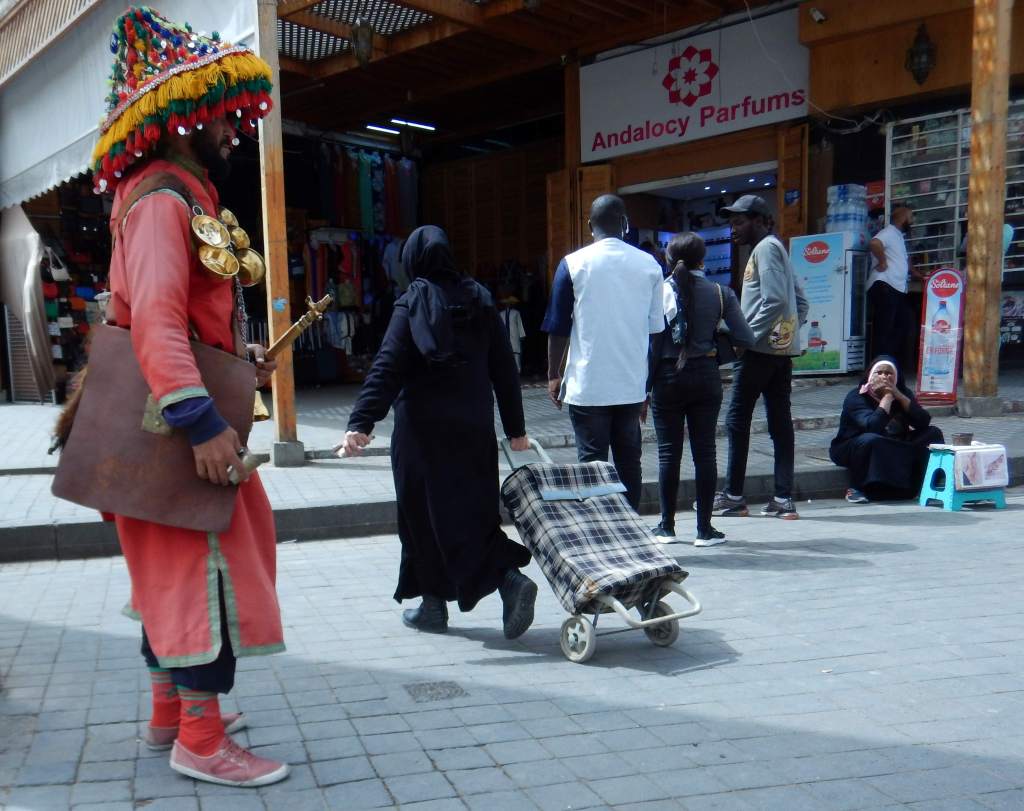
The streets of Casablanca were fairly quiet during morning hours but come alive in the afternoons. Especially walking through the Souks.

One sea day and almost 300 miles up the coast we come to Tangier, Morocco. It lies 40 miles southeast of the tip of Spain, in the bay of The Strait of Gibraltar.  

Tangier, Morocco

We arrive early on a 60-degree, windy day. To get an overview of this sprawling city of 1.2 million, we opt for an overview via their convenient Hop On/Off Bus.

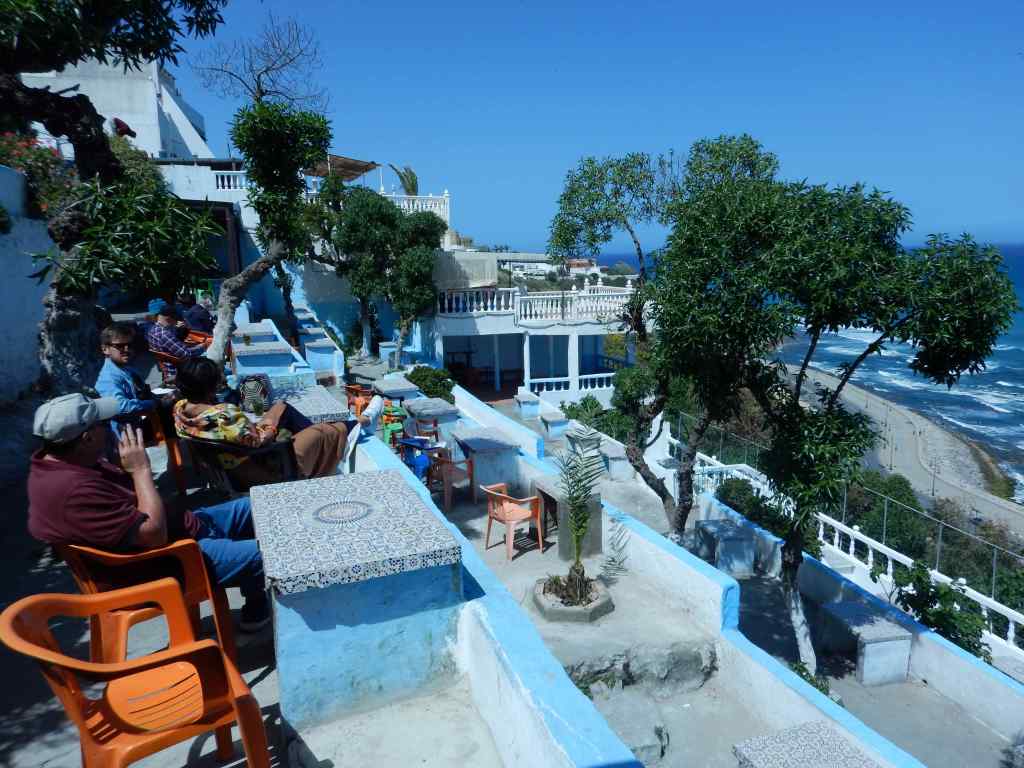
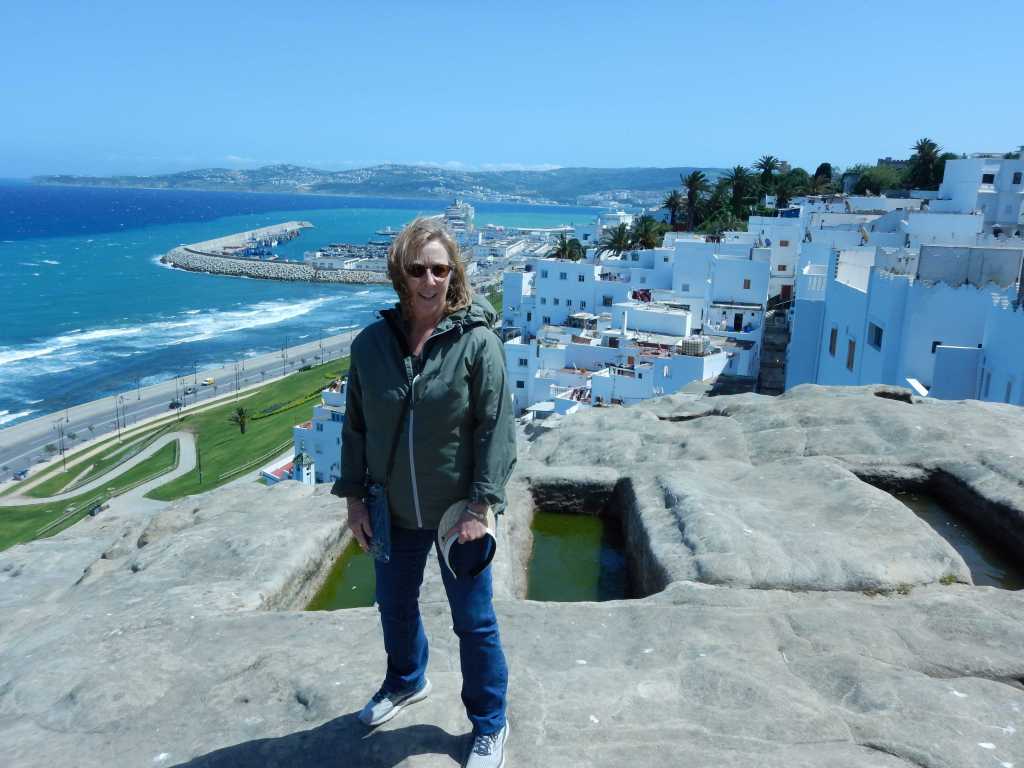
We rode it for one hour until we returned to our intended stop, The Café Hafa. Established in 1921 and built on the cliffside of the ocean, it afforded us breathtaking views while we sipped mint tea and nibbled on almond cookies.

From there, we wander through hilltop neighborhoods that led us to the entrance of their medina.

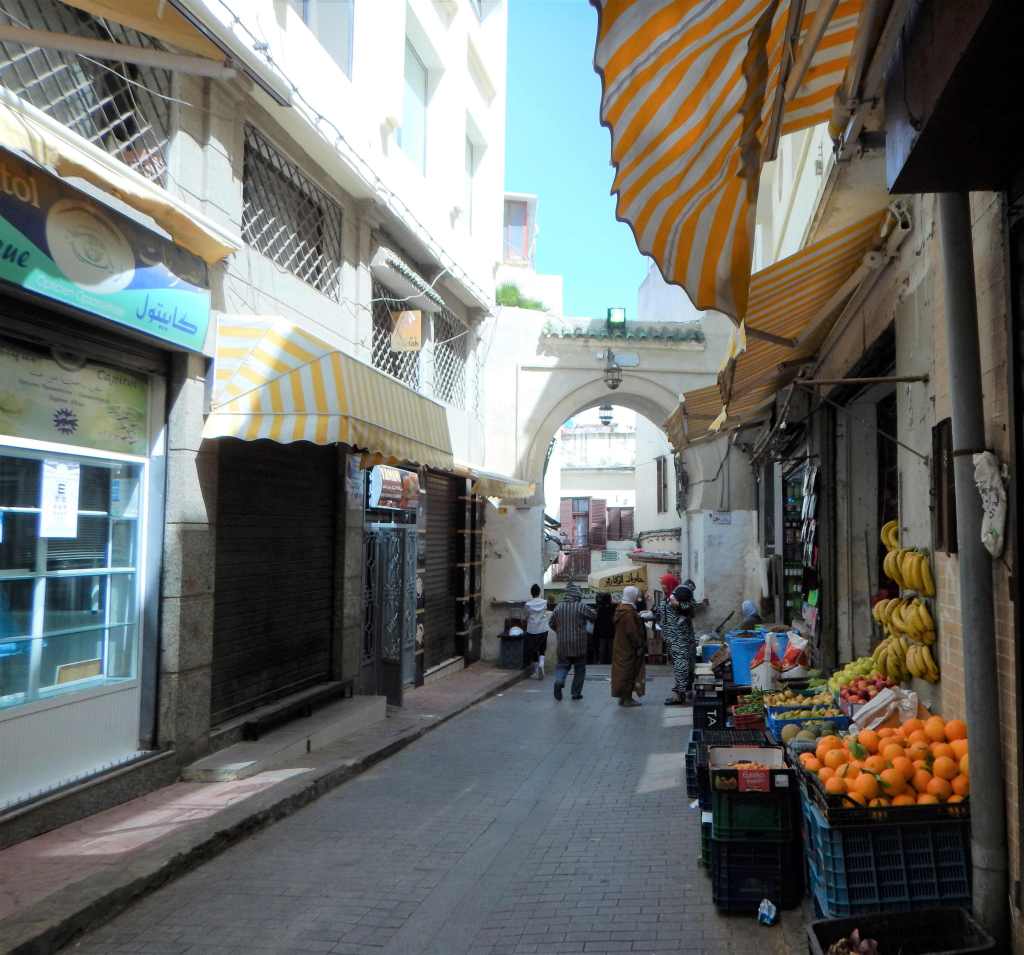
Once inside the medina, it is very easy to get lost in the twisting and narrow alleys of residences and tiny shops.

Back down to sea level, we must pass through the Grand Souk with its Friday shoppers, before heading through the Mendoubla Gardens and back to the ship.

While we may not have had the opportunity to sample local Moroccan cuisine ashore due to the locals fasting in observance of Ramadan, the chefs aboard the ship prepared a delicious feast!

We turn the clocks two hours forward tonight as we sail into the night towards Malaga, Spain. More to come….

2023 World Cruise, Cruising, Travelogues

Leg 6: Africa

While growing up, our household seemed to hold every National Geographic magazine ever printed.  I marveled at all the glorious photos trying to imagine life in all those far-flung, exotic places, especially Africa.  Today, some of those pages came to life.   

The skyline of Maputo, Mozambique

Two million people live in Mozambique’s largest city of Maputo, and its complex history has been riddled with strife.  Only as recently as 1975 had Mozambique achieved independence from Portugal. However, their broken system continues to struggle. Literacy is only 40%, unemployment is 80% and poverty is widespread. The average life expectancy in 2018 was 48; today it is still only 55.  It’s also a melting pot of many ethnic groups, resulting in 40 languages that are spoken here, though Portuguese is primary.   And in step with ethnic groups, many religions are also worshipped here. 

Our 2.5-mile guided walking tour educated us on the history, economy, and politics of this city, and we learned that similar struggles are also common across Africa’s 55 countries. It is a continent of ‘haves’ and many more ‘have nots’, and sadly, homelessness is prevalent.

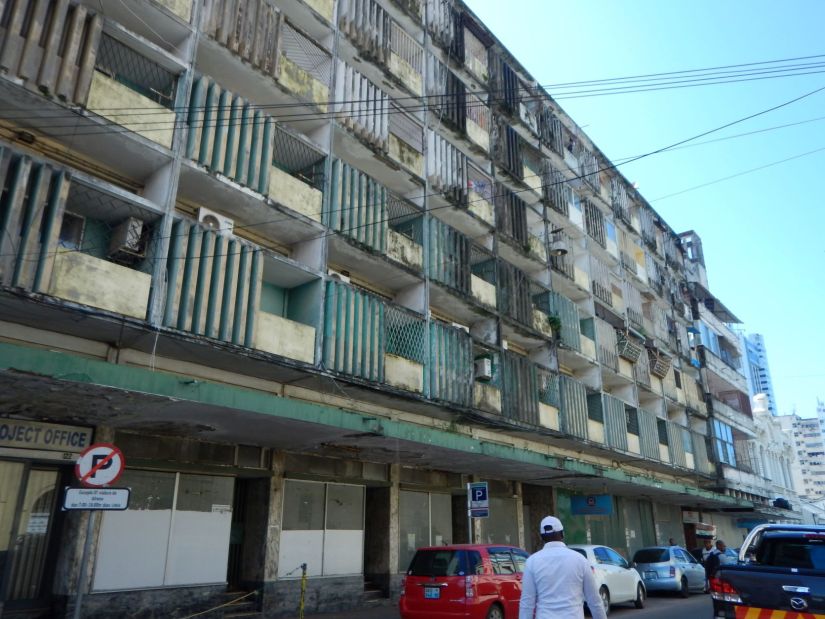
Maputo Apartment Building

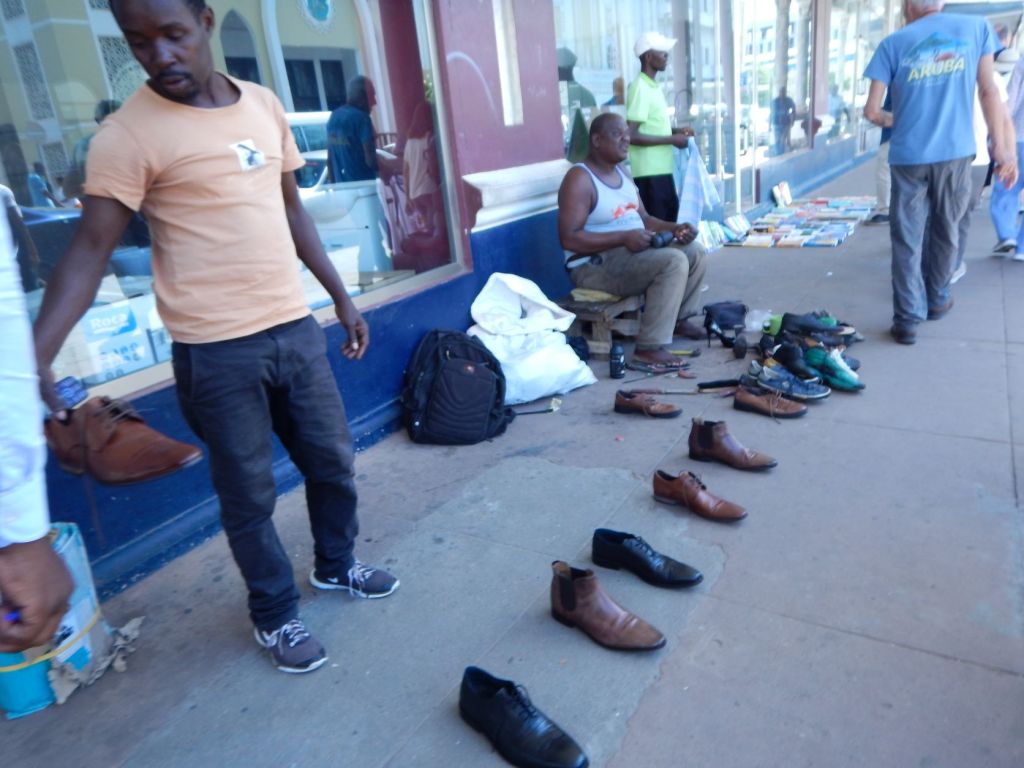
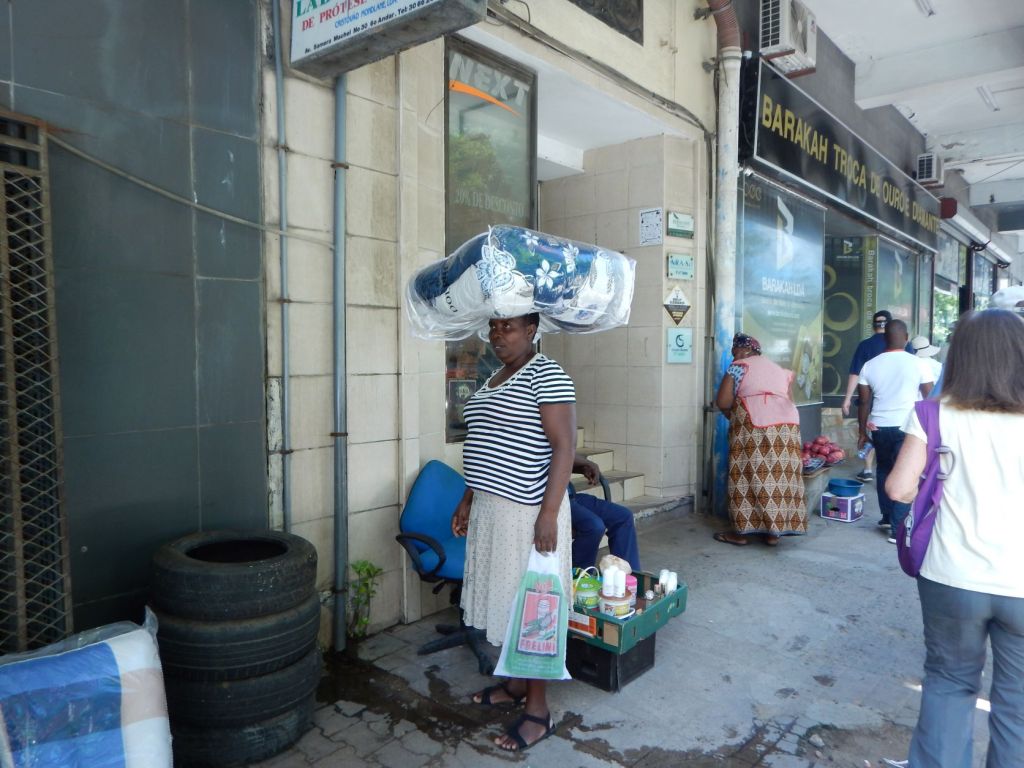
Throughout our walk, desperate street vendors were on foot aggressively hawking leather belts, hats, sunglasses, wooden carvings, bead necklaces and bracelets.   Sidewalk vendors were also set up beneath building overhangs selling used shoes, electronics, boiled eggs…pretty much anything that might earn them some money to feed themselves and family. 

The din of the Central Market was buzzing with vendors ready to haggle over everything from fish, cashews, along with the usual produce. 

The oddest category we’ve ever seen in ANY market anywhere, is hair and wigs.  Yep.  Four entire aisles. Such a paradox.

Amidst the gritty downtown, the Railway Station sits like an unlikely jewel and is recognized as one of the world’s most beautiful stations. 

Maputo Railway Station

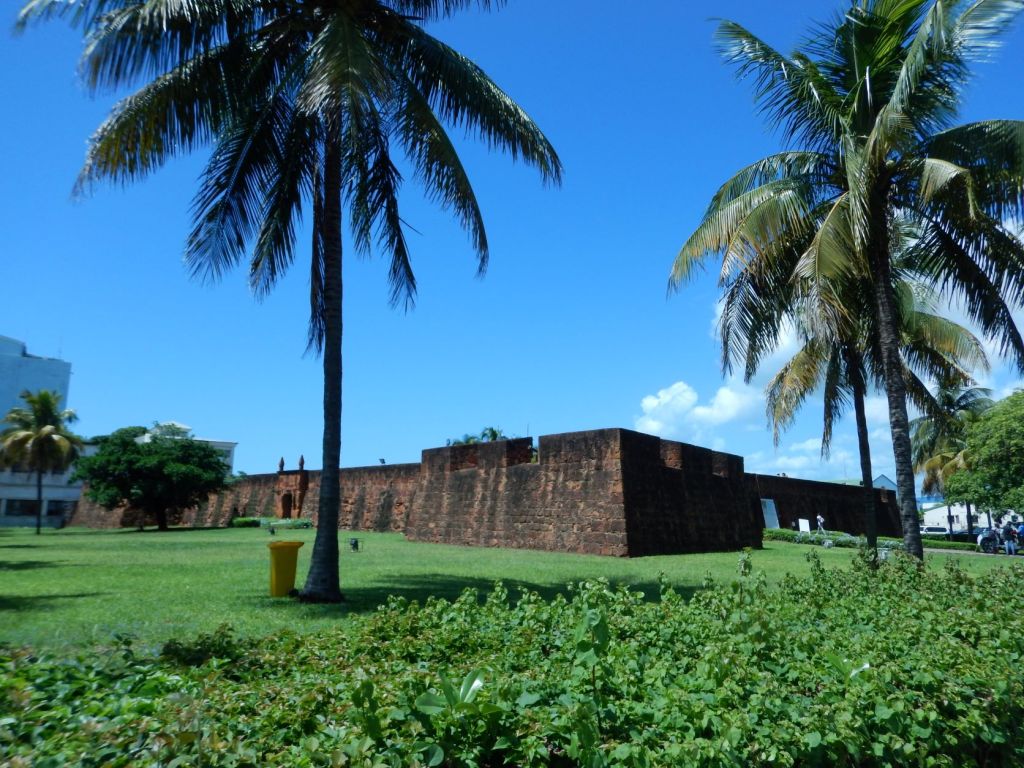
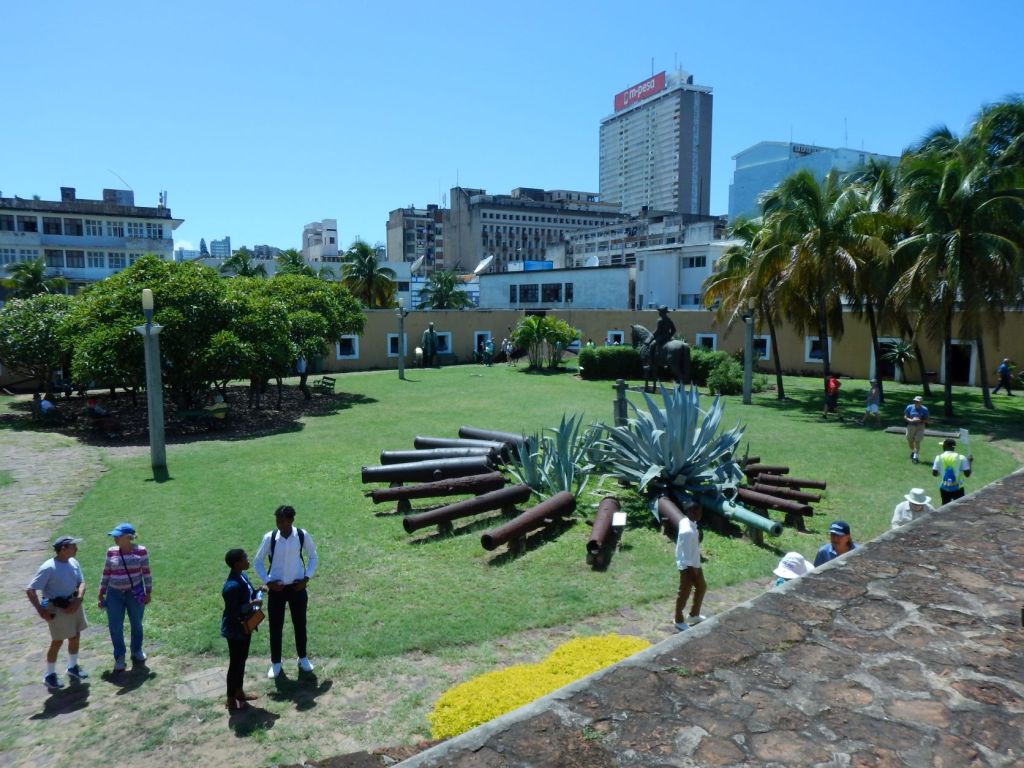
The nearby ruins of the waterfront Fort built in 1721, protected against all invaders, of which there were many.

Once the walking tour ended at the port, we boarded a shuttle bus that took us up the hill to a different section of the city.  Here we found an entirely different Maputo; the ‘haves’, with beautiful roof-top pool hotels, sidewalk cafes and eateries, office buildings, administration headquarters, etc.    

Highly recommended was a visit the FEIMA Handicraft Fair, a large village of co-op artisans.  Acres of shaded paths threaded throughout batik art canvases, woven baskets and purses, wood carvers, cloth, leather goods, as well as outdoor cafes and colorful umbrellas.  The elevation and trees provided breeze and shade, which was a welcomed relief after the blazing heat of the city.   We took a seat to relax and share a panini along with a local ale, Manaca. 

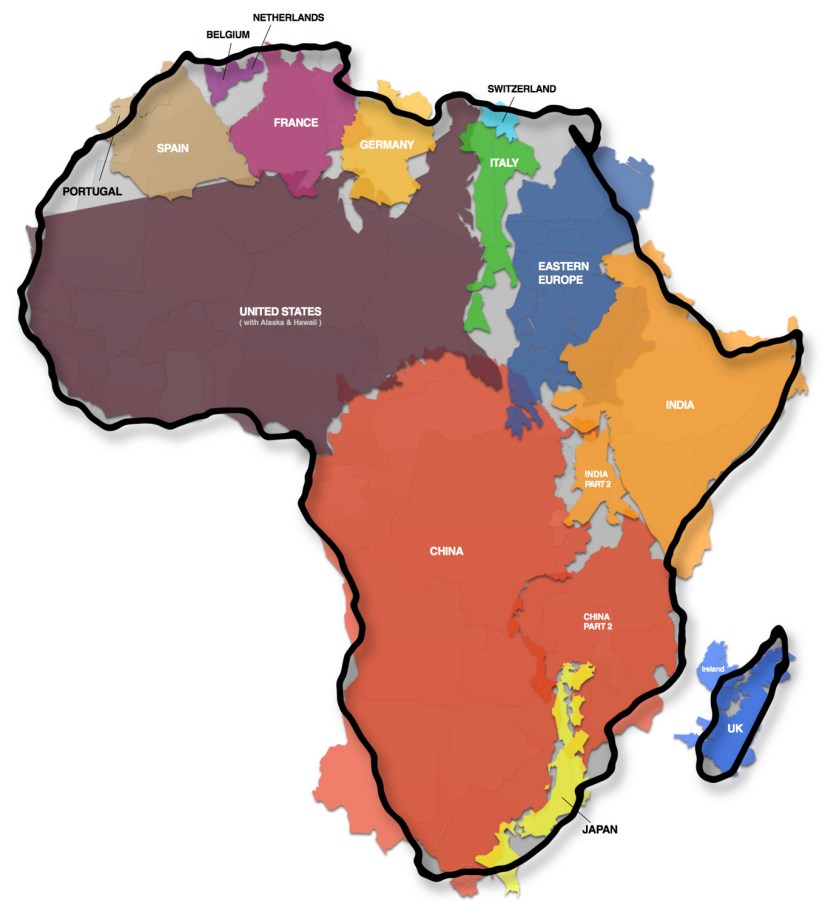
Mozambique was certainly an interesting introduction to the first of ten ports that we will visit on the African continent. To grasp just how enormous this continent is, please take a moment to let this graphic soak in:

Next up was the sprawling city of Durban, the third most populous city in South Africa, home to 3.7 million people (and 250,000 public buses). Another city of many contrasts. For instance, while it is the largest container port in South Africa, it is also flanked by 75 miles of wide, golden sand beaches which are a wonderful backdrop to the many surfing competitions held here.

Durban skyline

Unfortunately, due to its large population of impoverished people, local authority instructed tourists not to walk freely about the city.   Anyone going ashore was urged to either take an excursion or stay aboard.  This was underscored by the fact that city officials provided a free shuttle from the cruise port to an adjacent gated, beachfront family amusement area filled with shops, cafes and attractions.  The 10-minute commute made it was clear that the warnings were solid.  The area was rough; both in neighborhood and its inhabitants. 

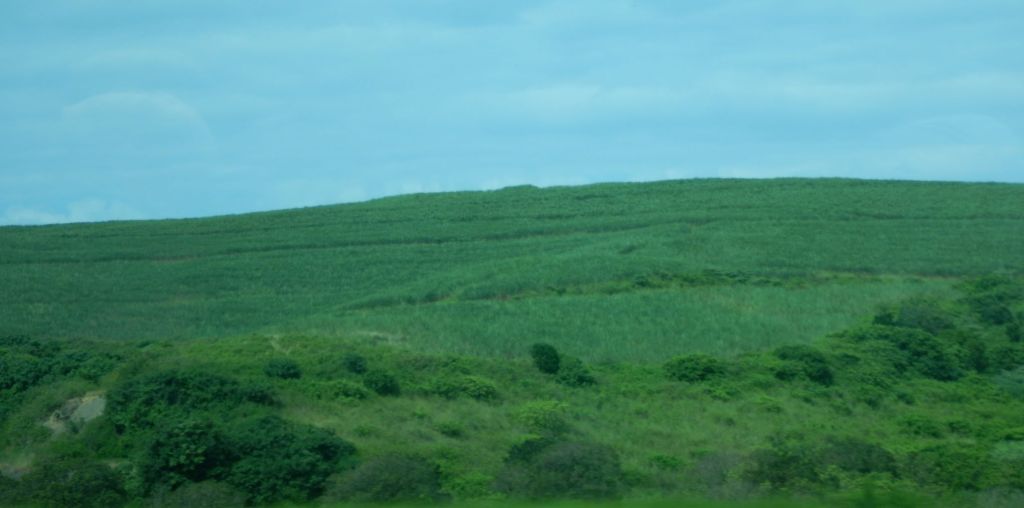
We opted for a tour that drove us along the north Durban coastline, which is known for South Africa’s sugar cane.  In winter, they burn the cane before processing; it not only chases snakes out of field, but it burns off the leaves and makes the sugar sweeter.  If you didn’t know you were looking at sugar cane, you could have been driving past acres of Wisconsin corn fields! 

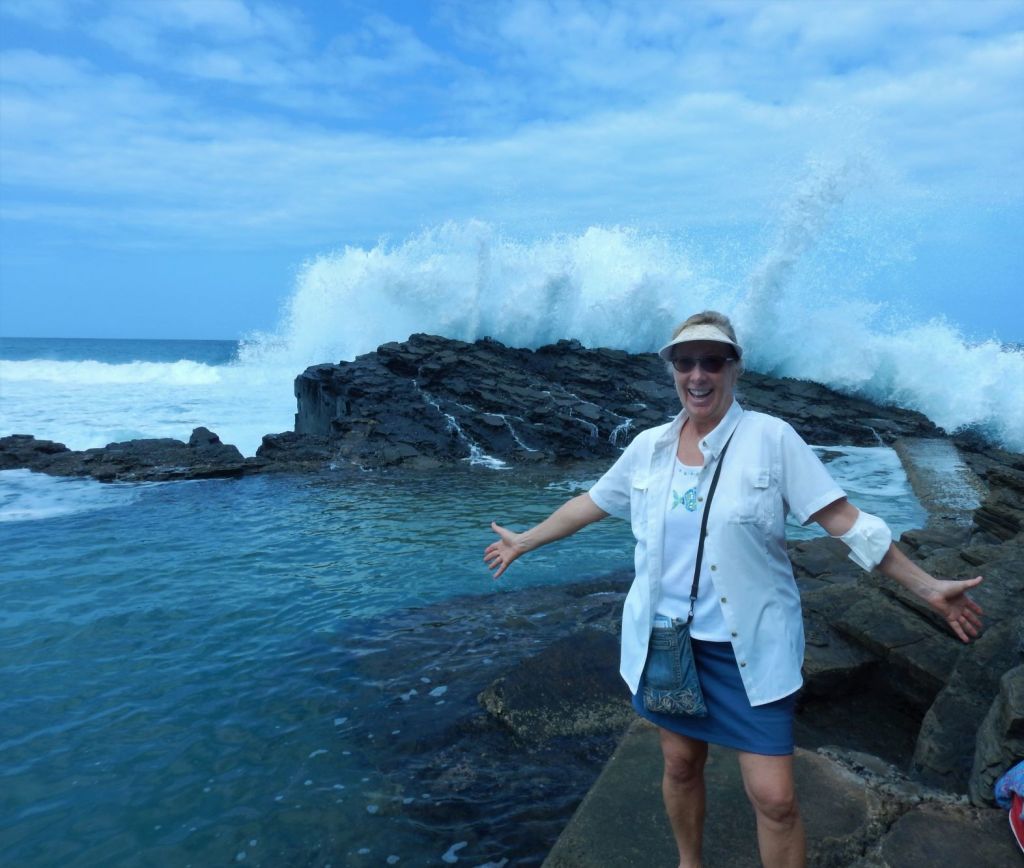
Beyond the agricultural region, the shoreline became rocky, and we passed through the Umhlanga Rocks and eventually, Thompson’s Bay, with its tidal pool and Hole in the Wall.    

Thompson Bay’s “Hole In The Wall”

About 500 miles southwest of Durban is Port Elizabeth, South Africa. We will use this port to drive inland 1.5 hours to the Kwantu Game Reserve https://kwantu.co.za. The high coastal sand dunes fall away as we rise in elevation, soon replaced by rural pastureland with cattle farms and horses.  The Kwantu Lodge is beautifully appointed and upon arrival, were offered coffee, tea, juice, and water with hot appetizers.  Refreshed, we stroll among the onsite ‘bomas’, large natural areas which are fenced.  Lions, tigers, and cheetah, each in separate bomas.  These are animals being rehabbed before being released back into the wild. 

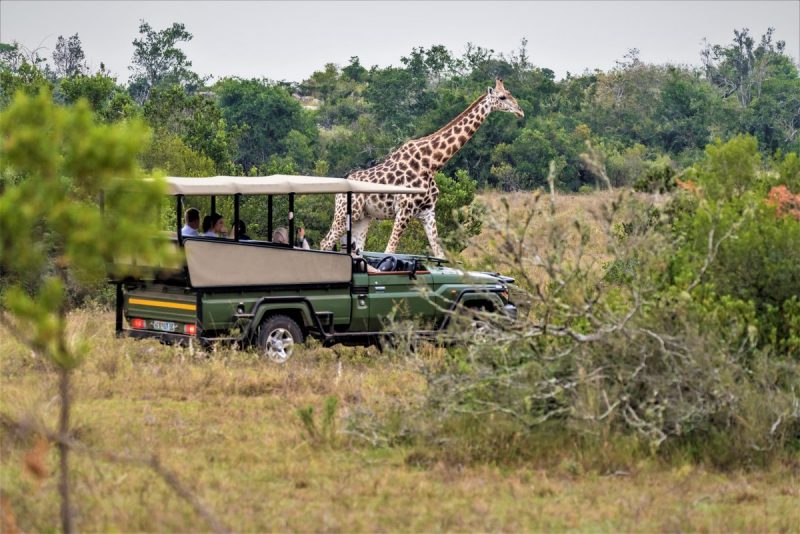
From here, we boarded safari vehicles to head into the bush for a 2.5-hour game drive on their 11,000 acres.

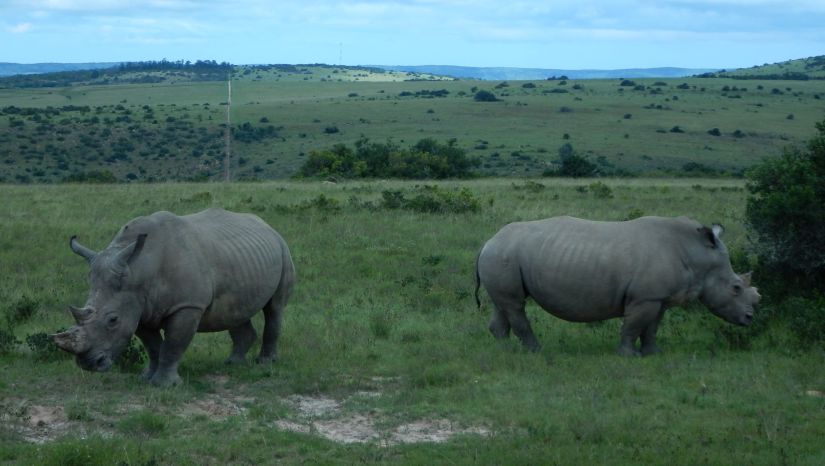
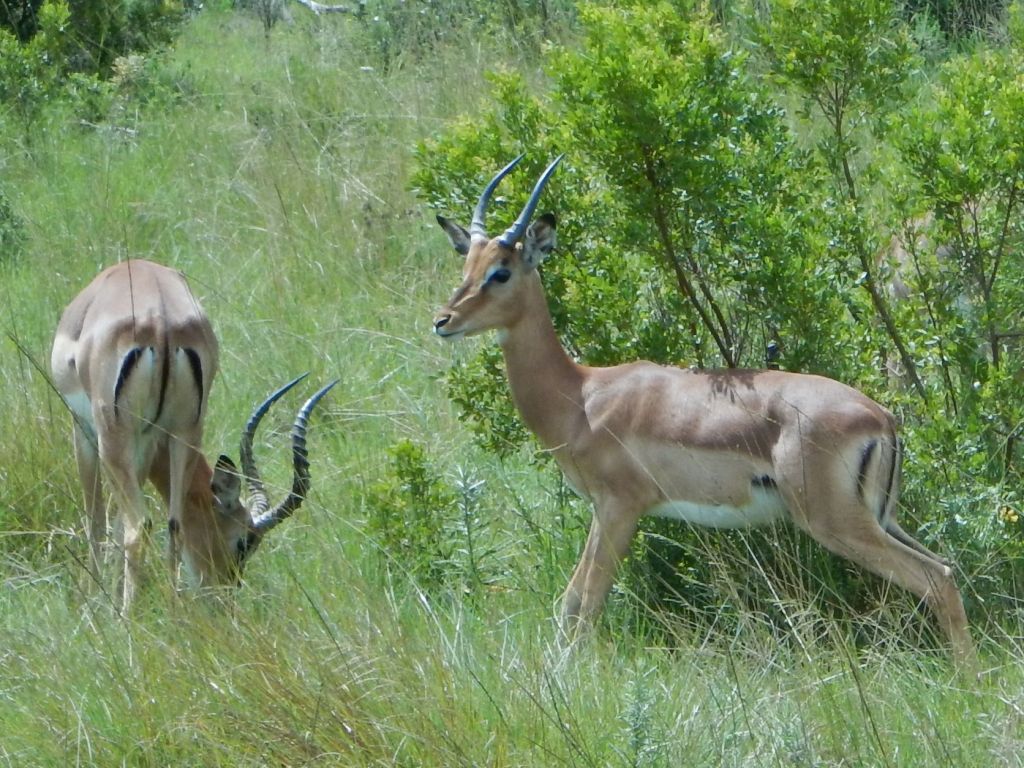
We came across giraffes, 2 rhinos, elephants and their baby, kudzu, many antelope, hippo, zebras and warthogs.  It is absolutely thrilling to be in their natural environment. 

The savannahs offered such panoramic views.  The almost 70-degree temperature played to our advantage in that the animals were more active and out in the open. 

Returning to the Lodge we were treated to song and dance of the Xhosa natives, (of which I was reluctantly recruited!) with a hearty 3pm buffet that followed. 

Xhosa Natives (less one)

It was quite a packed 8-hour tour.  We made it back to the ship for last call aboard for passengers and crew, then headed straight to the sail away celebration already in progress. Thank goodness for a restful sea day before we reach Cape Town.

As we near Cape Town, South Africa, we leave the Indian Ocean and enter the Atlantic Ocean waters.  It’s such a pleasure to have two days to explore this cosmopolitan city with its iconic backdrop. On our first day, we are blessed with mainly clear skies in the mid-70’s…perfect for visiting Table Mountain, one of the seven natural wonders in the world.

Table Mountain

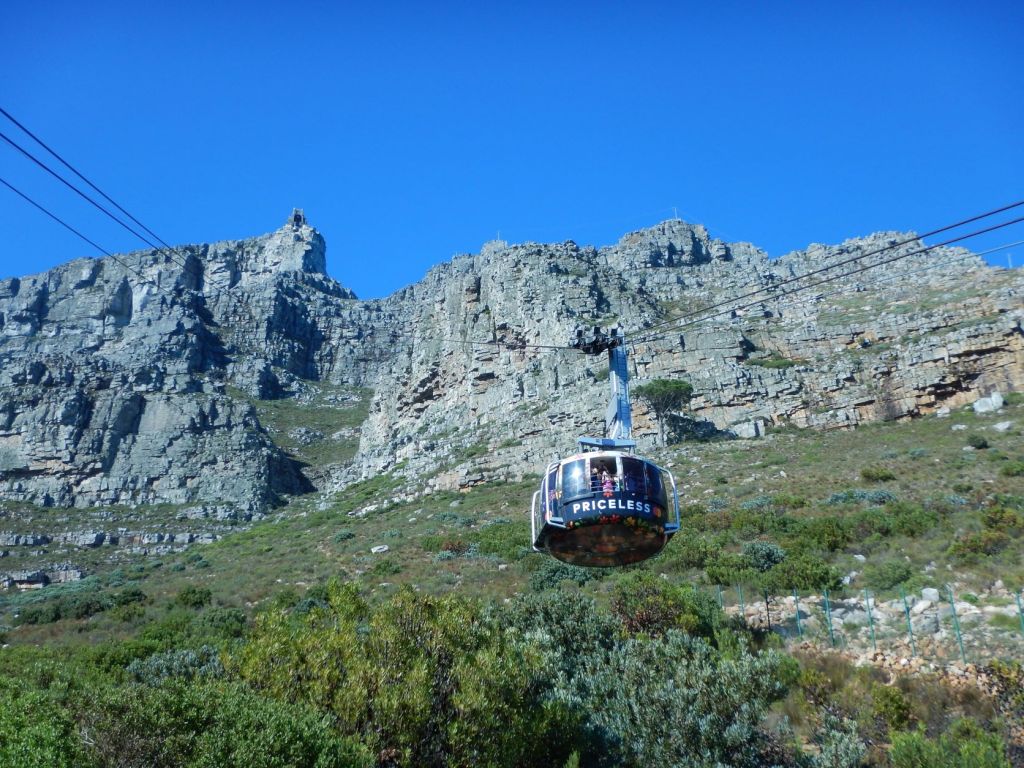
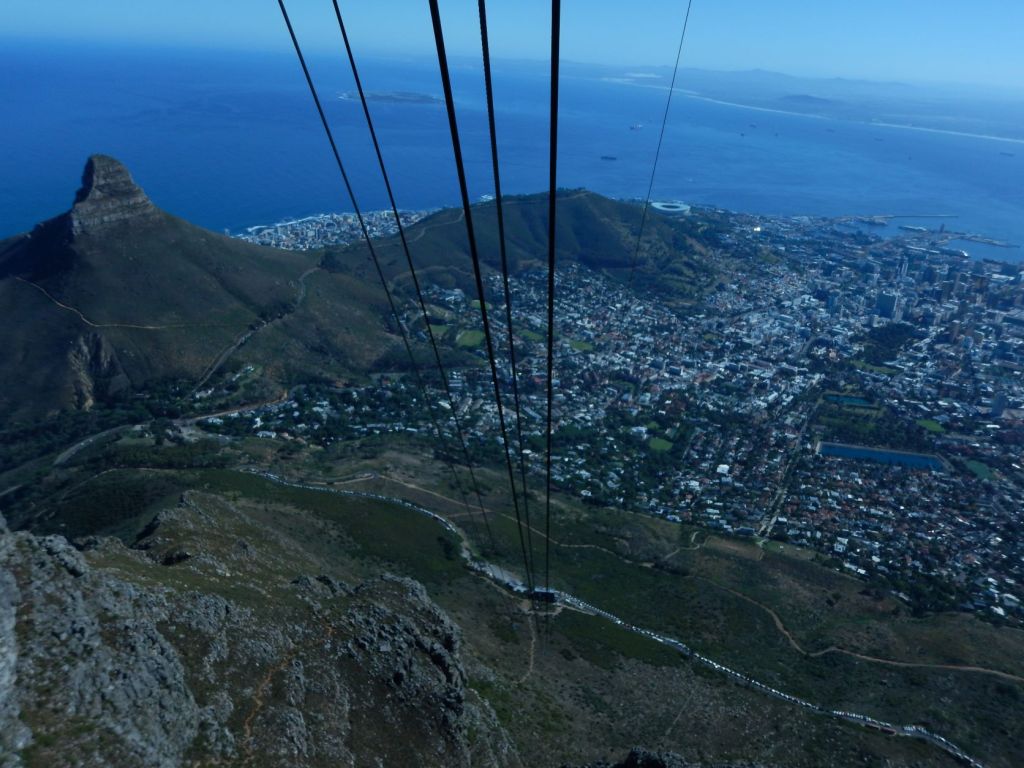
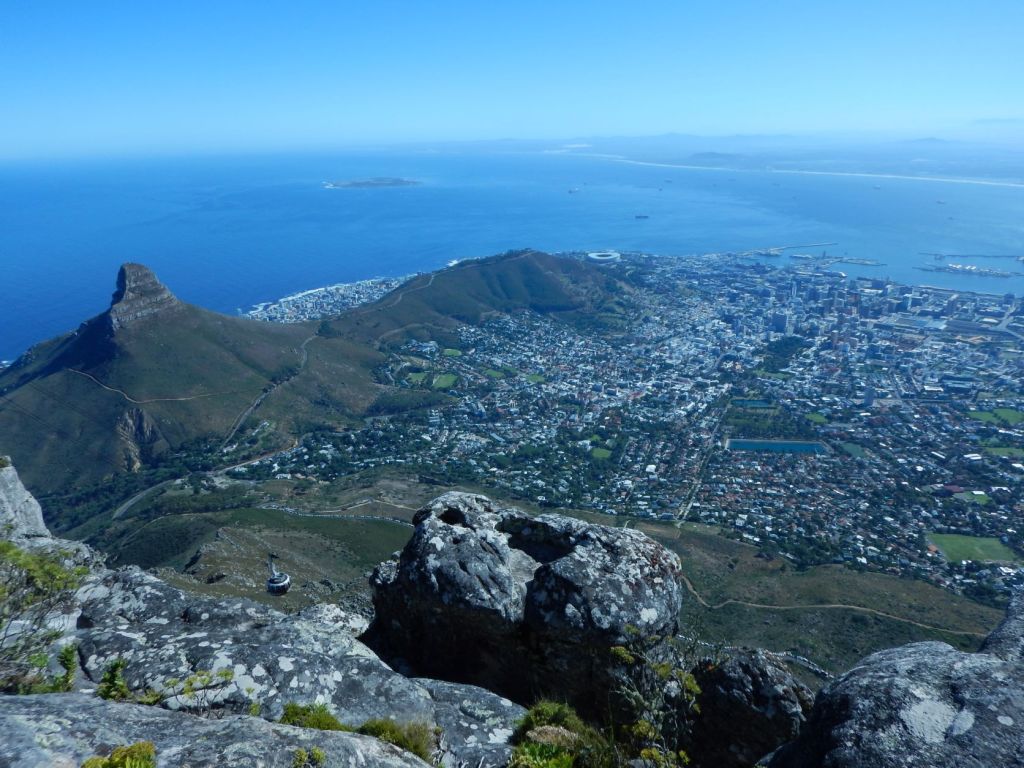
We boarded a cable car that rotates 360 degrees during the 5 minutes it takes to reach the top.  At the height of 3,560 feet, the view of Cape Town beneath us is breathtaking.   

We know how lucky we are, as clouds often completely obscure the entire mountain.  Locals refer to that as the Table Cloth.   But today we are treated to only the occasional waterfalling clouds over the ragged cliff edge which in itself is very mesmerizing.   

The view in every direction is quite stunning and we spend more than an hour following the circular pathway of the rocky top with sparse, stubborn vegetation. 

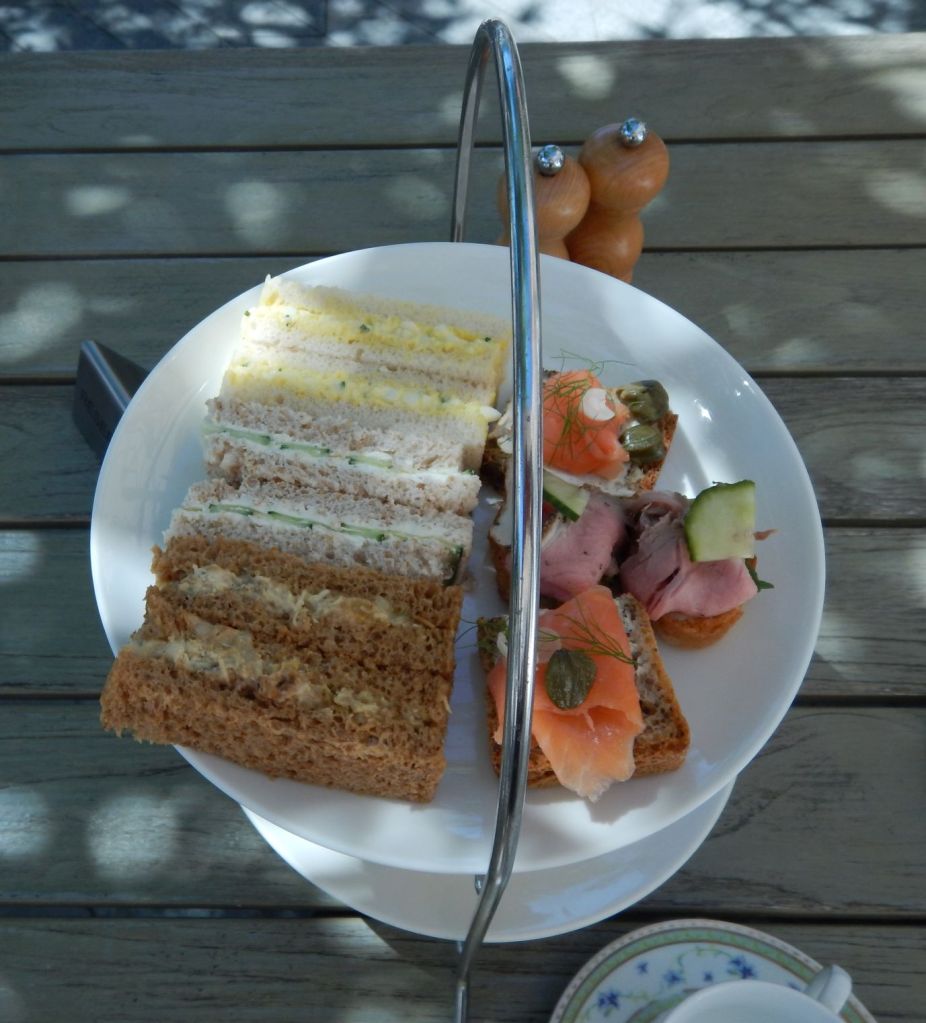
Coming back down from the mountain, our next stop is the exquisite Mount Nelson Hotel. Established in 1899, it is known for its High Tea.  And now we know it too…a 3-course, truly scrumptious and elaborate presentation of savories and sweets.  Oh, and tea!  Their own blends, of course. 

Day 2 in Cape Town finds us riding the Hop On/Hop Off bus for city sightseeing, as well as visiting the 330-year-old Constantia Groot Winery, 330 year old winery.  

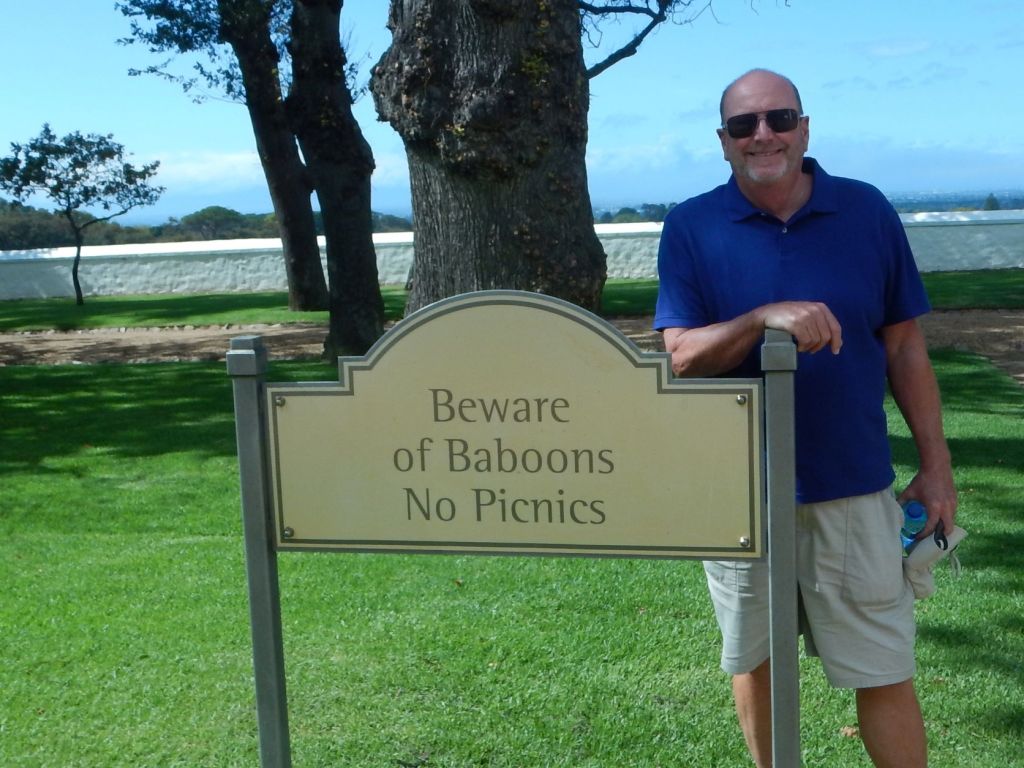
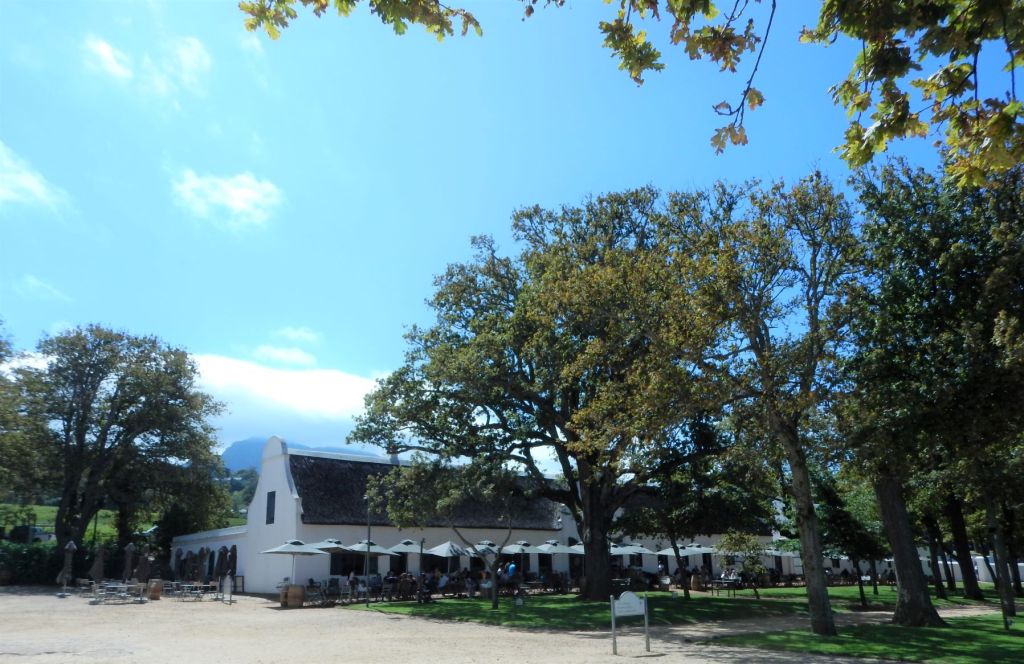
After the tour, we enjoy a wonderful lunch on their beautiful grounds overlooking the vineyards.  On the menu, was a delicious local fish called Kingklip, a member of the cusk eel family. 

Leaving Cape Town, the Zuiderdam has now travelled 19,613 nautical miles.

Table Mountain Contemplation

Lüderitz:   This old German town lies on the coast of southern Namibia, founded in 1883 after Adolf Lüderitz bought the land from the local Nama chief Joseph Frederiks. In 1909 after the discovery of diamonds in the area, the town grew very fast. As a result, the large majority of their old buildings look like they were plopped down from the Alps into the desert.

Lüderitz street leading up to the church

Ashore around 9am, the town of 13,000 people is quiet with almost deserted streets.  It feels surreal, little like an abandoned movie set. 

The few main streets are paved, but side streets are all a sandy dirt.   At the edge of town, we could see the low, one-story primary school and hear children singing; their voices hanging in the hot, dry stillness.   

The Lüderitz sign mocks the more famous Hollywood sign.  Sand and rock are everywhere.

The art nouveau Goerke Haus is open for touring and we marvel at how well-preserved the home and it’s furnishings are.  The founding family lived in the house only 2 years. It is now still owned by the diamond company. 

Goerke Haus

Back onto the main street that borders the shore, we sought sodas and a noon snack at the Portuguese Fish Restaurant.  While waiting for our grilled oysters, we chatted with a South African couple who were seated at an adjacent table.  She was in Namibia to retrieve a copy of her birth certificate so that she could file for dual citizenship (Namibia and South Africa).   In general, the locals were all extremely friendly and eager to chat; curious about us, our ship.  Lüderitz does not receive many cruise ships and they are quite thrilled to have visitors.  

Heading northward up the Namibian coast, our next port is Walvis Bay. Just beyond the port gates, awaits the throngs of hustling locals. 

Outside the port gate, hawkers await.

Yes, the usual characters are on hand; taxis selling tours, handicraft makers trying to convince you to buy their wood carvings, brightly colored fabric goods, baskets, all spread out on tarps laying on the ground.  But for the first time, we also witnessed bare-breasted African Bush women, tinted head to toe by the reddish clay they use to adorn themselves. 

We quickly push through the expanse of hawkers barking their offers and turn the corner to a quiet street that paralleled the coast.  The neighborhood homes were tidy. 

Walvis Bay waterfront

We pass open sports fields and soon come upon a few seaside restaurants and the Walvis Bay Yacht Club.  

While sipping on a cappuccino there, we strike up a conversation with Theo, the former commodore.   He’s a warm and engaging man, well-traveled with more than 5,000 scuba dives logged.  He is 4th generation Namibian and offers some directional recommendations for our walkabout.   By the time coffees were finished, our mutual rapport lent to our returning later in the afternoon for a cold beverage. 

At Walvis Bay Yacht Club with shipmate friends, and former Commodore Theo (back left)

But first, we ended up walking through town and a few suburbs until we reached the Mall, where our ships shuttle buses would give us a ride back.  It ended up being a walk of just over 7 miles. 

Luanda, Angola   The ships Cruise Director hosts “Port Talks” a few days in advance of each port we visit.  They are informative presentations that provide map locations of where the ship will be moored, interesting places to visit, how to get around, currency information, expected weather forecast, places to find free Wi-Fi and the like.   But when it came to Luanda, it proved challenging to speak about much else other than personal safety, as well as informing us that we would be shuttled to the patrolled town square where we would remain to shop handicrafts from locals. Speaking of currency, conversion here is $1 USD equals $504.80 Angolan Kwanza.

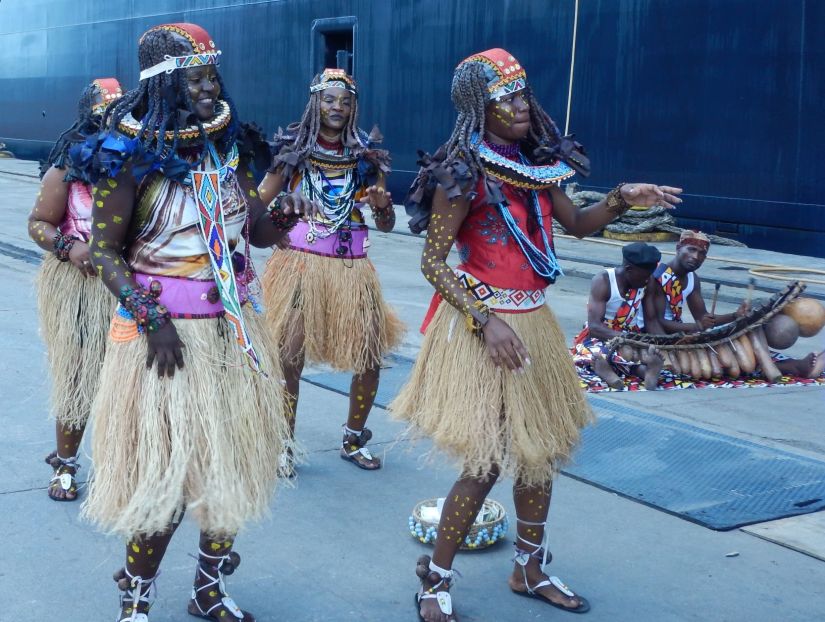
Local Angolan costumes and dance

Beyond the equator northward, we reach Takoradi, Ghana. At first glance some folks may be put off by its harsh environment, however while walking around its massive, circular market, we found the friendliest people. 

For our dear crew members, we purchased about 4 cups of hot peppers and about 3 pounds of avocados for $5.  

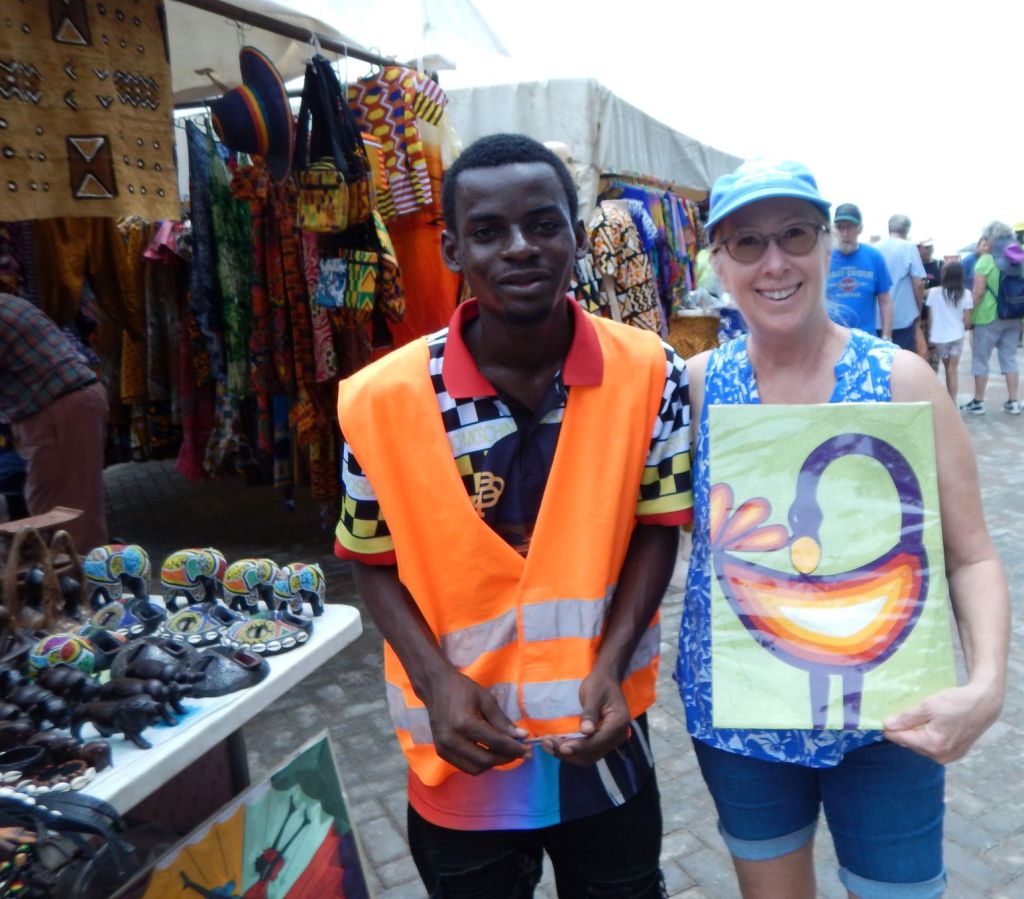
And in the the most unlikely Menswear store found there, Tom bought a bow tie, matching pocket square and cufflinks for a whopping $8. Back on the pier, I bought colored string artwork from artist Ajud.

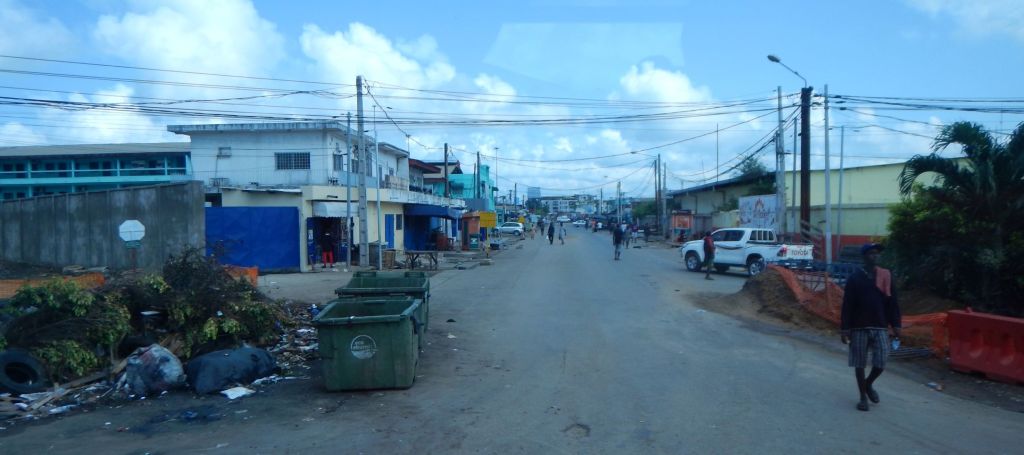
Abidjan, Ivory Coast   Abidjan is “categorized by a high level of industrialization and urbanization” according to Wikipedia. The Zuiderdam pulls into the sprawling port where oil refineries and shanty towns can be seen for miles. 

Abidjan shoreline and shanty towns

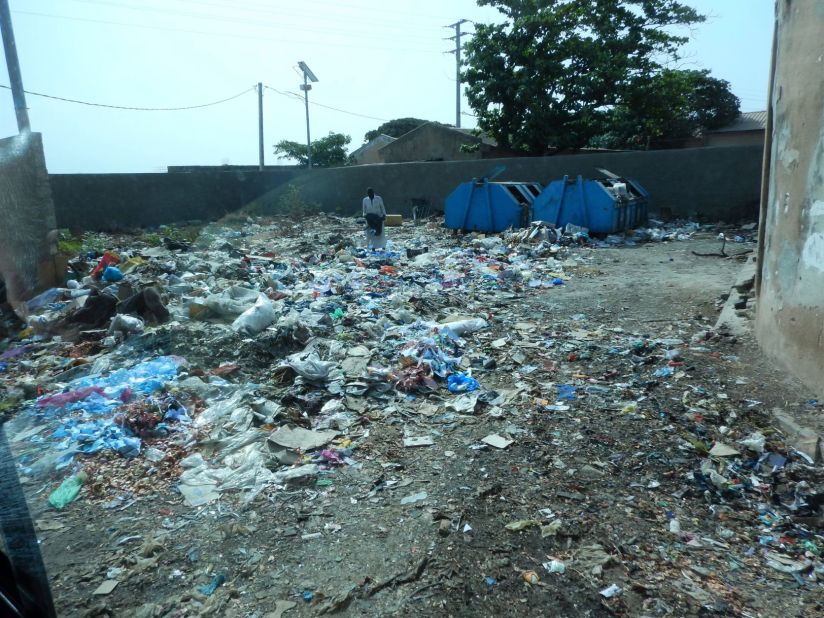
Our next 3 ports of Africa are very poor, with battered infrastructures, resulting in dangerous living conditions. The exchange rate of the West African Franc is $616.36 to $1.00 USD.

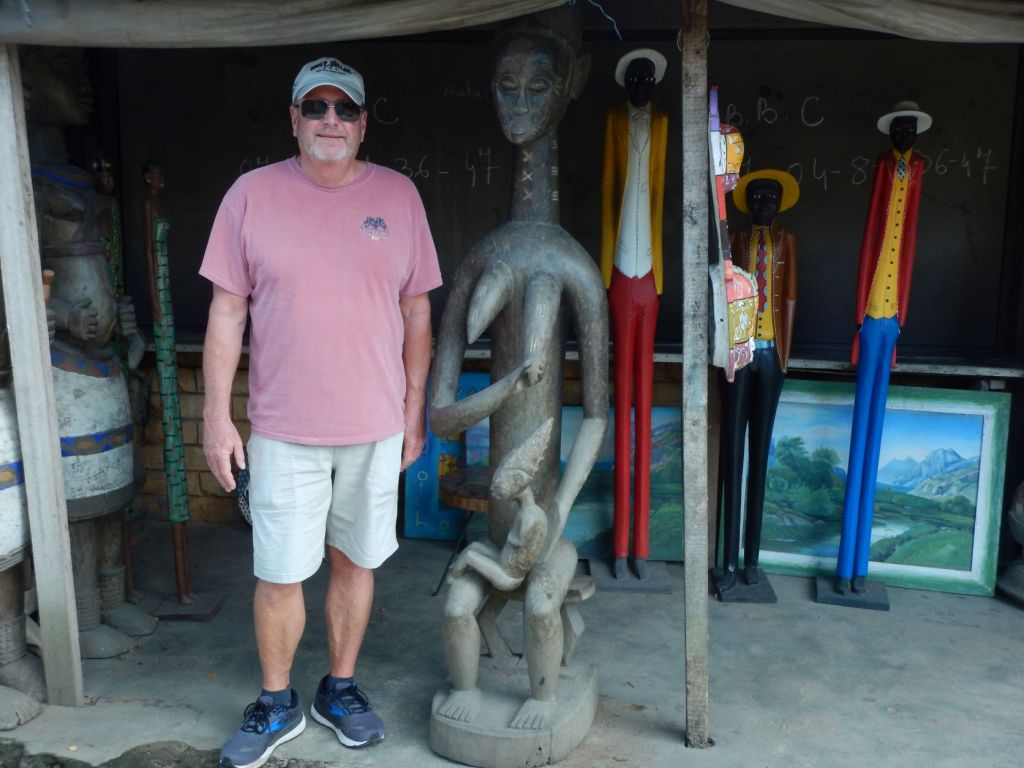
Due to heightened security, the port arranged the opening of a very controlled, claustrophobic crafts market for the passengers.

The art was interesting, but our visit was short.

Arriving to the shores of The Gambia demonstrates another example of the lack of infrastructure here. It comes in the shape of a “power ship” anchored along the city of Banjul’s shoreline. We’ve seen a few of these in this corner of the world. The 36 MW Karadeniz Powership Koray Bey uses low Sulphur Heavy Fuel Oil (HFO) to generate electricity for the area.

Power Ship

We hope that the suddenly mandatory $155 visa per person for our 8-hour stay helps in some way. Some think it was pure extortion. A small local shuttle bus bounced us on dusty, dirty roads to a handicrafts market. Perhaps it was the nearly 100-degree heat and humidity or maybe it was the other conditions present, but most passengers (including us) never got off the shuttle, using it as a means for a quick but poignant tour.

In the morning of our arrival to Dakar, Senegal, the Captain announced that our visit had now been changed to be a service call only, due to Civil unrest. Local and World News coverage reported that local police were using tear gas and stun grenades to disperse political protesters.   No one would be going ashore.  The ship awaited eight 40-foot containers that never arrived. Apparently, authorities were trying to extort money for their arrival. Holland America Line said they would not engage in bribery. Our ship sailed in the morning, for the Canary Islands. More to come…. 

Reflecting on our fascinating time in Africa, I recently read this quote by Mae Chevrette:

“It is in all of us to defy expectations, to go into the world and to be brave, and to want, to need, to hunger for adventures. To embrace the chance and risk so that we may breathe and know what it is to be free.”

2023 World Cruise, Cruising, Travelogues

Leg 5 – Indian Ocean Islands & Cyclone Season

Since leaving Perth, Australia, our 3,900-mile westward track crosses the vast Indian Ocean during Cyclone Season.  We were fortunate that Cyclone Enala passed north of our route, but a more intense and exceptionally long-lived Cyclone Freddy has been churning for 5 weeks. Aboard the Zuiderdam, there is much conjecture of whether we will/will not be able to visit Madagascar in a weeks’ time.  The captain has been closely monitoring Freddy and providing daily updates. In the meantime, we have two ports on our schedule before we reach Madagascar: the islands of Mauritius and Reunion.

The Republic of Mauritius is an almost 800 square mile island in the Indian Ocean and the only known habitat of the extinct dodo, a flightless bird.  

Mauritius

Located 1200 nautical miles southeast of the African continent, it has a predominately West Indian and African influence.  English is the predominate language, but Creole and French are still spoken. Their most common places of worship are ornately decorated Hindu temples, but there are also Christian churches and Muslim mosques. 

Hindu Temples

Tourism may be their coastal source of economy, but textiles and sugar support the rest of the island.  It’s a volcanic island with dramatic, steep mountains.  The volcanic rock is widely used; pulverized and reconstituted as building and street construction material. 

We dock in Port Louie, an industrial port and a popular mooring field for at least 40 large Chinese fishing vessels, all rafted together.  

Port Louis, Mauritius

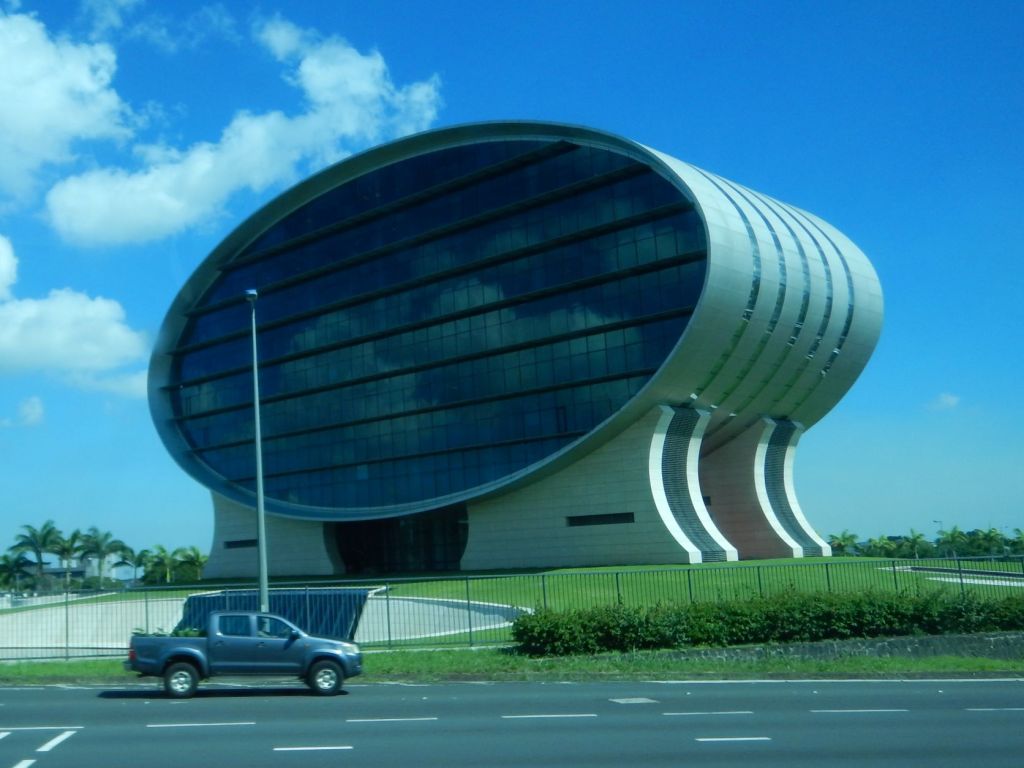
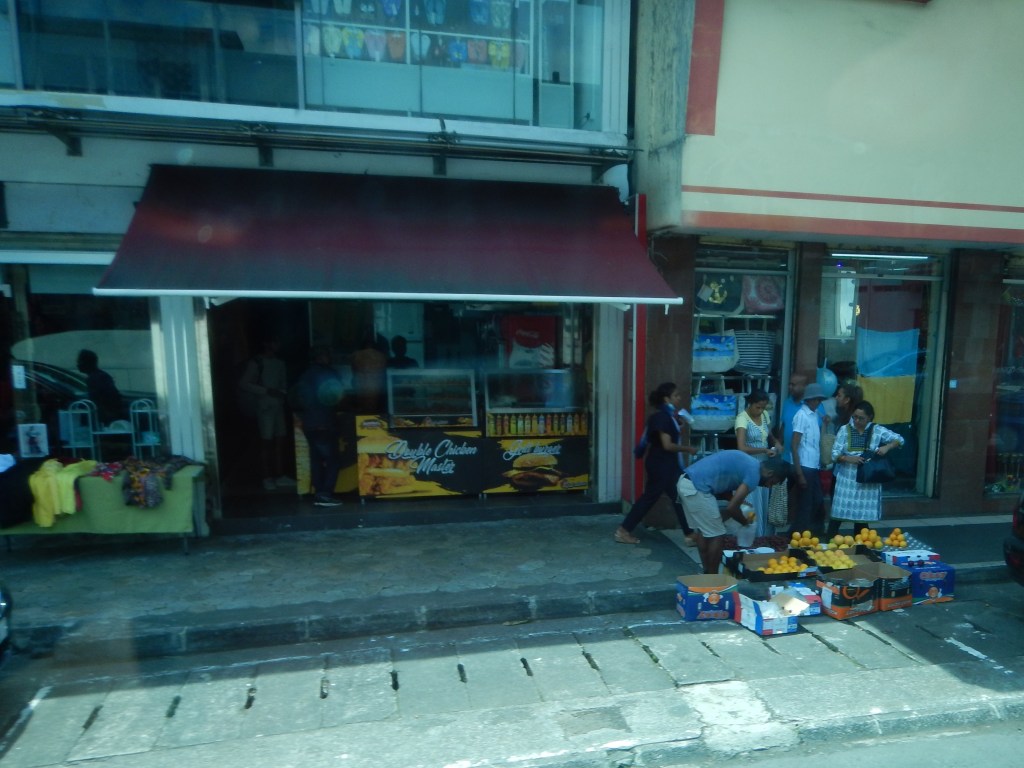
While the island boasts magnificent beaches, posh resorts and scuba diving, we sought to go see the ‘real life’ Mauritius first, since we’ve never visited here.   It’s a wild mix of battered, run-down buildings as well as newer districts with modern high rises. The most unique was a bank building that may have found its inspiration from an old cyclops horror movie.

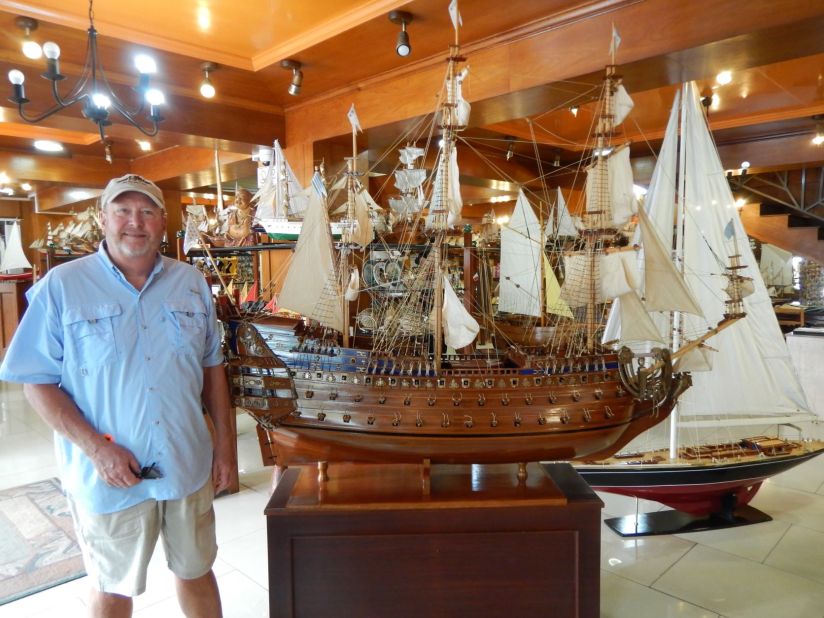
We’ll begin 30 minutes away in Curepipe, the second largest city.  The drive and views from its elevation give us a panoramic view of their environment, tempo and livelihood of life on the island. For instance, they are known for their intricate and sometimes elaborate model ship building.  Diamond jewelry factories are also found here.

Travellers can learn a lot about any culture by visiting their central market.  Always fascinating.

Central Market

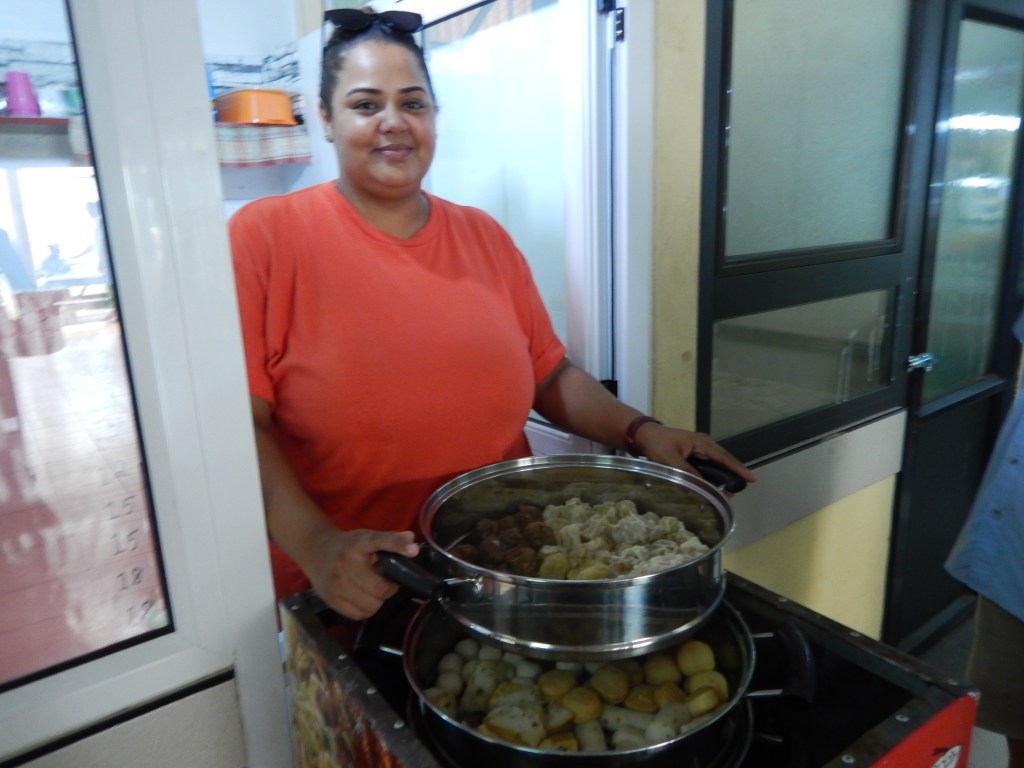
Common local snacks are bhujia, a crunchy and crispy deep-fried Indian savory dry snack made by using boiled grated potatoes, chickpea flour, and essential spices.  Also popular are bouchon dumplings, typically pork in wonton wrappers.  

The market offers cooked foods, produce, clothing, shoes, backpacks, fabric, woven goods and jewelry, all from tightly packed stalls.

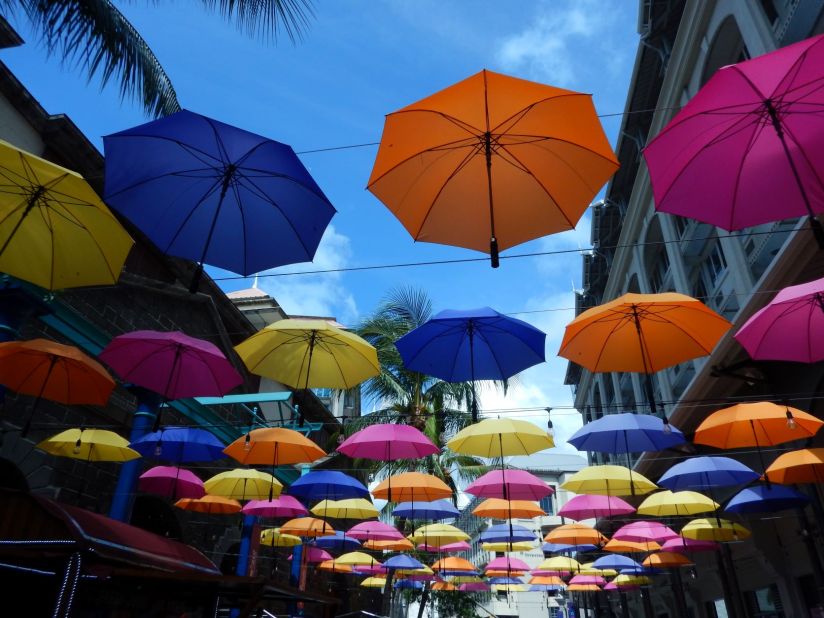
In stark contrast to the central market, the modern Caudan Waterfront shopping plaza back in Port Louis is filled with cafes and restaurants, including a Pizza Hut.

Caudan Waterfront

After a long day visiting Mauritius, Zuiderdam casts off her lines and we settled into a lounge chair on Deck 3 to watch our sunset departure.  With full bellies from dinner, we remained until the moon had risen, listening to the swish of the wake against her hull before retiring to our cabin.  We will push 175 miles through the night and awaken as we approach Reunion Island.

Sunset while departing Mauritius

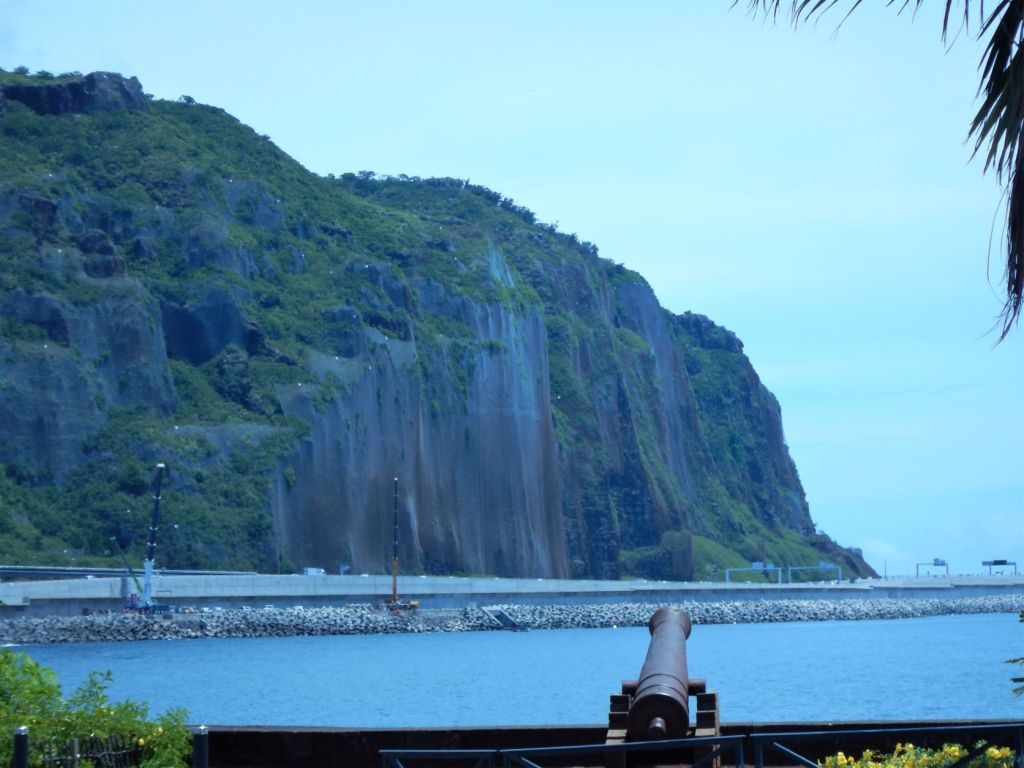
Once alongside the pier in La Possession, Reunion Island and the ship is cleared by Customs, we proceed to a shuttle bus that will take us 12 kilometers to the neighboring town of Saint Denis.  Part of which is a 7-kilometer bridge, which appears to have been built within the last 10 years.  Impressively engineered, as well as the levees that protect it. 

Reunion is part of the European Union and while considered a sister island to Mauritius, it couldn’t be more different.  It’s cleaner for one and appears to have a more stable infrastructure. 

Ancien Hotel de Ville & Monument aux Morts

Many well-preserved historic buildings, beautifully shaded squares and parks, central market, pedestrian mall of several blocks with many shoe, clothing and jewelry shops, cafes and restaurants.  

Saint Denis street

We snacked on a crusty French baguette sandwich and bought some lovely cheese from a local la fromagerie.

Our 5-mile walk gave us a good feel for this quaint town on lovely Reunion Island. Someday, we may have to visit again to explore the rest of this volcanic island which is 40% national park.

Unfortunately, Cyclone Freddy dashed our hopes of visiting Madagascar. Forecasters have been astonished by Freddy’s persistence and lack of movement. Cyclone Freddy has earned the designation as both the longest-lasting and highest-ACE-producing (Accumulated Cyclone Energy) tropical cyclone ever recorded worldwide. The captain altered our course southward to avoid the highest winds and seas. The yellow boat in the chart below represented our original intended course around the southern tip of Madagascar, while the red boat shows our altered course. We gave Freddy a wide berth, and therefore, felt only moderate winds and seas.

Cyclone Freddy, off the southwestern coast of Madagascar

And so, we set a new course for Maputo, Mozambique on the African continent. More to come…
2023 World Cruise, Cruising, Travelogues

Leg 4: Australia & Tasmania

Welcome to Australia!   The largest island and the smallest continent.

Zuiderdam sailed three days from Wellington, New Zealand to Sydney, Australia.  It was still dark when we maneuvered into Sydney Harbor, past the Opera House and beneath the Harbor Bridge.  A stunning sight at any hour.  We are so glad to be here for two days. 

Since having laser surgery 3 weeks ago in Tahiti to repair a torn retina, I’ve been quite anxious to receive my follow up appointment here in Sydney to confirm that all is well.    As soon as the authorities cleared our ship’s arrival, we made our way through customs and immigration, then straight out to the shuttle buses that take us from the White Bay Cruise Terminal, over the Anzac Bridge and into downtown Sydney, dropping us off in Darling Harbor.   Armed with the address of the ophthalmologist office, we head uphill to Macquarie Street, about a 20-minute walk.  It’s an overcast cool morning and we arrive at their offices in Park House at 10am. Within 40 minutes, I had my eyes dilated and awaited The Professor, as he was referred to by staff.  Dr. Gilles has almost an entire alphabet behind his name proclaiming all his accomplishments.  All I needed to know was that he was a retinal specialist, who was about to give my eyes a thorough going over.  He determined that all was in order, the laser surgery had sealed well and that I should not be concerned for the rest of the trip.  The floaters, however, would likely remain.  I breathed an enormous sigh of relief at this fantastic news!

Thanks to Patrick A. for sharing this cartoon!

As we left the doctor’s office, the wind picks up and rain moves in.  We sought refuge in the conveniently discovered Bavarian Pub for celebration beers and traditional brotzeitteller (luncheon plate), complete with leberwurst, ham, brie, pickles, radishes, mustard and crusty bread.  Rotkraut (red cabbage) on the side.  German cuisine is comfort food to me and seemed just what the doctor ordered, as it poured outside our window seat. 

Plates emptied, glasses drained, rain abated, and dilated eyes returning to normal, we head back into the wet city streets.   We strolled back to the ship for one of the best naps I’ve had in a month, not having to worry about my eyeballs anymore!  Yeah, maybe the German beer and food helped too.

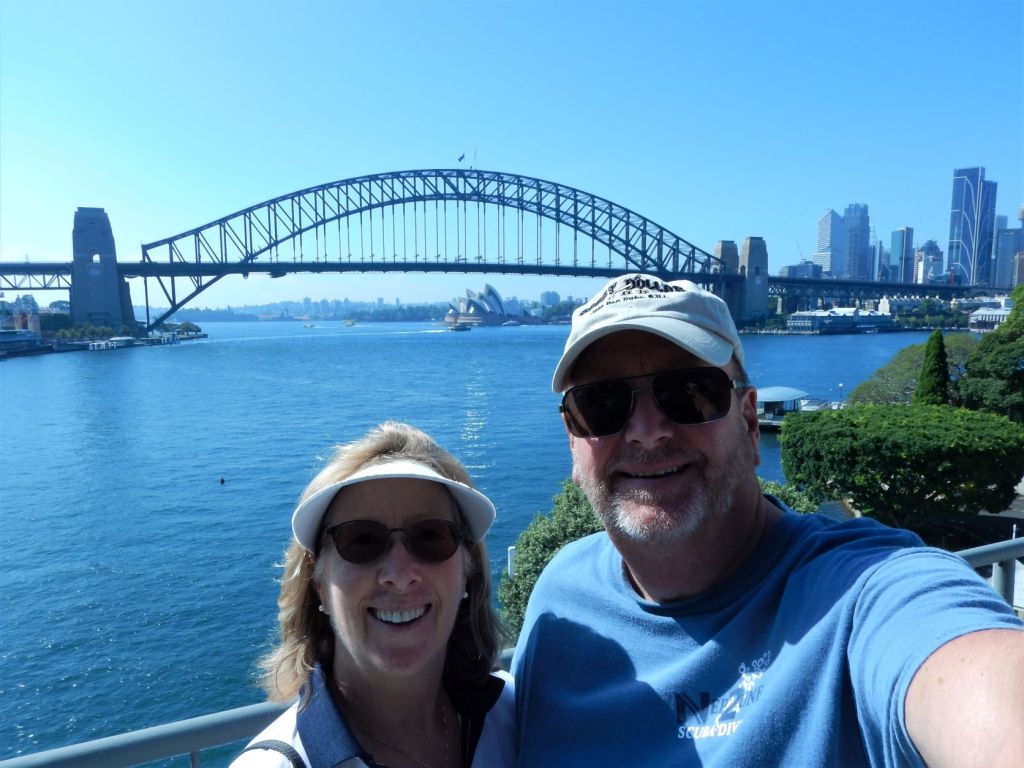
Abundant sunshine fills the morning sky as we head out to explore Day 2 in Sydney. Having visited the Opera House on a previous trip, we head towards North Sydney to walk the neighborhood, then over the Harbour Bridge, through The Rocks, back to Darling Harbor.    A fun day of sightseeing, café rests and chats with locals along the way.    

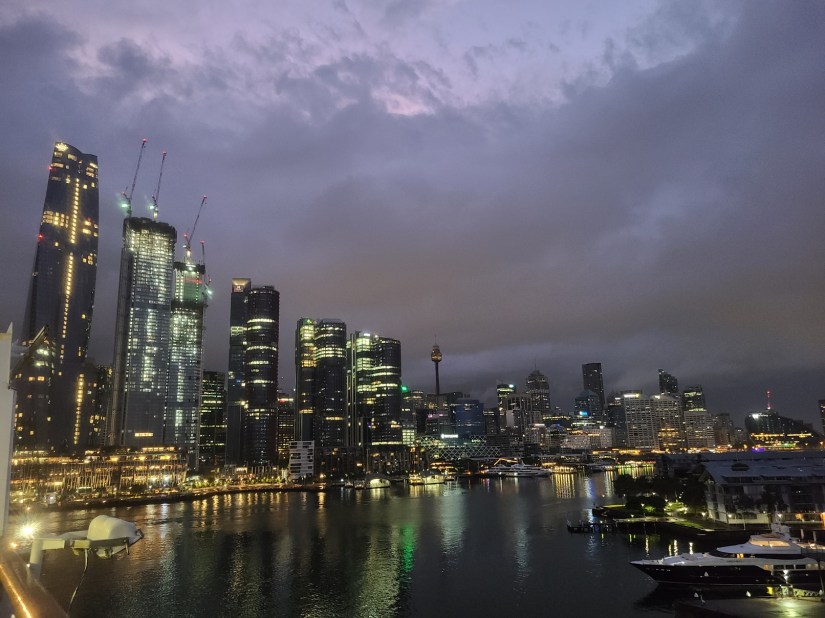
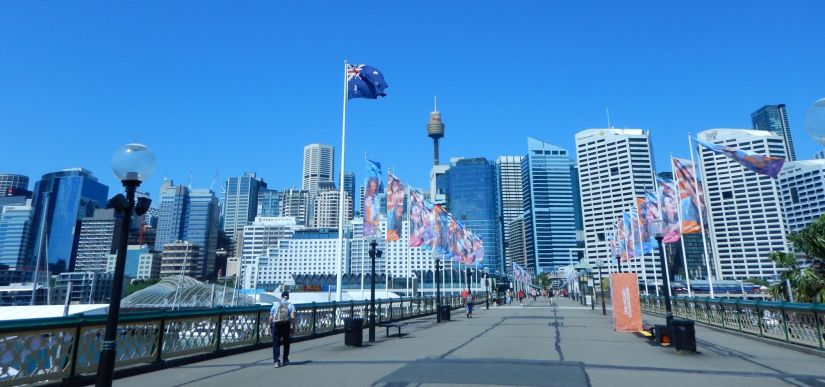
Darling Harbour

A fantastic sail-away with great weather and a festive crowd listening to live music on the aft deck.

Everyone stayed well after sunset, when a thunderstorm chases us all inside for a late dinner and finally, to bed after a long day. 

Meanwhile, the Zuiderdam strikes out into the night for our next port of call.  Since leaving Ft. Lauderdale, we’ve now sailed 10,737 nautical miles.

It’s early morning when we anchor.  The placid water is like a mirror, reflecting the hills of tall trees.  Pines scent the air.  It’s quiet.  You could almost imaging yourself on an inland lake in Minnesota.  But no…Welcome to Tasmania.

We step ashore into the beautiful Port Arthur’s Historical site.  In contrast to its serenity, this place also has a dark past, as unfortunate inmates found themselves here in the 1800’s.  Now on the World Heritage List, visitors may wander the penal colony ruins.  

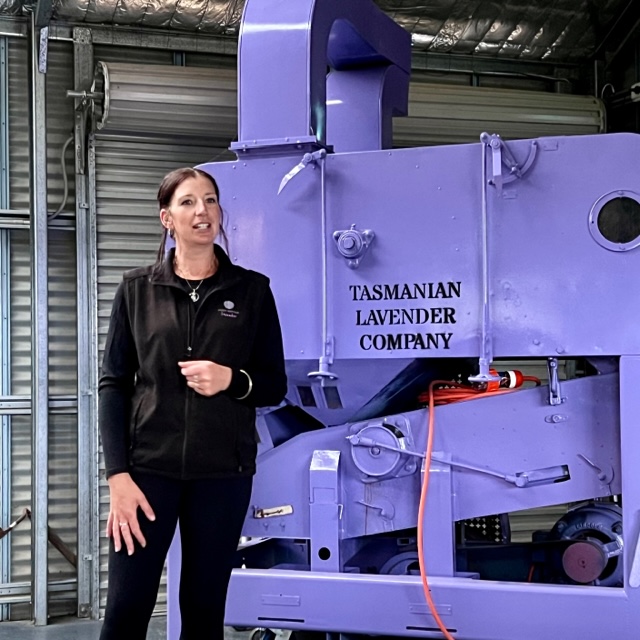
Aside from being known for the infamous Tasmanian Devil, did you know that Tasmania is also home to lavender and wineries? We toured a lovely Lavender Farm and learned about the cultivation, harvesting and production of the fragrant flower into their many products, including soap and sachets.  We were also treated to a delicious tea where scones were served with lavender butter, cream and jam.  Even lavender chocolate!

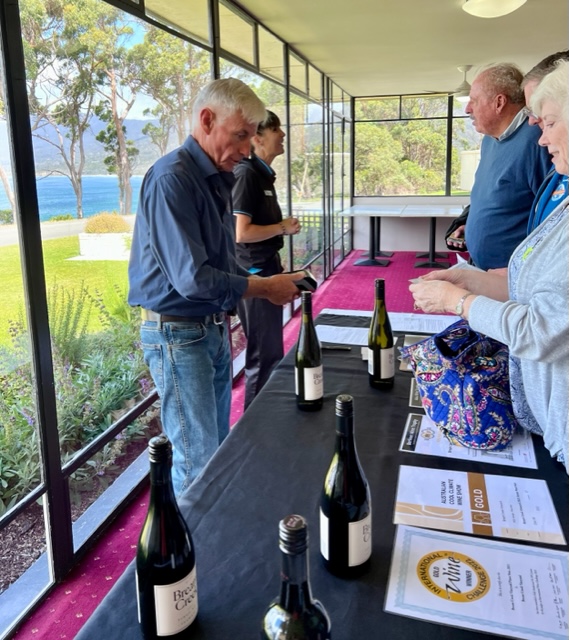
The owner of Bream Creek Winery was also on hand to tell us about the local varietals.  The Tasmanian’s east coast soil and cool climate are perfect conditions for crisp white wines and pinot noir. 

Lavender treats!

Blustery winds kick up as we arrived to see the tessellated pavement, a natural wonder named for the tiled-like appearance of the rocks along the water.  Made up mostly of siltstone that formed about 300 million years ago, the shoreline rocks were fractured by the movement of the Earth and resulted in what is called jointing.  Jointing itself is not incredibly uncommon, but the presence of salt crystals and consistent erosion by the Tasman Sea’s waves and sediment deepened the pattern to give it its startling appearance.  

Tessellated Pavement: A natural wonder

By our afternoon departure, the sun returns and we are blessed with some gorgeous scenic cruising around to the south and west, onward to Cape Raoul for the stunning views of 1,000 foot cliffs eroded by time, wind and waves.

Special thanks/photo credit go to J. Johnston for her photos of Port Arthur. Our camera was on the fritz!

From Port Arthur, it’s only a few hours sail into Hobart, Tasmania and we dock at 8pm.  It just so happens to be the Australian Wooden Boat Festival this weekend, and we are the beneficiaries of a spectacular display of tall ships, schooners, skiffs and dinghy’s.  Some are over 100 years old, some brand new, and everything else in between. 

As Zuiderdam will overnight here, we have the chance to walk the docks after dinner.  It’s no secret that boaters are a friendly sort.  And as such, it’s no surprise that owner Tony Lovely and his crew invite us aboard after we were oogle-ing his trawler from the dock.  The five of us chew on sea stories for an hour or more, before we bid them goodnight.  They would be heading back to Brisbane the next day. 

Even though it’s a Sunday night, tomorrow is a national holiday here, which gives festival-goers the stamina to continue celebrating.   By the time we strolled into the fest pavilion, the rock band, food trucks, and local breweries were all going strong to entertain attendees.  

On Day 2 of our visit, we meandered more docks and displays of the Wooden Boat Festival.  The varnished surfaces of all the various wooden watercraft were gleaming in the warm sunshine. 

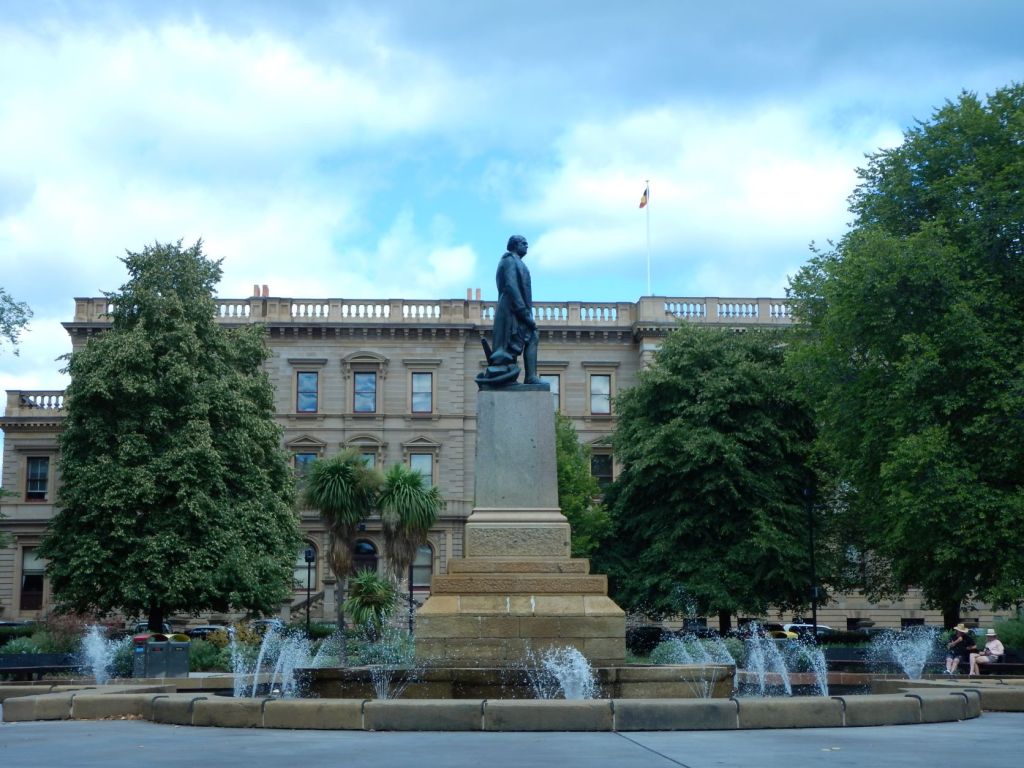
Further beyond the bustling waterfront, we discover that Hobart’s spotless downtown shines with interesting architecture, parks and places of interest.  Overall, Tasmania was such a delightful surprise!

After one sea day of 768 miles, we arrive in Adelaide, South Australia mid-afternoon.  Since we are not leaving here until 10:30pm tomorrow night, we have plenty of time in this city of 1.2 million people.

A 40-minute train ride takes us from the industrial Outer Harbor and transitions through a variety of neighborhood styles, suburbs, shopping areas, corporate parks.

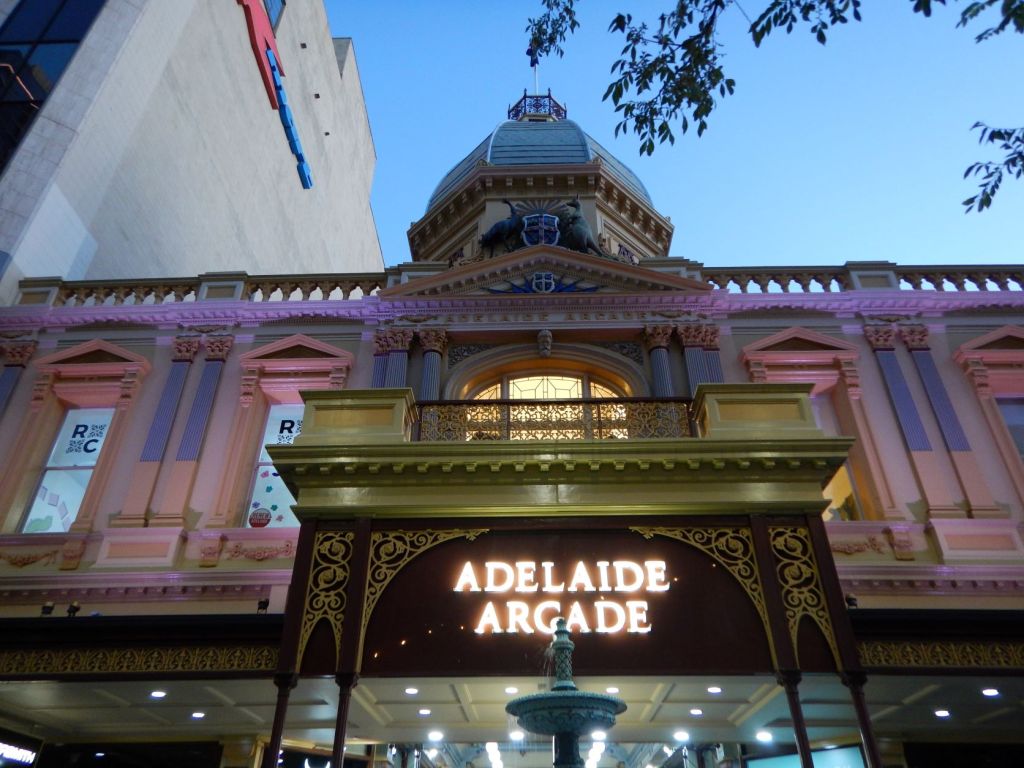
As we pull into the downtown Adelaide Railway Station, we are surrounded by the grand architecture that this city is known for.  Each building is more stunning than the one before, both inside and out. 

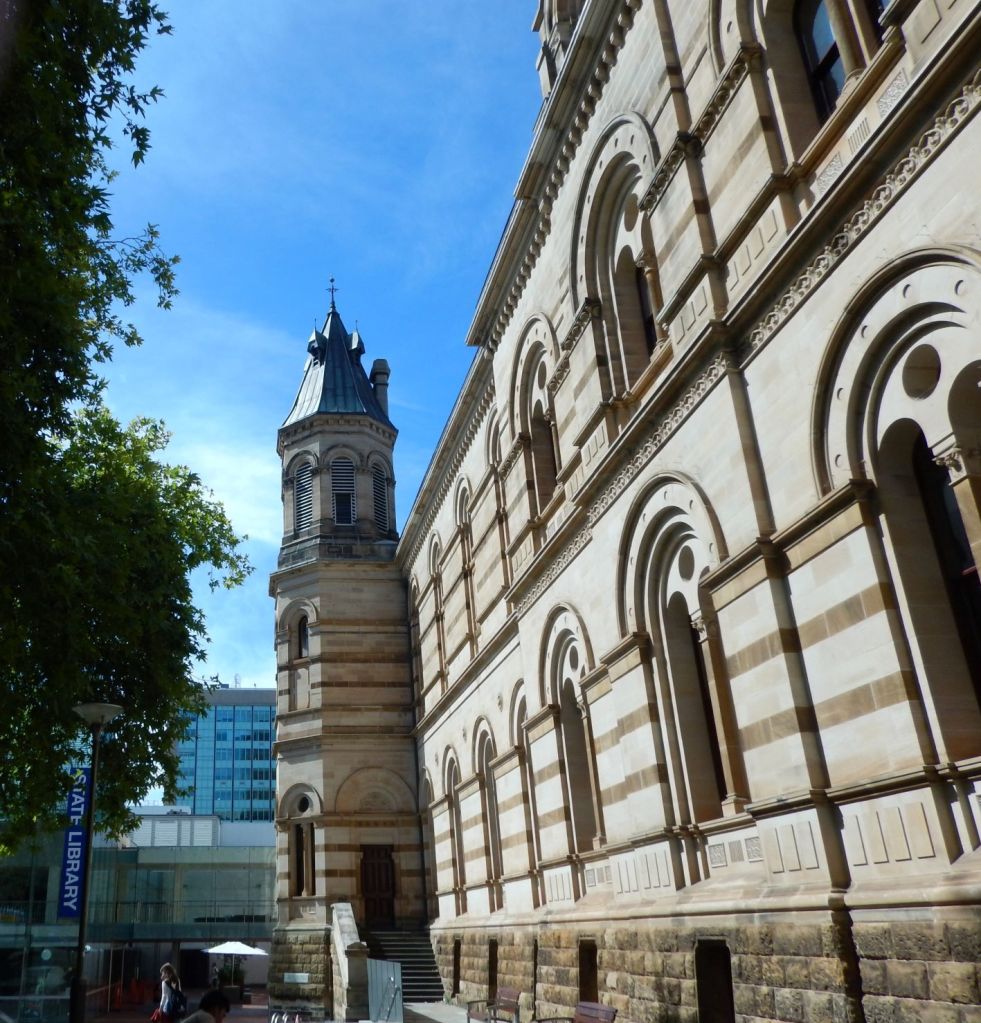
On the wide, tree-lined boulevard of North Terrace, we spent the afternoon between the State Library, the South Australian Museum, and the Art Gallery.  It’s a lovely, sunny day of 85-degrees.

The Art Gallery of South Australia

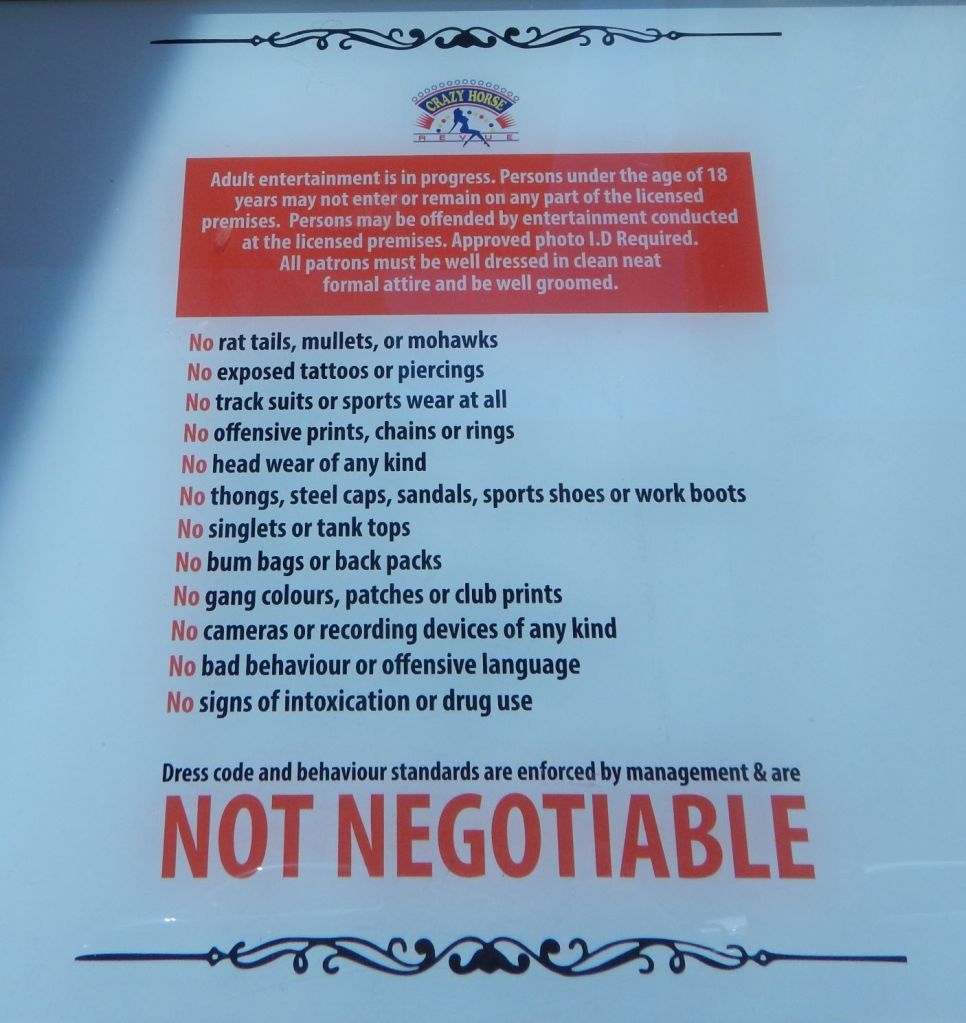
It’s always a safe bet to ask a college student where the best pizza might be found.  She replied, “Oh you have an accent….where are you from?!”  After exchanging pleasantries, she indeed directed us to a fabulous sidewalk pizza restaurant a few blocks away, where we could sit and watch the bustle of Adelaide.  Along the way, there are always interesting signs to read:

On Day 2, we strike out in the morning to get a “flat white” coffee. Supposedly originating in Australia in the 1980’s, customers were tired of fluffy cappuccinos and seeking an espresso drink with thinner milk and less foam. Popular with good reason!

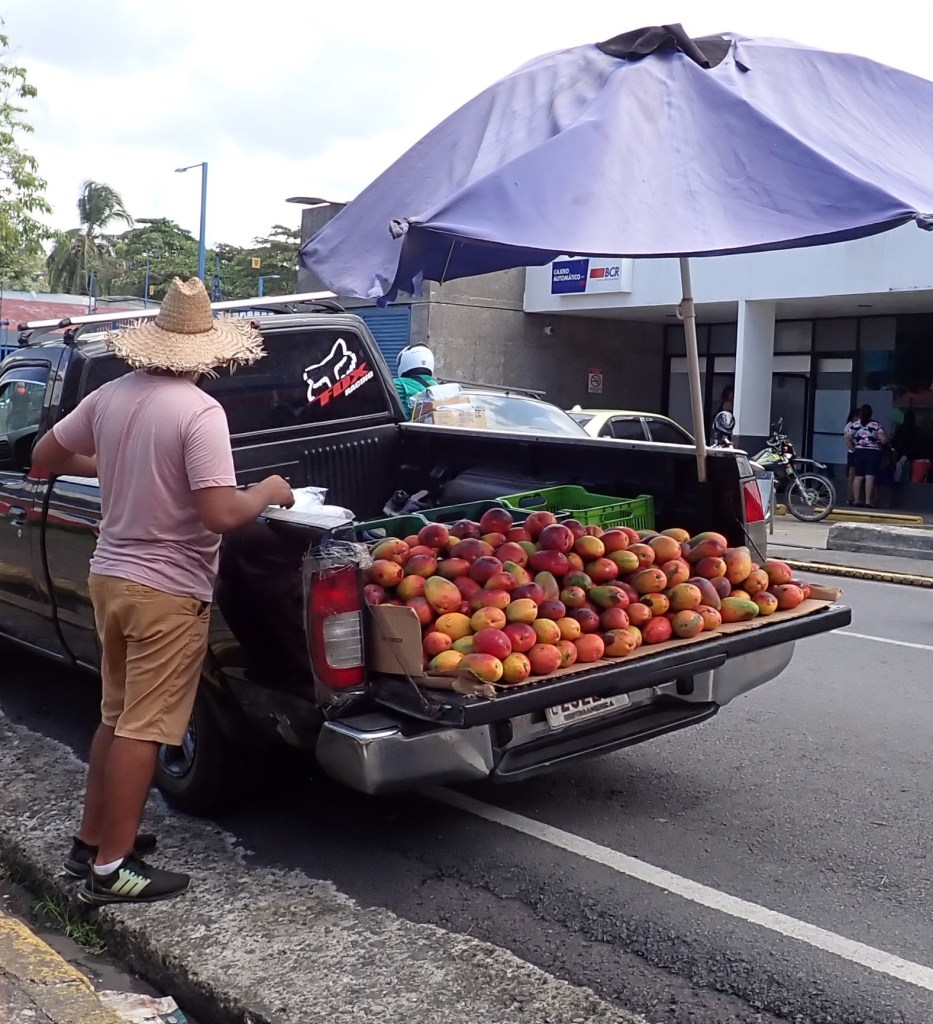
After coffee, we locate the Central Market.  Vast but organized booths hold every imaginable gastronomic delight, which also makes it the perfect place for lunch. And for some of our beloved Zuiderdam crew who favor fruits, we bought avocados and mangos.  Others have a penchant for Doritos.  We’re happy to bring back bundles of these treats for crew, as often they do not have the opportunity to go ashore. 

Leaving the Market, we make our way past older architecture, as well as pass through colorful and fragrant Chinatown.  Then Rundell Mall and Hindley Street; pedestrian streets brimming with specialty shops, arcades, pharmacies, and even an urban K-mart. 

The afternoon temperature rose to a dry heat of 103 degrees.  Tuckered out, hot and thirsty, we sought refuge in a Belgian Pub for a flight of Chimay…thank you, Monks, for your fine brewing expertise!   And speaking of hydration, these were posted in most public restrooms across the city:

Kangaroo Island lies 54 miles off Adelaide, on the southern coast of Australia.   It’s a large island with small towns and over a third of the island is protected nature reserves.  Zuiderdam anchors off Penneshaw and we tender in to spend the day in this charming village. 

Our 20-minute tender ride gives us a beautiful perspective of the coastline, which is rimmed with menacing, serrated rocks that have been the cause of a long history of shipwrecks.  It’s a shame that those ships missed the ¼ mile white sand beach that surely was their intended target.  But the jagged shore has also provided a home to seals, penguins and cormorants.

Ashore, we’re greeted by extremely friendly locals who dispense maps, offer highlights and we stroll the park-like setting.   After yesterday’s 103-degree temperature, we are surprised by the 70 degrees we have today.   Warm sunshine, with a cool breeze. 

About a dozen local artisans have set up tents with their handmade arts, honey, opal jewelry, textiles and baskets.  The Kangala Wildlife Rescue is on-hand, accepting donations to aid orphaned or injured kangaroos in rehab. An acoustic guitarist provides entertainment and parents, kids, dogs and tourists seem to all meld together in shopping and conversation. 

An orphan baby kangaroo in the care of Kangala Wildlife Rescue

The interior of the island is gently rolling grassland, where kangaroos are free to roam.  We came across one while strolling through the sculpture park. 

Free roaming kangaroo

The adjacent shoreline boasts a beautiful broad sandy beach, clear blue water.  Unfortunately, the water temp is only 60-degrees.  

After our 5-mile walkabout, we quench our thirst at the Penneshaw Restaurant & Pub and are joined by a few fellow passengers before returning to the ship.  Another wonderful port!   

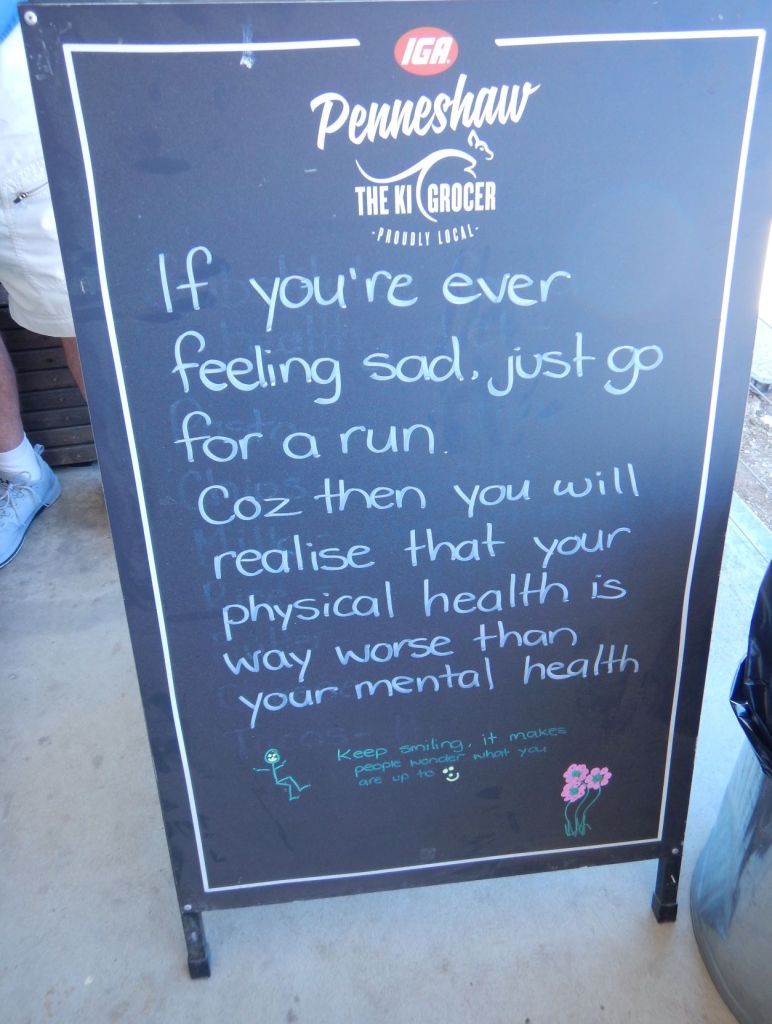
Public service announcement outside the local IGA grocery store

After dinner, Australian comedian Jim Short was onboard to give us some good laughs before bedtime.  We are very happy to have 3 sea days now to catch up with laundry, emails and journaling, as well as planning for our next ports of call. 

Awakened early to watch our arrival into the port of Freemantle, Australia at 6am.   

Entrance lighthouse at the Port of Freemantle

This port is an eerie déjà vu for the 483 passengers aboard (us included), who were feeling a great deal of apprehension as we approached this port on March 21, 2020.  This was the port of disembarkation for us when the Covid 19 Pandemic caused worldwide travel to halt, and yet we were about to begin a 34-hour journey back home.  But not this time.  This time, we would be able to stay and explore Freemantle and her sister city, Perth for the next two days.  The two cities are just 12 miles apart and have completely different personalities.

The Freemantle train station is just a 10-minute walk from our ship, and we jump on a clean and modern train for the 40-minute ride into Perth. 

Transiting various neighborhoods gives us a good sense of their homes, shopping centers and places of business.  If we didn’t know better, it could easily have been the U.S., as we passed by Dunkin Donuts, KFC’s, Aldi’s, etc.

The Perth railway station is bustling with 9 tracks, yet we easily navigate our exit onto the main street of a modern city. 

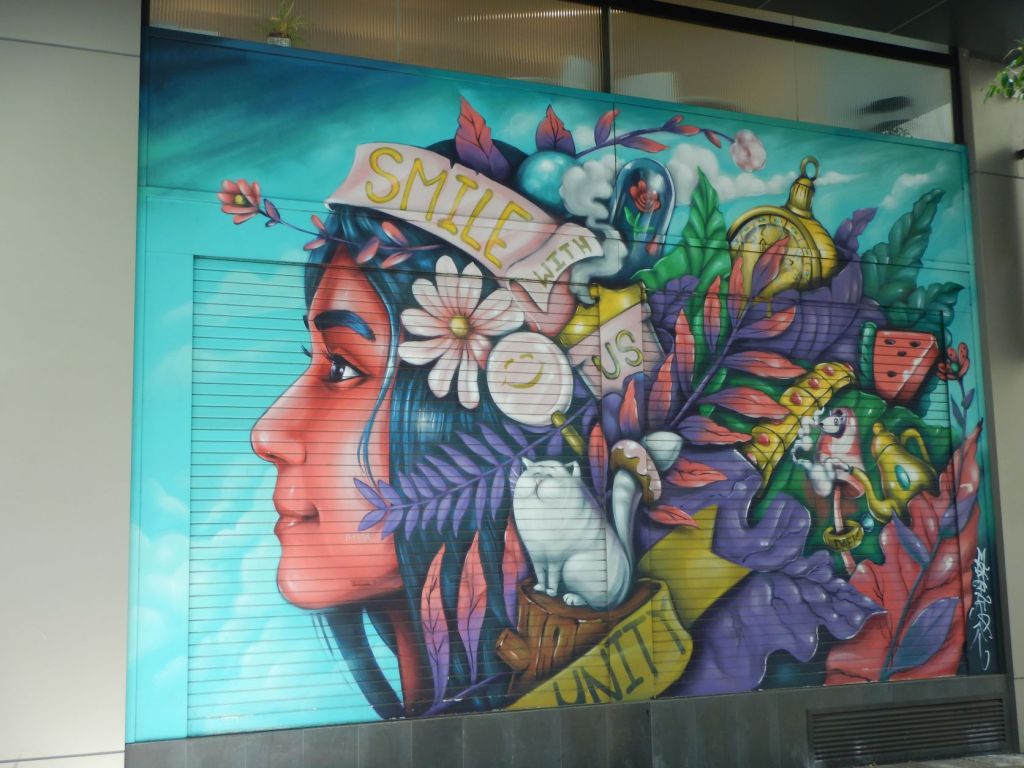
Numerous and vast pedestrian street shopping malls throughout the urban layout, include many high-end, pedigree stores: Cartier, Louis Vuitton, Tiffany, etc, as well as old world markets and arcades.

Arcade Alley filled with European shops

Getting around is a snap, as both Perth and Freemantle offer free bus routes.  We rode several giving us a good overview, then went back to the areas we wanted to further explore.

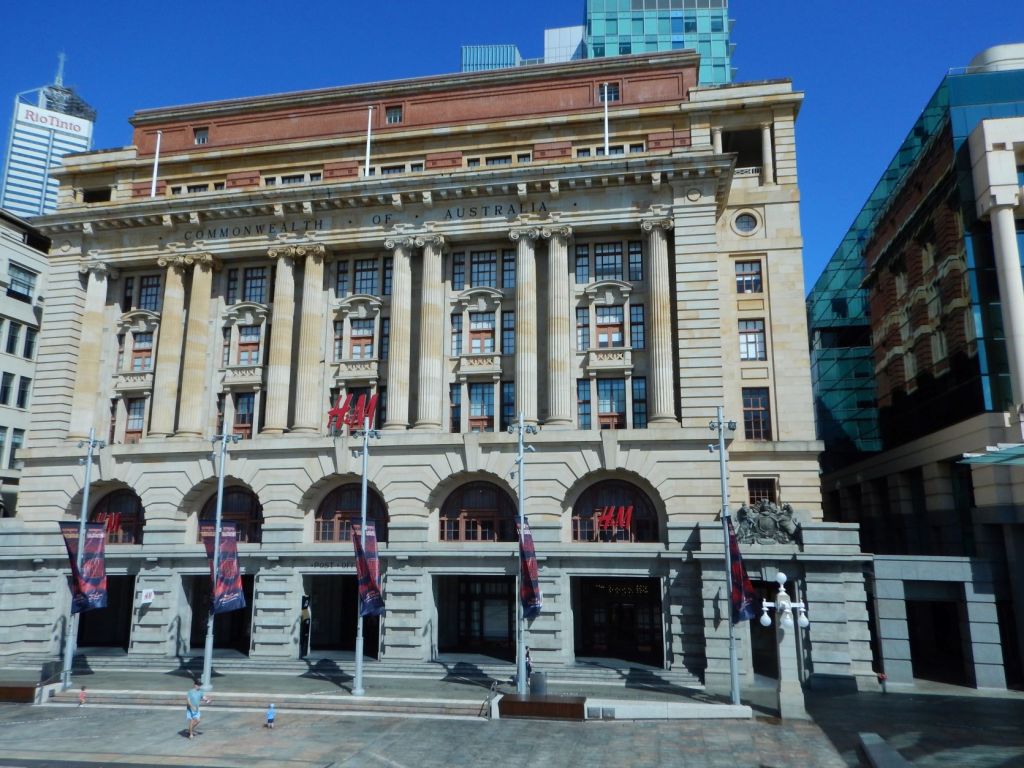
We came across His Majesty’s Theater, with its extraordinary façade; it beckoned a peek inside.  We were welcomed by volunteers who were eager to offer us a tour of this magnificent building and theater.

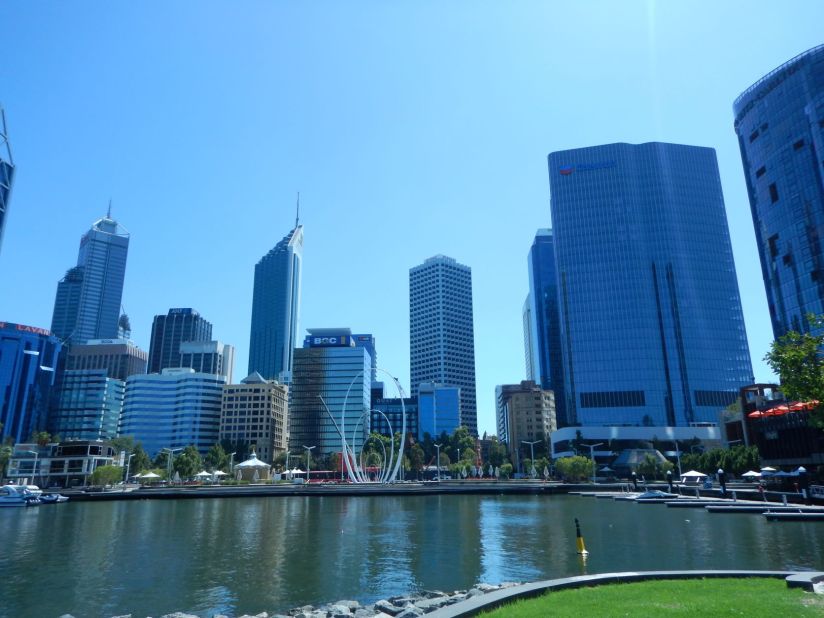
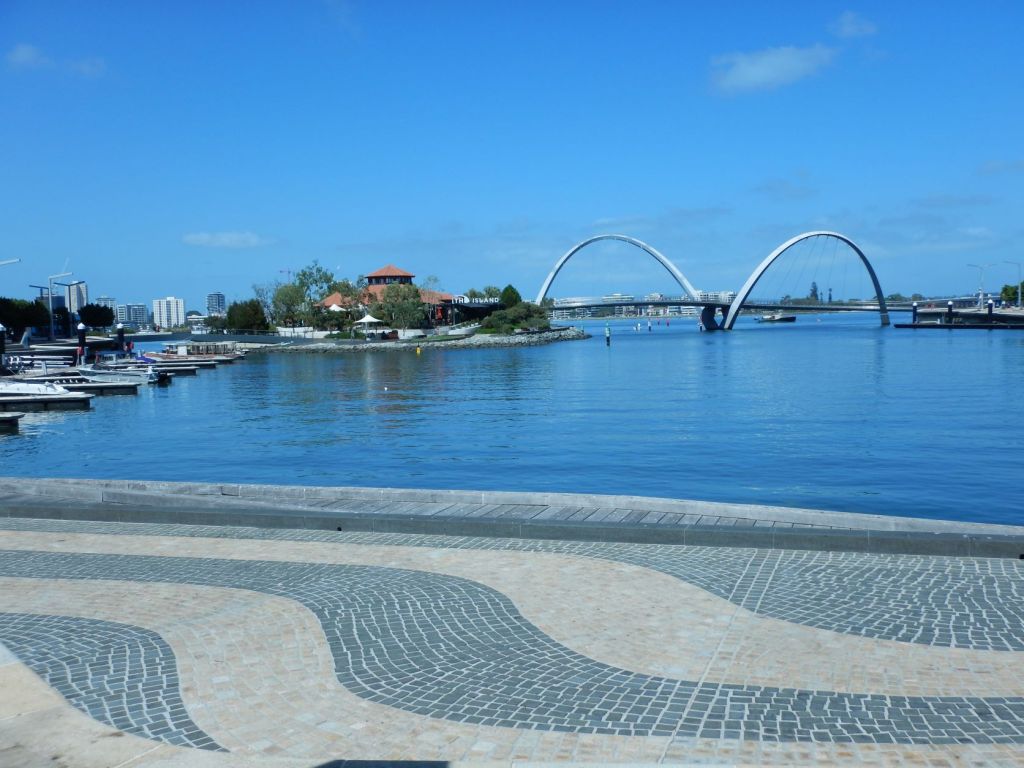
The waterfront area of Elizabeth Quay is sprawling and clean. Ferry boats offer tours of Swan River or even further out to Rottnest Island.  

Amidst the city are vast green spaces including Stirling Park, the Supreme Court Gardens, Kings Park and Botanic Gardens just to name a few. A beautiful and inviting city.

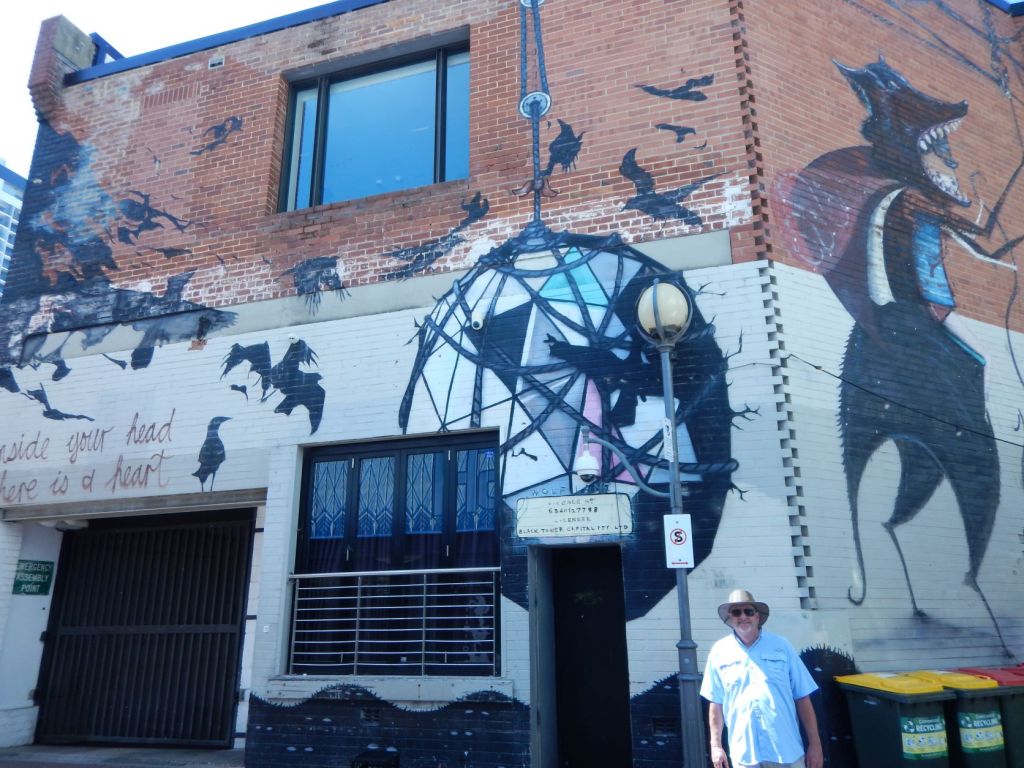
On our second day in port, we focus on discovering Freemantle (or Frio as it’s known to its locals). It has a much more laid-back vibe. 

This college town is filled with artisans, bookstores, shops and cafes.  There’s even a street referred to as Cappuccino Strip.  Warm and sunny, everyone is out enjoying the day. 

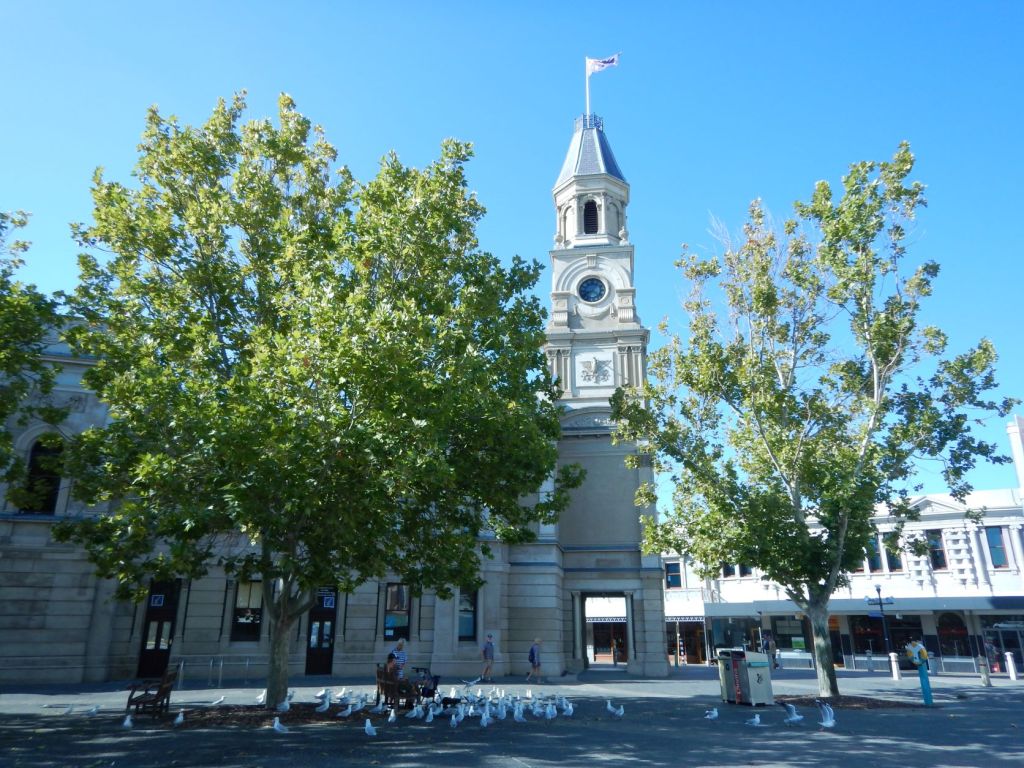
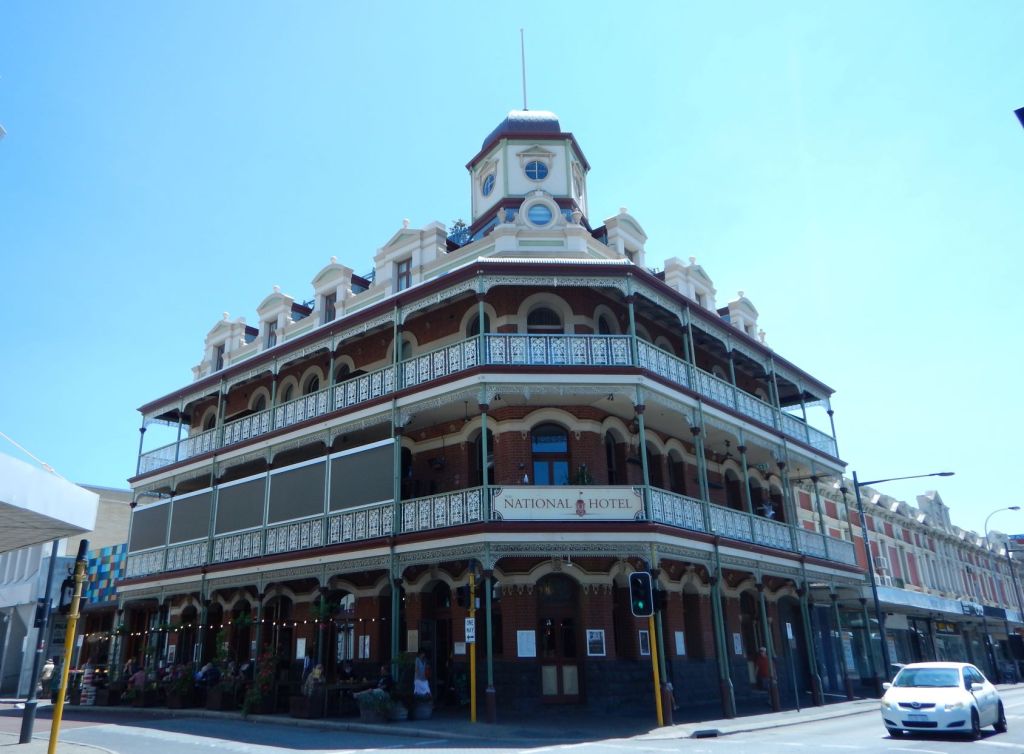
The town is filled with ornately decorated and beautifully maintained historical buildings and hotels. And of course, we couldn’t leave “Frio” without checking out their massive marina and promenade.

We are so relieved to be leaving Freemantle by ship (this time).  It sure feels like redemption for our ill-fated, covid-impacted departure in 2020 when we were police-escorted by bus to the airport.

We now head west in the Indian Ocean for 8 days towards Mauritius and Reunion Islands. 

2023 World Cruise, Cruising, Travelogues

Leg 3: New Zealand

Auckland is New Zealand’s most populous and beautiful city and it’s well known for its white-sand beaches, delicious seafood, and stunning modern architecture. Also nicknamed the City of Sails, this harbor city is brimming with sailboats and ferries that will take you to waterside suburbs and nearby islands.  Specifically, there are over 135,000 registered yachts in Auckland; about one in three households own a boat. The Viaduct Basin, on the western edge of the Central Business District, hosted three America’s Cup challenges (2000 Cup, 2003 Cup and 2021 Cup).  Among sailors, it could be considered Mecca.   And like moths to a flame, Tom and I are helplessly drawn towards the massive marinas to wander and wonder at the forest of masts before us.  

And it’s not just sailboats.  Here we’ve also witnessed some of the largest dry-stack storage sheds for power boats we’ve ever seen.

Dry stack for powerboats. One of many.

Since our previous visit here included the Maritime Museum and other notable downtown sights, we opted to explore the city’s fringe.  Once we reached the Harbor Bridge, our planned walking route takes us up Shelly Beach Road, through hip neighborhoods with tree-lined streets and gorgeous Victorian homes. 

The Ponsonby neighborhood is where we came upon a local gentleman who happened to be crossing the street at the same time with us.  We asked where we could find a good cup of cappuccino and he replied that he was walking to his favorite cafe himself and he’d be delighted if we would join him.  His name was Grant, and he was taking a break from repairing his 100-year-old home that suffered a good bit of damage caused by the deluge of rains this past week.  New Zealand, and Auckland in particular, received as much rain in one day as they get all year.  Grant was grateful for the distraction of meeting fellow boaters and the three of us swapped boat ownership stories for the next hour over coffee.   Back in the 1970’s, he and some of his mates built a ferrocement sailboat, not without many interesting and entertaining challenges.   He was also pleased to share the coincidence that he once owned a small sloop named Monica.  We hated to part, but Tom and I had to start heading back towards the port and Grant reluctantly had to begin removing wet soggy carpet from the lower level of his home.

New Zealander’s are very engaging and friendly

We saw a lot of places carting off wet carpet, soggy sofas, etc., but the downtown area did not reveal too much damage other than muddy street gutters.  

Cutting through Victoria Park we marvel at the enormous London Plane trees which were planted in 1905 for the parks opening. The trunks are easily more than 10 feet in circumference and look like they could still easily outlive us.   

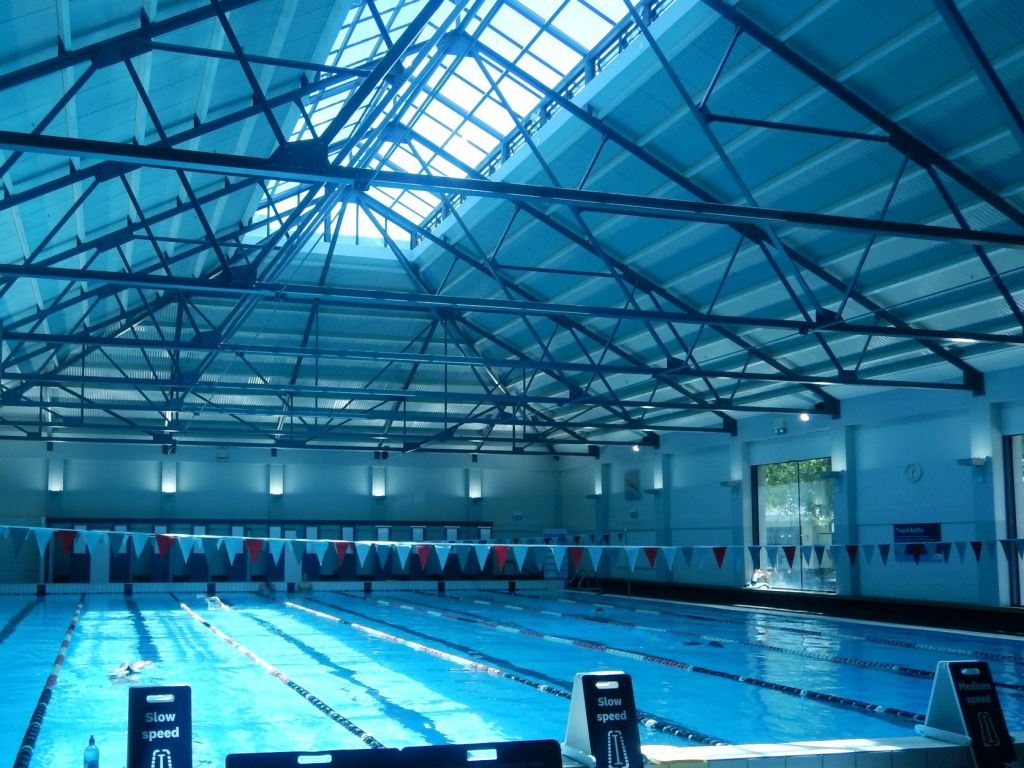
We stumbled upon the “Tepid Baths” building built in 1914, which houses Auckland’s oldest public swimming pools, still in use today.   

Back down to the Viaduct area by the harbor, we rested our tired feet at one of the numerous cafes before heading back to the ship.  Our devices revealed we walked 7.1 miles today.            

The iconic Steinlager 2 champion sailboat

A festive sail-away is enjoyed on Zuiderdam’s aft deck, as we watch Auckland fade astern into the sunset for our overnight passage to Tauranga.

The extremely narrow passage into the shared harbor of Tauranga and its suburb, Mount Maunganui, makes for an exciting dawn arrival. The harbor pilot boards Zuiderdam in the early darkness and deftly guides her around “The Mount” has it’s known to locals.

Mount Maunganui

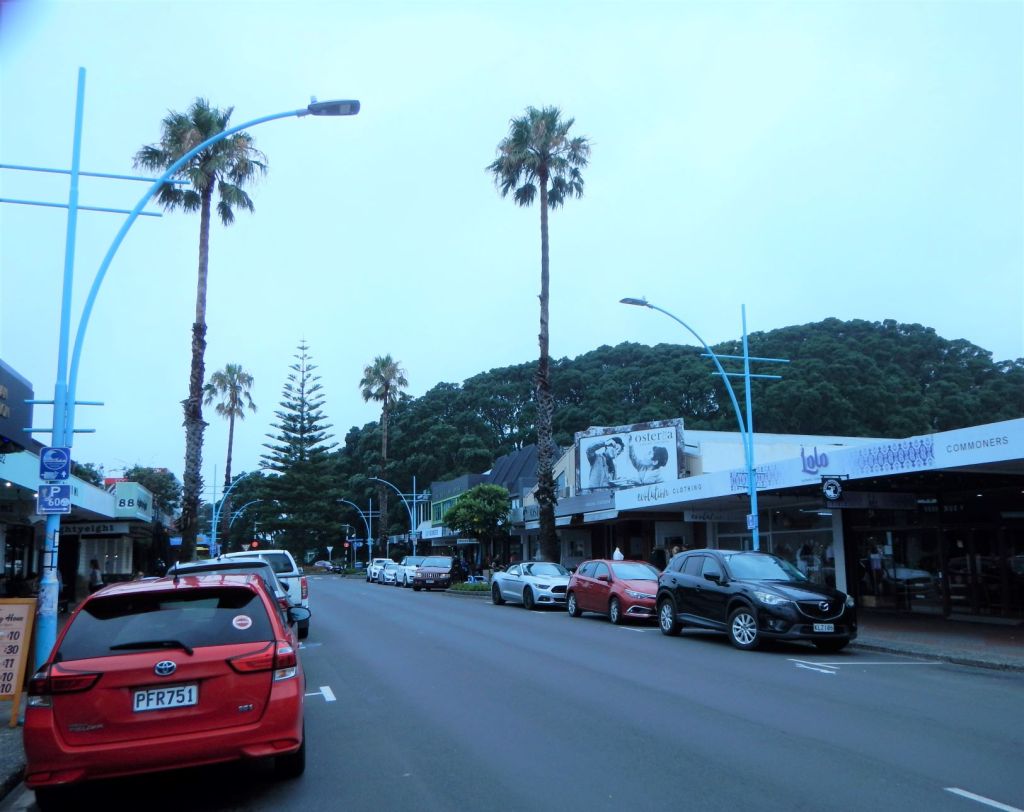
The occasional drizzle on this breezy, overcast 65 degree morning will eventually give way to sunshine and 75 degrees by afternoon.  With all the rain that the Kiwis have been dealing with over the past week, they’re all out at the first ray of sunshine in this relaxed beach town. We made early morning phone calls to home (now an 18-hour time difference), among the giant palms that line the bay’s boardwalk.  We were startled when one large soggy palm tree plummeted a good portion of its “collar” about 20 yards from where we sat. The mass landed with a thud. 

During our last visit here in 2020, we hiked up The Mount.  The walking tracks to the top of this 760-foot-high extinct volcano provide 360-degree views which span the entire length of the Bay of Plenty.

But this time, we walked the shoreline boardwalk, through a few blocks of beach rentals, then down Maunganui Road towards the many shops and cafés which featured some of the best salmon eggs benedict and green-lipped mussels.  We could easily live here!

Gisborne, New Zealand is the Easternmost point on the date line and therefore, the first city in the world to see the sun of each new day.   It’s a quaint coastal city, with beautiful beaches, residential neighborhoods and three rivers, where rowing teams are abundant.  The Māori style, outrigger boats which have been prevalent throughout the South Pacific are still popular here.  In fact, some energetic rowers even “draft” our tender boats on the 20 minute tender ride to the town dock. 

One of three rivers in Gisborne
Outriggers outside their rowing club

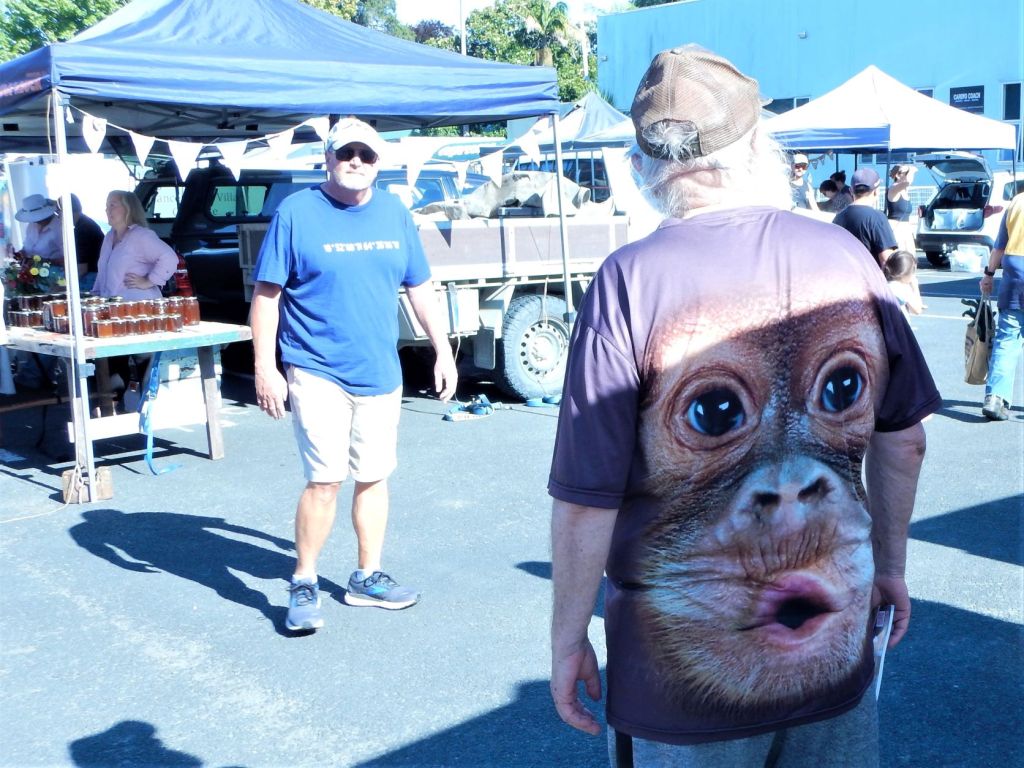
Ashore on an 80-degree Saturday with abundant sunshine, our first find is their well-attended Farmers Market.  The produce, flowers, artisan wares are as colorful as their shoppers. 

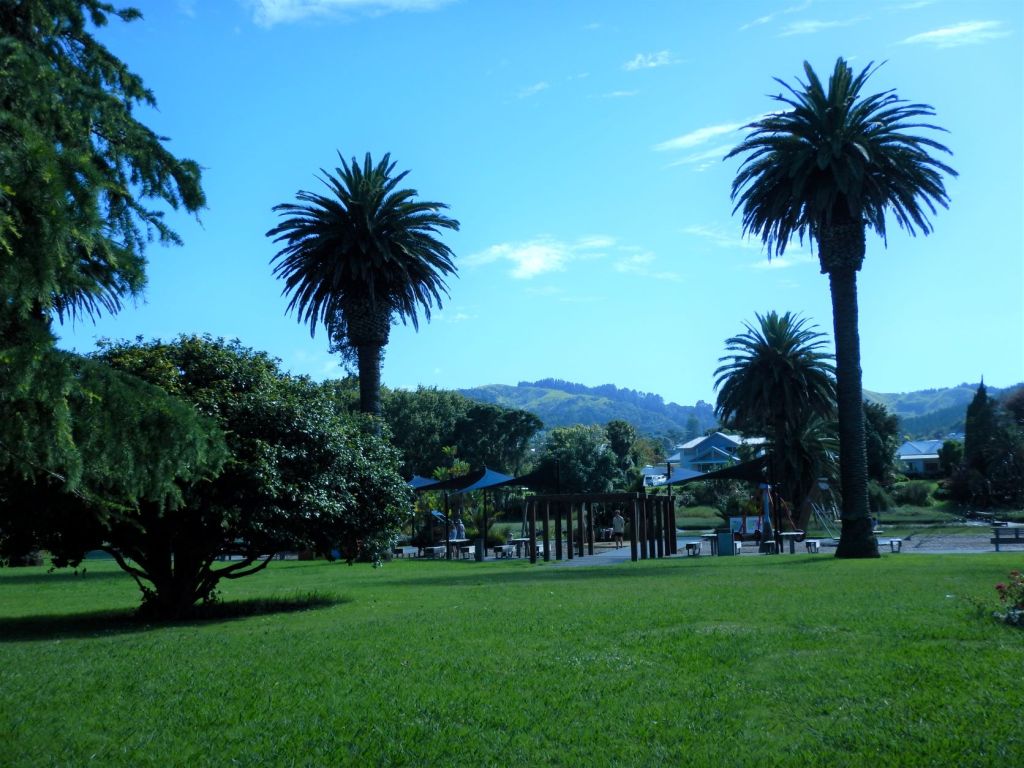
From there we wandered through their riverside Botanical Gardens on the way to their very art deco downtown. 

Gisborne Botanical Gardens & Park
Gisborne Mailman

The main boulevard is lined with large palms which were planted 20 years ago for their centennial anniversary. 

We enjoyed a nice cappuccino at a sidewalk café featuring a music duo.   The hilly countryside of Gisborne is also home to about 25 wineries, but we’ll have to save that for another visit.  

All aboard at 3pm for our overnight sail down to Wellington.

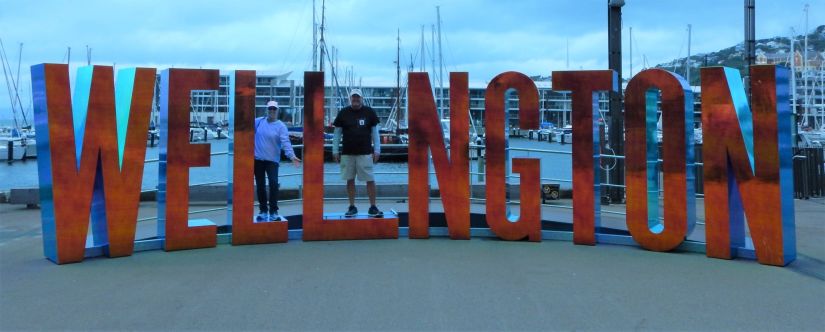
Wellington is located in the world’s 2nd largest natural harbor (behind Nova Scotia). It’s the capital of New Zealand and the southernmost city of the north island.  

Our pier is next to the Wellington Stadium, home to their fierce rugby team the All Blacks, who perform their famous hacka… an intimidating, physical, full-body war dance performed by all 23 team members.  Worth googling a video!

New Zealand’s Ruby Team, “All Blacks”, performing haka prior to a game

Our visit falls on Waitangi Day, a national holiday celebrating the signing of the Treaty of Waitangi, New Zealand’s founding document.  While some downtown shops and businesses are closed, there is plenty going on with local festivities.  

We begin our morning ashore riding up the Wellington Cable Car  for a beautiful view of the city, cricket and rugby fields below.   A couple of cappuccinos to fortify our 2- hour hike through their massive botanical gardens, which is practically an arboretum. 

Duck pond in Wellington Botanical Gardens

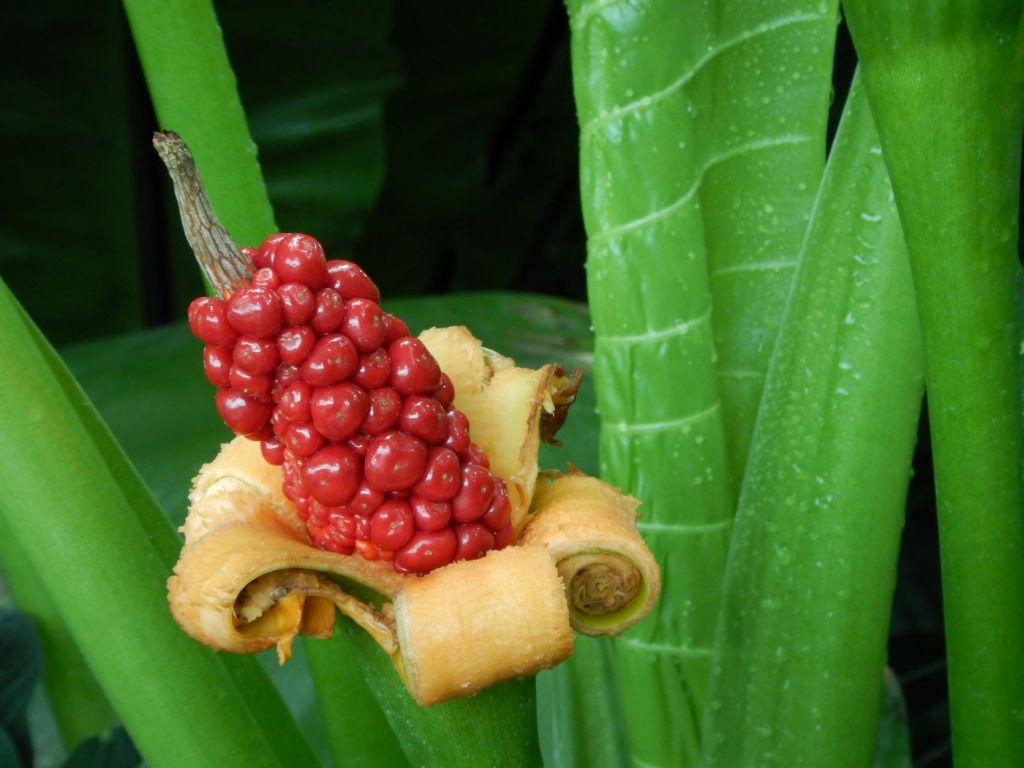
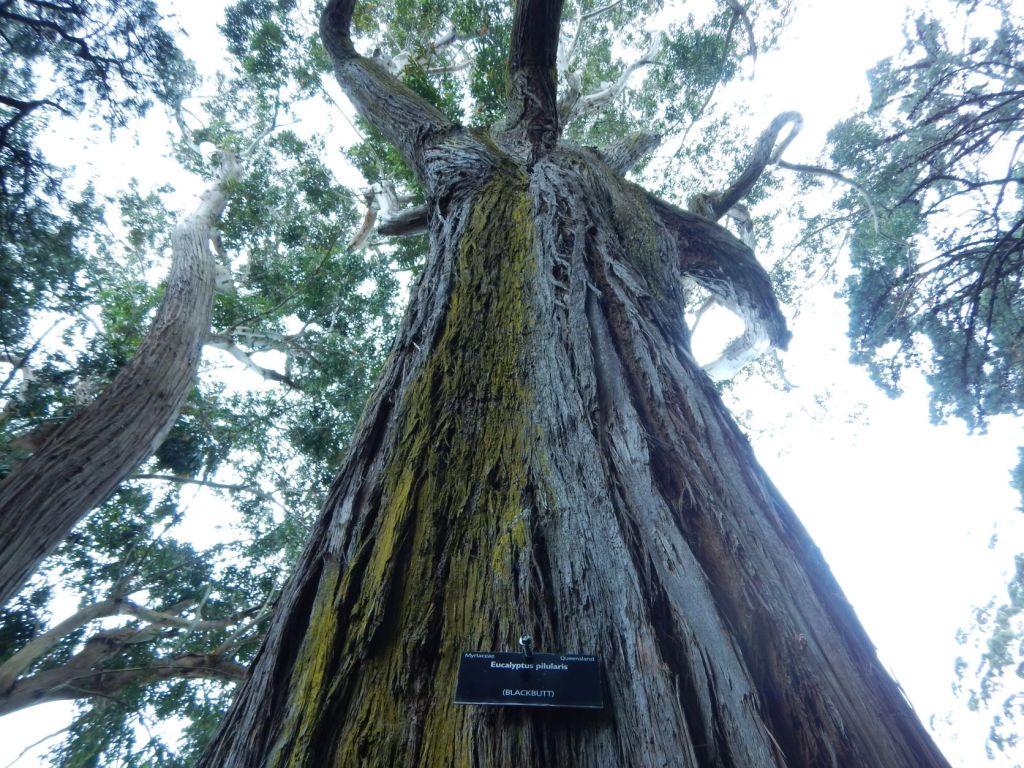
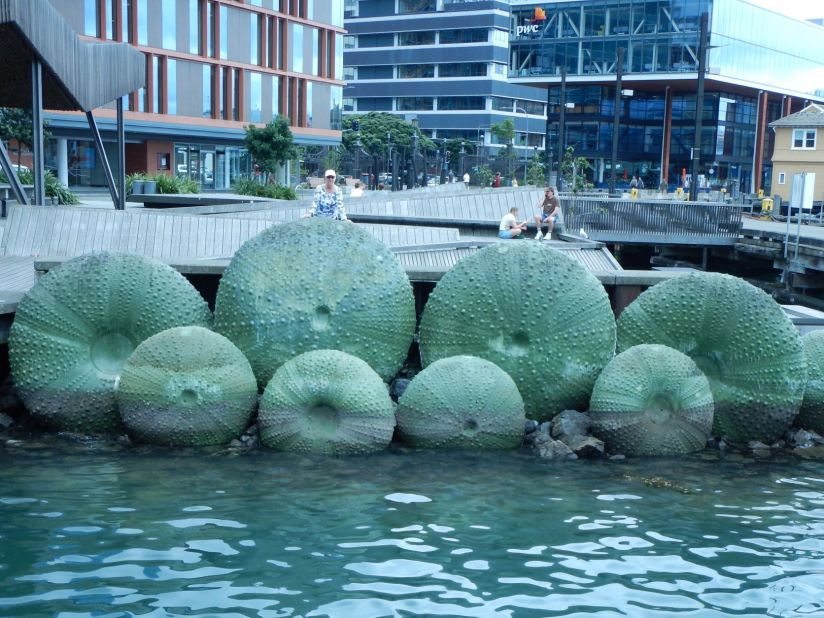
Cloudy, breezy 70 degrees.  Gargantuan eucalyptus trees, roses, exotic tropical flowers of every shape and color.  Back down the hill and instantly back in the city streets and onward to the boardwalk area of the shore, lined with restaurants and pubs, museums, food trucks, art sculptures and the towns public diving platform.  

Wellington’s waterfront boardwalk

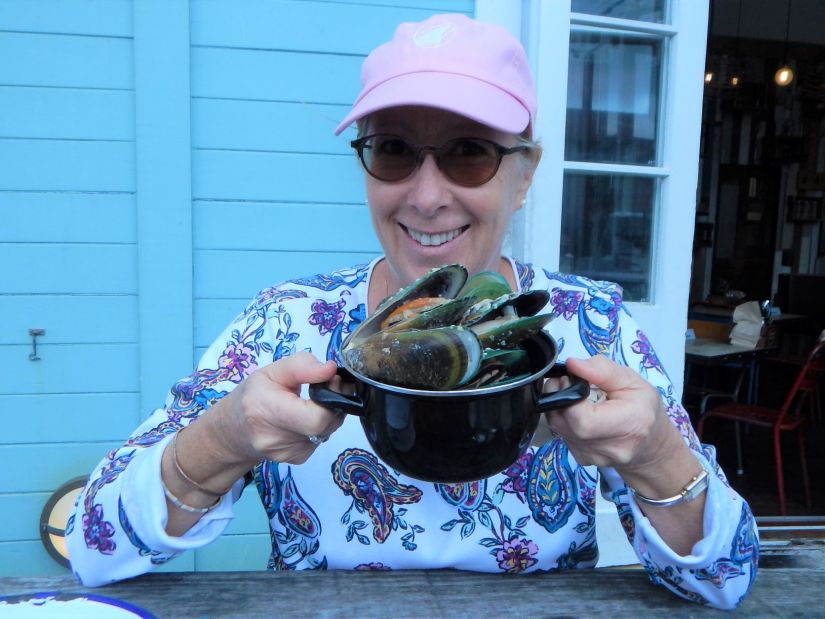
Lunch by the harbor consists of my favorite, green-lipped mussels, some hearty chowder and crusty bread to mop it all up.  

Green Lipped Mussels….YUM!

Local dancers and drum corps begin their performance celebrating the national holiday and it grew into a festive scene.

We were lucky that the weather held for our six-mile walkabout today, but a strong cold front had moved in for our departure from the dock.  We watched with interest as the mighty tugboats aided our departure in sideways rain, the wind ripping the tops off waves and frothing the surface.  

Our ship heeled away from the wind as we proceeded out of the harbor and into open sea, enroute to Sydney, some 1,200 nautical miles westward.

2023 World Cruise, Cruising, Travelogues

Leg 2: South Pacific

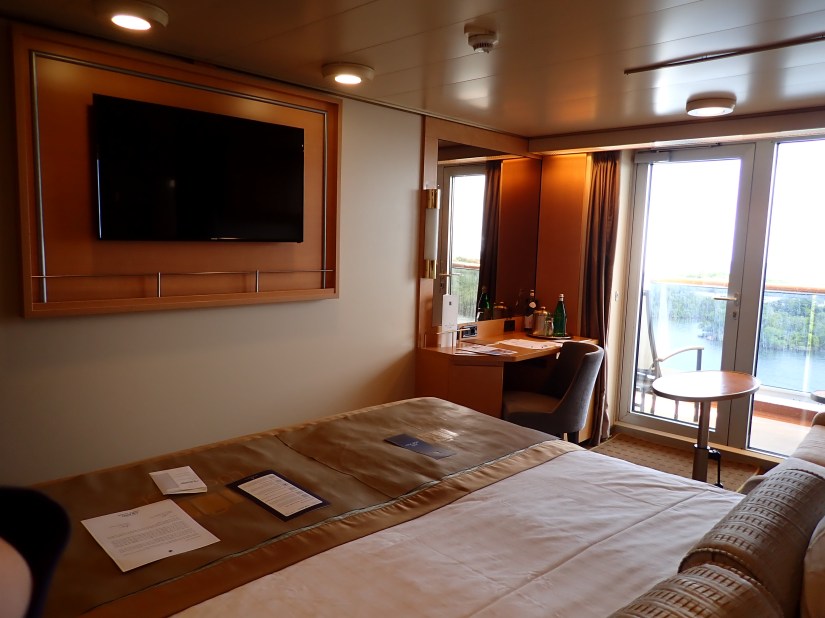
Life At Sea: Out of the 128-day itinerary, we have 60 sea days.  One of the longest stretches of sea travel we have are the 8 days before our landfall in the Marquesas Islands.  You may wonder, what do we do all day??   Never a dull moment, actually!  Since this long sea passage happens so soon after coming aboard, we use some time for more unpacking and organizing to make our 250 square feet cabin comfy and orderly for the next 4 months. 

Then there is the fun daytime stuff: pickleball, swimming, watercolor painting, reading, catching up on the computer, walking on the open-air Deck 3, the fitness center, napping and of course, the wonderous three square meals a day.   A wide variety of classes, for instance Ukulele lessons given by the Polynesian Ambassadors who are on board right now.   Also, the fascinating lectures by visiting speakers, including geologists, retired Naval Captains, astronomers, etc., giving talks about the area we are currently traveling through.   Lastly, there is always a rotation of activities on the schedule should one choose to partake:  ping pong, chess, trivia, Mah Jongg, playing bridge, arts & crafts, etc.

Main Stage

After dinner, we also have many choices for entertainment. Performances on the Mainstage include comedians, magicians, singers/dancers, instrumentalists, movies and ‘What’s In Port’ presentations, etc.    The Rolling Stone Lounge features a seriously talented house band, and the Billboard Lounge offers a dueling piano-style of entertainment.  The Lincoln Center hosts classical musicians. If you are feeling lucky, the Casino is waiting for you. 

But for those nights you just want to chill, movies on-demand are available in your cabin.  And you can’t beat just grabbing a lounge chair on the back deck, gazing up at the stars and listening to the ships wake.    Here in the southern hemisphere, we are viewing lots of different constellations than at home, like the Southern Cross.   It’s no wonder that the Crosby, Stills and Nash song of the same name seems to play in our head as we near the Marquesas Islands.   The Marquesas are a group of volcanic islands in French Polynesia and considered one of the most remote in the world.  The group lies 852 miles northeast of Tahiti and 3,000 miles west of Mexico (the nearest continental land mass).

After 8 sea days since leaving the Panama Canal, it seems that the entire ship is awake early with excitement of our landfall.  Dawn is breaking when Nuku Hiva, Marquesas, looms into view and we make our approach.  The passage into the harbor is magnificent, flanked by high ridges of topical vegetation.  A silver thread of a waterfall is to starboard. 

Nuku Hiva, Marquesas – French Polynesia

The Zuiderdam creeps further in until our bow edges into the mooring field.  We practically drop anchor behind a 50 ft catamaran from Copenhagen with a group of divers preparing their gear.  What a sight it must have been for them; being in the shadow of our great overhanging bow along with an imposing bulbous nose protruding at the waterline.  The Zuiderdam backs down on her anchor leaving the catamaran a safe 400 yards away.  Our ships azipods will also keep her in position, away from the nearby rocky shoreline.  (The term “Azipod” combines the words “azimuthing” and “pod.”  They work by having the propeller located on the front of its pod. This allows the cruise ship to be pulled through the water rather than being pushed as in a traditional shaft and propeller system.)

Zuiderdam at anchor in Nuku Hiva

It’s 8am when we ride the second tender to shore, being welcomed by a local, traditionally-tattooed Marquesan playing native drums.   The artisan market vendors were scuttling about, getting their wares set up.  They’re known for their wood carvings, black pearls and tribal art. They seem as excited as we are…while it may be our first landfall in 8 days, we were told that they only receive 4-6 cruise ships a year.

We begin by walking the main street, which is no more than a two lane, sometimes dirt/gravel road.  Schools, churches, homes and one pizza shop.  Ancient stone statues stand sentry to this village, some looking out to sea. 

After 2.5 mile walk in the tropical heat, we arrived at a boutique hotel, quenched our thirst and enjoyed the elevated view of the harbor with Zuiderdam at anchor.  At least our return walk was downhill.  Nuku Hiva is immensely beautiful and a taste of more South Pacific islands to come.  But first, two more sea days.

Trouble in Paradise: That evening, I noticed a new, ‘smudge’ of a floater in my lower left eye before going to bed. Uh-oh. While on deck in the bright sunshine the next morning, the smudge suddenly became dark, spidering streaks and I immediately sought shade and the medical center aboard.   They dilated my eye and could determine that while there was no retinal detachment, their limited equipment couldn’t rule out a hole or tear in the retina.  Torn retinas may become common between ages of 50-70 and being near-sighted (like me) is one of many factors that can increase the risk.

Our landfall in Papeete, Tahiti the next day allowed a visit to an ophthalmologist for full exam. The doctor was French-speaking (naturally, as we are in French Polynesia), but he spoke very good English.  After a thorough dilated exam, he confirmed that I had a ‘hole’ in my left retina.   He also indicated that my lower right retina showed an area of weakness, which by itself was not an emergency but given our extensive and sometimes remote travel and timeframe, he recommended repairing that also.  Gulp. Ok. Naturally, we did grill him on his credentials, how many of these surgeries he’s performed, etc. etc., as it was a bit daunting to suddenly be faced with this remedy without a doctor your familiar with!   He performed laser repair on both eyes. So far, all seems to have gone well.  I will have a follow-up ophthalmologist appointment while in Sydney, in about 3 weeks.  I’m told that the floaters may remain.  Meanwhile, I’m avoiding any jarring activities (pickleball, etc), nor am I snorkeling or anything like that until after the follow up appointment.   The good news is that it is pretty simple to take it easy aboard the Zuiderdam!   And now that the internet availability is becoming better, I especially hope to catch up on my journaling and blogging. 

Docked in Papeete, Tahiti

In the 18 days of this voyage so far, we have sailed 6,274 nautical miles. As we travel westward, we have been routinely turning back our clocks one hour at a time.  Waking at 5am has not been unusual, in fact welcomed, as it seems to coincide with viewing our arrival into a new port.  Only a few miles from Tahiti, the silhouette of Moorea reveals itself at first light.  We make our way around the coastline towards Bahia D’Opunoha.  Despite some cloud cover, it’s an absolutely stunning approach with its jagged, emerald peaks.   The famous peak of Mount Tohivea comes into view.  Locals refer to it as Bali Hai. The camera simply cannot do it justice.

Moorea at dawn

Once tendered ashore, we decided to take a tour of the island.  It’s a group of nine of us aboard a bus that would otherwise hold 14.  Our driver, Bryan, takes us on the 40-mile circle route of Moorea, beginning with a fantastic view from atop Belvedere, looking out to sea. 

Next, we visit a historical sacred area, where long ago the natives would perform human sacrifices.  The stone platform shown is where the beheading would take place.  It was so long ago that tall trees now stand guard. 

Resuming downhill, we pull over on the side of the road to a pineapple field.   A small, vibrant yellow and incredibly sweet variety.  The surrounding trees offer wild-growing soursop, papaya, breadfruit and coconut, which Bryan cuts open for all of us to enjoy. 

Back down to sea level, we continue our clockwise route as it begins to drizzle.  Passing through numerous villages and settlements; the locals are going about their Sunday activities.  

The lyrical Polynesian chorus rising from each church is heavenly, indeed.  The coconut grove beaches are beautiful but deserted due to today’s rain. 

Regardless, Moorea stands up to its reputation of being the quintessential, idyllic South Pacific island!

We enjoyed a two-day visit in Raiatea on the island of Uturoa, located within French Polynesia’s Society Islands.  

We rented a car and toured Raiatea’s adjacent, smaller sister island of Tahaa.  Despite the rainy morning, the afternoon cleared.  We visited a small black pearl farm and watched them insert a nucleus (made from clam shells found in the Mississippi River) into a young oyster and place it on the ‘farming line’ for submersion later that day.  A fascinating process!

We also saw many vanilla farms, where the beans grow on vines and are hand-cultivated in tent-style greenhouses.   Countless coconut groves here too, and they use every bit of the nut.  They have small, covered racks they use to dry the nut itself for oil extraction later.  Otherwise, breadfruit, papaya, mango, avocado, soursop, pineapple, and several unrecognizable fruits and vegetables are practically growing wild everywhere you look.   The South Pacific islands are abundantly rich.

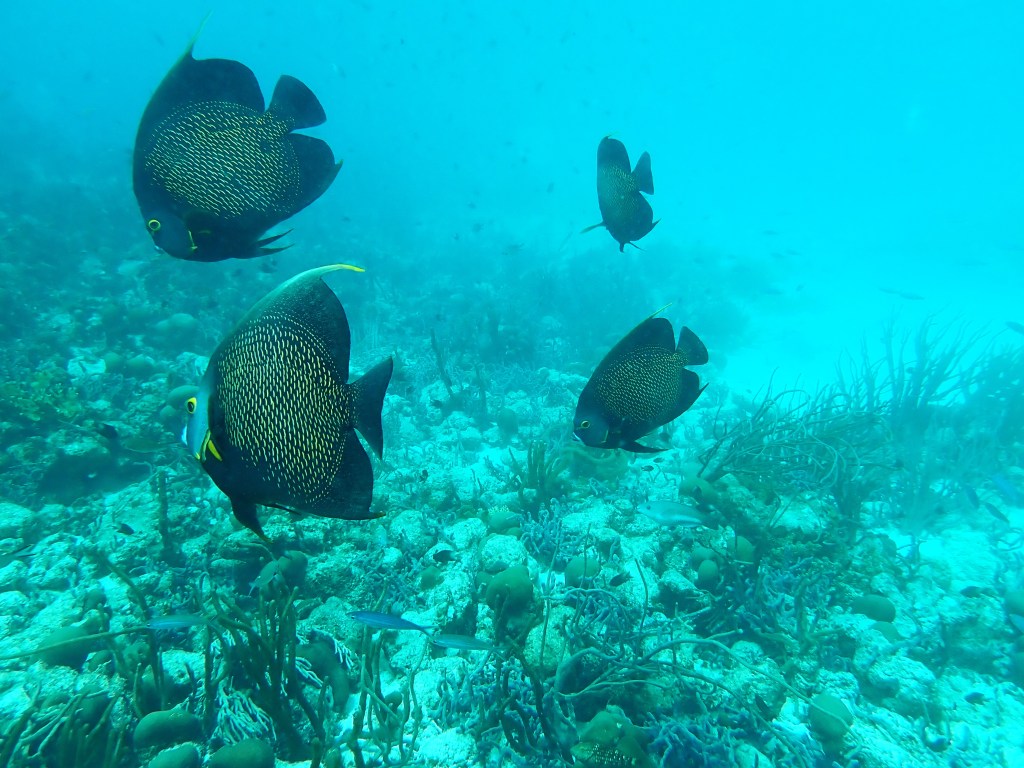
On the second day, Tom went drift-snorkeling over some gorgeous coral gardens, just inside this motu-ringed island.  Beautiful underwater formations teaming with colorful, tropical fish.  

Since I am sidelined from snorkeling because of my recent retina surgery, I went ashore and strolled Raiatea’s main street filled with shops.  For readers familiar with Lansing, Iowa, I discovered that Horsfalls has a second location in Raiatea, as shown by this photo:

Raiatea version of Horsfalls

Leaving Raiatea, we have more sea days….technically five if you look at the calendar, but in actuality we will experience only four due to crossing the International Date Line.   

Transitioning further westward, the contrasts are stark. Unlike the volcanic islands of French Polynesia, the islands of the Kingdom of Tonga, are low-lying coral atolls.  The tradeoff of the verdant green peaks is an entire spectrum of blue in the waters surrounding Tonga.  We dock in Nuku’alofa on a bright, sunny day, and are welcomed by the Tongan Police Marching Band.  After the ukelele musicians of the last few islands, the Sousa-style, “Rock Around The Clock” seems odd, but gleeful given their hearty enthusiasm!

Our first mission today is to revisit Kanokupolu Beach on the western side of the island. Almost one year ago this week, the Kingdom of Tonga suffered an earthquake and its resulting tsunami.  Sadly, the once pristine coral reef we snorkeled in the past, was now reduced to rubble.   Only the foundations of the two beach hotels remain.  Our taxi driver shared that about 200 people were displaced from their sister islands, and the government helped build housing for many families.  The main town of Nuku’alofa was largely spared, but now-empty shipping containers once filled with humanitarian aid were still evident on the pier. 

Back in town, we wander the marketplace where tapa-bark artwork and handicrafts are on display.

Taking a break from the extreme humidity, we sit beneath their enormous and famous “Raintree” to cool off. Down the street at the “Reload Bar”, we scored an open window seat facing the street and watch the parade of traffic roll by, most smiling and waving.  The Tonga people are some of the friendliest on Earth.

As we say goodbye to Tonga and its impossibly blue waters, New Zealand awaits on the horizon in two days’ time.  

2023 World Cruise, Cruising, Travelogues

Leg 1: Ft. Lauderdale thru Panama Canal

The bolt of lightning that struck the ship along with the simultaneous clap of thunder sounded like an explosion.  It was a direct hit to the M.S. Zuiderdam.  Within 15 minutes, the Captain and crew announced that the assessed damage was limited to a redundant radio antenna, as well as a shattered windowpane in the roof of the pool lanai.  We had just moored in Fuerte Amador, having completed our day-long, northwestward transit of the Panama Canal.  After a pristine day of scenic cruising, a strong, isolated weather front moved through swiftly, leaving its mark on the Zuiderdam. 

But I should begin from the start of our voyage.  On January 3rd, Tom and I boarded Holland America Line’s ship, the M. S. Zuiderdam, for a 128-day circumnavigation of the world.  The itinerary takes us through the Panama Canal, South Pacific islands, New Zealand and Australia, then follows the South and West African coastline northward to Morocco, into the Mediterranean and European coast before turning east towards the Azores, back across the Atlantic and returning to Ft. Lauderdale May 3rd.   A dizzying itinerary of 30 countries and 61 ports (with 7 overnight ports), traveling almost 35,000 nautical miles before reaching U.S. soil once again. 

Built in 2002, the Zuiderdam is considered one of Holland America’s smaller ships, at 936 feet long, 105.8 feet wide and can carry almost 1,964 guests. The good news for us is that there will only be about 1,400 guests aboard and about 700 crew. 

After departing Fort Lauderdale, our first port of call was Falmouth, Jamaica, which lies on the north coast between Ocho Rios and Montego Bay.   This historical, gritty working port reaches back from the by-gone days of sugar plantations.   This small town was bustling on a Thursday morning, despite the drizzle.  We strolled past the manicured cruise ship pier, past the locals hawking tours on the perimeter and finally, into the streets of the ‘real’ town, where aromas of jerk chicken cooking on wood fires mingled among the ganja smoke in the humid air.   We strolled past simple wooden structures of humble homes, schools and churches.   We noticed a man with bucket up in a tree, picking Jamaican apples.  The woman across the street smoking a joint, offered us one (an apple, not a joint).  We declined her friendly offer. 

One sea day of travel brought us to Puerto Limon, on the east coast of Costa Rica.  It’s the seventh largest city, with a population of 55,000, whose community traces its roots to Italian, Jamaican and Chinese laborers who worked on a late nineteenth-century railroad project that connected San Jose to Puerto Limon. 

Puerto Limon, Costa Rica

Despite the suburban shoreline, we found some wildlife hanging out in the trees in Vargas Park; a mom, dad and baby sloth, as well as a pair of owls. 

A bit further into town, the Saturday open-air Market was in full force and locals were going about their shopping; fresh fish being cleaned and cut on the street, fruit and vegetable stands (including breadfruit shown below), leather goods, backpack vendors, shoes, etc. 

We brushed off our rusty Spanish enough to find a small beach umbrella that would come in handy for the rest of our trip.  It’s always fun to have a treasure hunt in mind when going ashore and it gives us good fodder amongst the locals.  Yes, I have the Google Translator app loaded on my phone, but our Charades and Pictionary talents are much more enjoyable for both sides and leaves us all laughing. Upon our return to the ship, Tom set up his new umbrella by the aft deck pool and was immediately envied by other passengers, who are seeking lounge chair shade.  Apparently, the ship is expecting their shipment of new umbrellas sometime during our voyage, but no one could say when.  Tom being Tom, took matters into his own hands. 

Tom’s new set up

Onward to the Panama Canal transit. We were awake early and stationed ourselves in “The Crows Nest” observation deck for prime viewing of the day-long transit that would take us beneath bridges, through winding channels, locks and lakes of this 50-mile engineering marvel. 

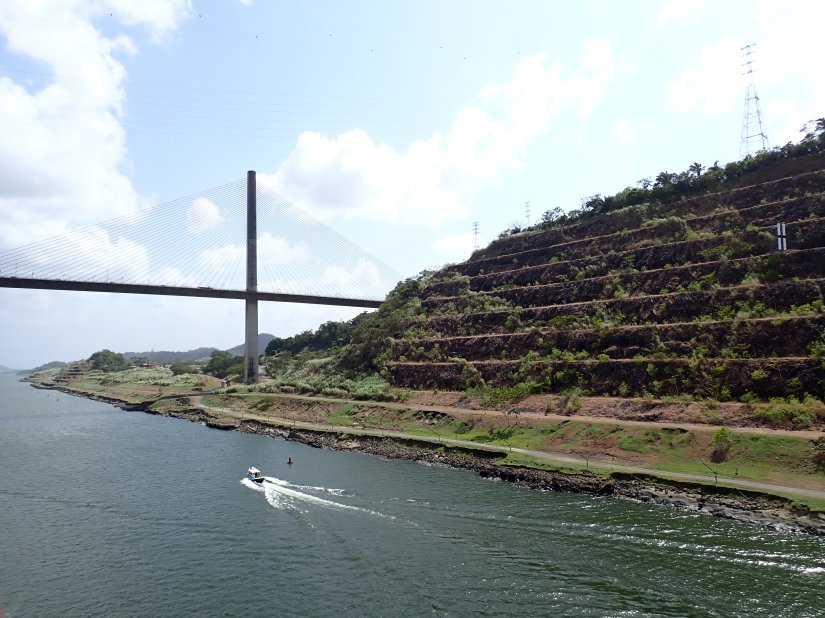
To begin, we pass beneath the Atlantic Bridge (completed in 2019), which spans the Atlantic entrance to the canal.  Then onto the Gatun Locks; three sets of double-lock chambers bring hulking ships almost 100 feet above the water, from the Caribbean Sea into the man-made Gatun Lake.   The lake encompasses 166 square miles and the surface sits at an elevation around 85 feet above sea level. 

From there, it’s through the Culebra Cut, an excavated gorge stretching more than 8 miles across the Continental Divide.  We are then lowered about 30 feet in the Pedro Miguel Locks, transit the small body of Miraflores Lake before descending another 54 feet in the Miraflores Locks. 

And lastly, we pass beneath the enormous Bridge of the Americas, that was completed in 1962 at a cost of $20 million. At 5,425 feet long (almost a mile), the bridge is a key part of the Pan-American highway. 

It’s late in the afternoon when the Zuiderdam finally moors in Fuerte Amador for the night.  The weather taking a swift turn, and the strong front brings driving rain, thunder and lightning that I described at the beginning of this post.  We’re all content to save exploration of Panama City for morning. 

Panama City Skyline from our ship

The Zuiderdam now floats on Pacific waters, and we will set a WSW course for the Marquesas Islands, an 8-day crossing.   Stay tuned. 

Cruising, Travelogues

The S. S. Badger

The majestic S. S. Badger

How does one drive from Wisconsin to Ohio while avoiding the traffic of Chicago?   The perfect solution is to take a ferry across Lake Michigan, which is what we did on a recent trip to visit family.  The SS Badger is a 410-ft passenger/ferry ship.  She was built in 1952 and in 1953 she began sailing back and forth between Manitowoc, WI, and Ludington, MI, 60 miles across the width of Lake Michigan. She still sails that route today, but instead of carrying rail cars for which she was originally built, she now carries up to 600 passengers, 180 vehicles and cargo on each crossing.

The SS Badger is the only remaining coal-fired steam ship operating on the Great Lakes and probably the only one on the waters of North America.  According to their website, her uniflow steam engine was designated a mechanical engineering landmark by the Society of Mechanical Engineers, and in 2016 she was designated as a National Historic Landmark (that moves!).  

The Navigation Bridge of the S. S. Badger

Manitowoc, Wisconsin was the point of our departure for the four-hour ferry ride across Lake Michigan.  We arrived at 1pm and positioned our car in line with the other vehicles that would be boarded for the crossing.  The weather forecast for the day was not ideal.  In fact, we received an email from The Badger offices the evening before, alerting all passengers that conditions “will be rough” and that if you would prefer, a full refund could be issued for an alternative day.  But we had a schedule to keep and if The Badger was running, we’d be aboard.  We are no strangers to rough water conditions, and given her size and reputation of flawless service, we were confident she’d have no trouble.   

On the bow of the S. S. Badger

Once aboard, we made our way up several flights of stairs and explored the decks which offered snack bars, lounges, theater and TV rooms, chaise lounges on the bow, as well as seating port and starboard that ran the length of the ship.  And inside the main lounge, free bingo, hosted by a very funny female comedian!  Time passed quickly and the ship cut through the waves like a knife through butter. 

Approaching the port of Ludington, Michigan

The SS Badger arrived just after 7 pm, and we stayed in a Ludington motel. After getting checked in, we walked down the street to find a bite to eat.   Refreshed the next morning, we continued eastward without the concern of what the morning rush hour would be like in Chicago.  If you ever get a chance to travel aboard this national treasure, take it.  You won’t be disappointed.

Interested in knowing more about the S. S. Badger? Go to http://www.ssbadger.com

2020 Half-World Cruise, Cruising, Travelogues

Leg 4: Australia and Homeward

Leg 4:  Australia and homeward bound

We experienced some rough seas for the first of two sea days as we made our way west to Sydney, Australia. Fortunately for passengers, the worst of it was overnight while everyone was in their bunks asleep. Improved weather filled in by daybreak of day two.

Sydney, Australia – At dawn on March 7, the Amsterdam rounds The Heads, the imposing rock cliffs that guard the entrance from sea to harbor. As we continue up the channel, we pass the spectacular Sydney Opera House on our port side, and then beneath the iconic Harbor Bridge, with scant clearance above us. Morning walkers on the bridge wave and cheer our arrival as they look straight down the few feet onto our decks. A thrilling experience from either perspective! The rising sun peeks through the broken morning clouds, sending a ray of light upward seemingly from the bridge’s massive pylons. Quite a glorious ‘Down Under’ welcome. Continue reading “Leg 4: Australia and Homeward”